

Reported by: Oahimire Omone Precious | Edited by: Oravbiere Osayomore Promise.
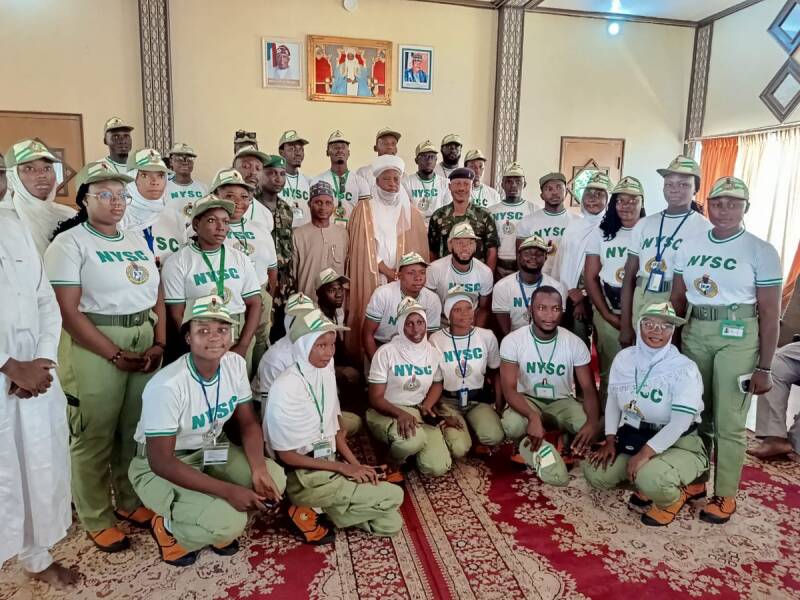
The Sultan of Sokoto and President-General of the Nigeria Supreme Council for Islamic Affairs (NSCIA), Alhaji Muhammad Sa'ad Abubakar, has issued a firm declaration that banditry, terrorism, kidnapping and other forms of criminality have no place in Islam, while urging Nigerians to abandon the growing practice of associating crime with particular ethnic or religious groups. The Sultan made the remarks on Monday, June 29, 2026, while receiving members of the 2026 Batch 'B' Stream I of the National Youth Service Corps (NYSC), who paid him a courtesy visit at his palace in Sokoto.
Addressing the corps members, the monarch, who is also Co-President of World's Religions for Peace (WRfP), headquartered in New York, described Islam as a religion founded on peace, justice, and respect for the sanctity of human life. He said Islam forbids the killing of innocent people and enjoins Muslims to live peacefully with adherents of other faiths by promoting compassion, mutual understanding and good neighbourliness, regardless of religious or ethnic differences. The Sultan condemned the growing tendency to associate crime with particular ethnic or religious groups, insisting that offenders should simply be identified as criminals. "Give them their proper name—criminals. Don't call them Fulani, Tiv, Yoruba, Muslim or Christian," he said. "Criminality has no religion or ethnicity. Evil people exist everywhere and should be treated as such."
The Sultan's comments come at a time when Nigeria is grappling with a wave of banditry, terrorism, and kidnapping that has claimed thousands of lives and displaced millions across the North-West and North-Central regions. In recent years, armed groups have been increasingly identified along ethnic and religious lines, with some communities and leaders labelling entire groups as terrorists or criminals. The Sultan, however, stressed that such profiling is not only inaccurate but also dangerous, as it fuels division and undermines efforts to build lasting peace. He noted that individuals arrested for kidnapping and other violent crimes bear names from different ethnic and religious backgrounds, demonstrating that crime has no religious or ethnic identity. "Whether a criminal bears a Christian name, a Muslim name, a Yoruba name, a Fulani name, a Hausa name or any other name is immaterial. Once you commit crime, you are simply a criminal," he stated.
The Sultan also urged the corps members to remain security-conscious throughout their service year, respect the customs, traditions and values of their host communities, and contribute meaningfully to national development. He encouraged them to ignore negative stereotypes about Sokoto State, assuring them that they would experience the hospitality and peaceful disposition of its people firsthand. He also advised them to verify information before believing or sharing reports circulating on social media, warning that false narratives only embolden criminals. "If you amplify only negative stories and ignore the good happening around you, you help evil to thrive. But when you tell the truth about what you have seen, you help humanity," he said.
Speaking on the sidelines of the visit, the Sultan addressed the recent killing of the Miyetti Allah Cattle Breeders Association of Nigeria (MACBAN) Chairman in Benue State, Alhaji Risku Muhammad, and others who were reportedly ambushed and murdered while returning from a peace meeting. He explained that the statement issued by MACBAN, signed by its President, Alhaji Baba Othman Ngelzarma, was intended to prevent reprisals and discourage innocent people from becoming victims of retaliatory attacks. According to him, the position taken by the association was consistent with the long-standing commitment of the NSCIA and traditional institutions to promote peace and uphold the rule of law. "We don't add fuel to the fire; we quench it. When innocent people are killed, our responsibility is to calm tensions, not inflame them. No one should take the law into his hands because doing so only creates more innocent victims," the Sultan said. He stressed that those responsible for criminal acts must be arrested and prosecuted through lawful judicial processes rather than through revenge or collective punishment.
The Sultan has repeatedly condemned acts of terrorism and banditry, insisting that such crimes should not be linked to Islam. In a previous statement in May 2026, he urged Nigerians to stop associating bandits with Islam, even if they may be Muslims or practice the faith, describing it as a "complete misrepresentation" linking Islam to violence. He had also lamented that more Muslims have actually been killed in the "madness" of banditry and terrorism across the North. His latest remarks reinforce his long-standing position that criminals should be called by their proper names and treated as such, rather than being labelled along ethnic or religious lines.
As Nigeria continues to grapple with its worst security crisis in a generation, the Sultan's message serves as a powerful reminder that the fight against banditry and terrorism is not a battle against any ethnic or religious group, but against criminality itself. His call for Nigerians to reject ethnic and religious profiling, verify information, and promote peaceful coexistence resonates at a time when social media has become a breeding ground for divisive narratives that fuel conflict and undermine national unity. The Sultan's emphasis on accountability and the rule of law also underscores the need for the government to ensure that perpetrators of violent crimes are brought to justice, while innocent communities are protected from reprisal attacks and collective punishment.
The Sultan's words carry significant weight, as he is one of Nigeria's most influential religious and traditional leaders, with a long history of advocating for peace, religious tolerance, and interfaith dialogue. His leadership of the NSCIA and his role as Co-President of World's Religions for Peace give him a platform to shape public discourse on issues of national importance. As the corps members begin their service year across the country, the Sultan's advice to remain security-conscious, respect local customs, and contribute to national development serves as a timely reminder of the role that young Nigerians can play in building a more peaceful and united nation.
📩 Stone Reporters News | 🌍 stonereportersnews.com
✉️ info@stonereportersnews.com | 📘 Facebook: Stone Reporters News | 🐦 X (Twitter): @StoneReportNew | 📸 Instagram: @stonereportersnews
Add comment
Comments