

Reported by: Ijeoma G | Edited by: Oravbiere Osayomore Promise.
The Federal Government has issued a stark warning to Nigerians, urging immediate preparations for possible flooding as the rainy season intensifies, and declaring that climate change has fundamentally altered the frequency, duration, and intensity of rainfall across the country, significantly heightening flood risks.
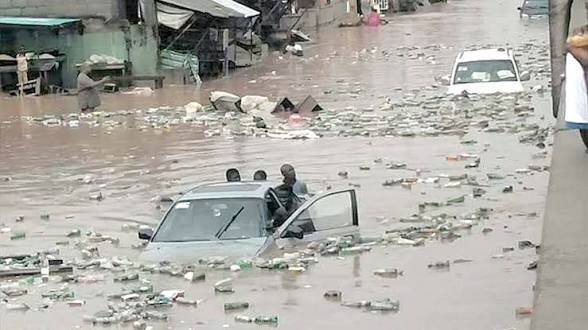
The call was made on Wednesday, July 1, 2026, by the Special Assistant to the President on Climate Change Matters, Yussuf Kelani, who said recent flooding in Lagos and other parts of the country should serve as a wake-up call for governments, communities, and citizens to prioritise disaster preparedness and climate resilience. In a statement issued in Abuja, Kelani said climate change was no longer a future environmental concern but a present-day national development challenge requiring coordinated action at all levels.
“Climate change has altered the frequency, duration and intensity of rainfall across many regions of the country,” Kelani said. “Instead of moderate rainfall spread over several days, communities increasingly experience short-duration but extremely heavy downpours that overwhelm drainage infrastructure, flood rivers, destroy roads and displace entire communities”.
According to him, scientific evidence has shown that rising global temperatures are increasing atmospheric moisture, resulting in heavier rainfall and more frequent flooding, coastal erosion, desertification, and prolonged droughts in different parts of Nigeria. Kelani noted that the recent floods, which submerged roads, disrupted businesses, and damaged homes in Lagos and other locations, underscored the growing vulnerability of urban centres to climate-related disasters. “Every flood is ultimately a human tragedy before it becomes an environmental statistic,” he said, noting that thousands of Nigerians had suffered losses of property, livelihoods and productivity.
The presidential aide warned that flood risks extend beyond Lagos, stressing that communities along the Rivers Niger and Benue, as well as states in the North-Central, South-South, South-East, parts of the North-West, and coastal regions, remain highly vulnerable. “As we move further into the rainy season, Nigerians living in flood-prone communities should begin preparations immediately. Waiting until floodwaters arrive is waiting too late,” he said. He urged state governments, local government councils, traditional institutions, religious organisations, and community associations to strengthen public awareness campaigns, inspect drainage infrastructure, and activate emergency response plans before the peak of the rainy season.
Kelani also called on Nigerians to adopt environmentally responsible practices, including regular clearing of drainage channels, proper waste disposal, tree planting, and adherence to weather forecasts and flood advisories. “Climate resilience begins with environmental responsibility,” he stated. Drawing lessons from countries such as the Netherlands, Japan, Bangladesh, Kenya, and Pakistan, he said Nigeria must increase investment in modern drainage infrastructure, flood forecasting and early warning systems, sustainable urban planning, wetland restoration, and other climate adaptation measures. “Floods cannot always be prevented, but disasters can be significantly minimised through planning, preparedness, engineering, public awareness, and strong institutions,” he added.
Kelani further identified climate education as a critical tool for reducing disaster risks, arguing that many Nigerians still see flooding merely as heavy rainfall rather than the combined effect of climate change, poor urban planning, blocked drainage systems, and environmental degradation. “Climate literacy should become part of everyday public education. An informed population is a resilient population,” he said. He added that the Federal Government, under President Bola Tinubu’s Renewed Hope Agenda, remains committed to implementing the Climate Change Act, the Energy Transition Plan, and Nigeria’s Nationally Determined Contributions to strengthen climate resilience. However, he stressed that government efforts alone would not be sufficient. “Government efforts can only succeed when matched by responsible citizen action. Climate change is no longer tomorrow’s problem. It is today’s reality,” he said.
The warning comes as the Federal Government intensifies its flood preparedness efforts across the country. Vice President Kashim Shettima has directed the immediate activation of a national coordination and early-action platform to tackle seasonal flooding, ordering agencies to move from reactive response to anticipatory preparedness as the rainy season intensifies. He also directed the immediate operationalisation of the Fusion and Trigger Room concept within the National Emergency Management Agency (NEMA) to coordinate flood monitoring, forecasting, and emergency response. The National Economic Council (NEC) recently approved an intervention fund of ₦83.2 billion to support anticipatory action against flooding across the country, marking a significant shift from reactive disaster management to proactive risk mitigation.
Additionally, the Federal Government has launched a flood protection pilot scheme targeting 100,000 riverine households in four high-risk states: Anambra, Benue, Kebbi, and Kogi. The initiative, a partnership between NEMA and PULA Advisors, is designed to provide timely financial protection for communities most vulnerable to flooding. The 2026 Annual Flood Outlook, presented by the Nigeria Hydrological Services Agency (NIHSA), identified 266 Local Government Areas in 33 states and the Federal Capital Territory as high flood-risk zones, with 14,118 communities expected to be affected. The Nigerian Meteorological Agency (NiMet) has also forecast light to moderate rainfall across 19 states and the FCT from July 1 to July 3, warning residents to remain alert to the risk of flash flooding and other weather-related hazards.
📩 Stone Reporters News | 🌍 stonereportersnews.com
✉️ info@stonereportersnews.com | 📘 Facebook: Stone Reporters News | 🐦 X (Twitter): @StoneReportNew | 📸 Instagram: @stonereportersnews
Add comment
Comments