

Reported by: Ijeoma G | Edited by: Oravbiere Osayomore Promise.
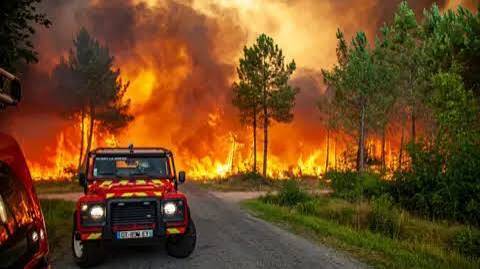
Wildfires are ravaging southern France, forcing the emergency evacuation of nearly 3,000 people, including hundreds of tourists and local residents, as the country reels from a record-breaking heatwave that has parched the Mediterranean coastline and turned forests into tinderboxes. The fires, which broke out in the Pyrenees-Orientales region, have spread rapidly, destroying dozens of mobile homes, burning moored boats in a marina, and blanketing the area in thick, toxic smoke.
The crisis escalated on Thursday, July 2, 2026, when a wildfire ignited in the coastal town of Sainte-Marie-la-Mer and quickly spread to the neighbouring resort of Canet-en-Roussillon, a popular tourist destination near the Spanish border. The fire, fuelled by strong winds and dry vegetation that had been baked by an 11-day heatwave in June, destroyed dozens of mobile homes at a campsite before reaching the marina, where thick black smoke engulfed boats and warehouses. Local authorities closed the airport in nearby Perpignan as the flames advanced.
The largest blaze in the Aude department, near the Spanish border, had scorched approximately 900 hectares by Thursday, with nearly 700 firefighters deployed to battle the flames amid strong winds of up to 70 kilometres per hour. In the Pyrenees-Orientales region, nearly 3,000 tourists and local residents were urgently evacuated after the fire spread to Canet-en-Roussillon. Firefighters said nearly 3,000 people were evacuated, with half of them from three campsites in the affected area. Two firefighters sustained minor injuries during the operation.
In the communes of Pouzols-Minervois and Mailhac, about 200 people were evacuated or confined to their homes as smoke thickened. One evacuee, Danielle, 99, told officials: "The smoke was so thick, so suffocating that firefighters told us to leave." Smaller blazes also broke out near Marseille, with fires reported in Rognac and Lançon-Provence.
Interior Minister Laurent Nunez said 1,200 firefighters had been mobilised since Wednesday to battle the blazes, with 200 firefighters and four water-bombing aircraft deployed specifically to the Canet-en-Roussillon fire. "We are mobilising a large network of volunteers," said Pierre Regnault de La Mothe, the top regional official for the Pyrenees-Orientales department. Prime Minister Sebastien Lecornu, who chaired a crisis meeting in Marseille, described the situation as "fairly tense," noting that nearly 7,000 fires have broken out since the start of the summer season, with some 8,700 hectares already burned. He warned that the fires were starting "roughly 15 days to three weeks earlier than the usual periods," indicating the severity of the current wildfire season.
However, the government has faced sharp criticism. Some politicians have denounced what they describe as the authorities' inadequate measures to help France face rising temperatures, and the Green party filed a no-confidence motion against the government on Thursday. The criticism came amid growing public frustration over the government's preparedness for the escalating climate crisis, as health authorities estimated that the previous heatwave may have caused at least 1,000 excess deaths in the country during record-breaking temperatures.
The wildfires are the direct consequence of a brutal heatwave that swept across western Europe in June, with temperatures climbing above 40°C in many parts of France for 11 consecutive days. The World Meteorological Organization warned that the extraordinary heatwave had "major impacts" on human health, ecosystems, agriculture, and infrastructure, while significantly worsening the risk of wildfires. Meteo-France, the national weather agency, has warned that another spell of high temperatures is expected to hit the country next week, though it is not forecast to be as intense as the June heatwave.
With France enduring its third heatwave of the summer and the Mediterranean region facing a future of more frequent and intense wildfires driven by climate change, the situation remains precarious. The French government has mobilised thousands of firefighters, volunteers, and military personnel, but the combination of drought, high winds, and parched terrain continues to challenge containment efforts. As the country braces for another heatwave, the fires serve as a stark reminder of the accelerating climate crisis gripping Europe.
For the thousands of evacuees, the immediate priority is safety, but for France as a whole, the question remains: how many more summers like this can the country endure before the political will matches the scale of the emergency? As one official put it, "We must acknowledge that they are occurring roughly 15 days to three weeks earlier than the usual periods." The fire season has only just begun.
📩 Stone Reporters News | 🌍 stonereportersnews.com
✉️ info@stonereportersnews.com | 📘 Facebook: Stone Reporters News | 🐦 X (Twitter): @StoneReportNew | 📸 Instagram: @stonereportersnews
Add comment
Comments