

Reported by: Oahimire Omone Precious | Edited by: Oravbiere Osayomore Promise.
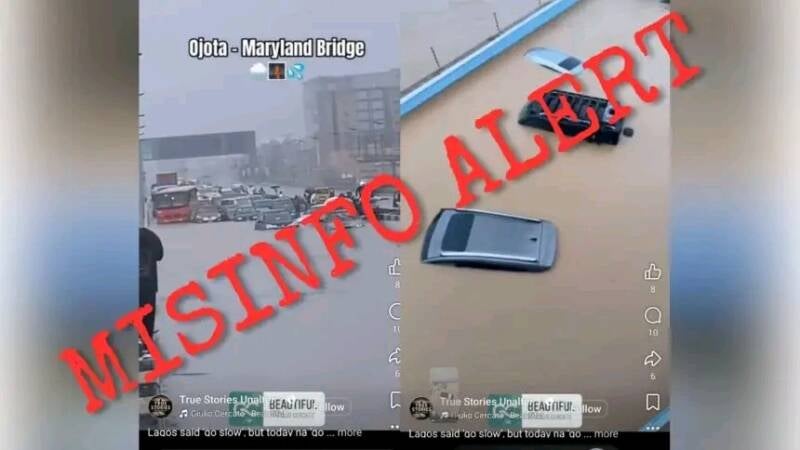
In the wake of heavy rainfall that triggered flooding across Lagos, Abia, Delta, and other states in Nigeria on Monday, social media was flooded with videos and images of submerged roads, vehicles, and buildings. Amid the deluge of content, one particular video stood out—a clip showing a man being swept away by powerful floodwaters as helpless onlookers watched from a distance. The video quickly went viral, with many Nigerians sharing it as evidence of the devastation in Lagos, accompanied by captions criticising the government's handling of the flooding crisis.
However, a fact-check conducted by The FactCheckHub has revealed that this claim is misleading. The viral video does not show a recent flood disaster in Lagos or any other part of Nigeria. Instead, it originated from Ghana, specifically from the capital city of Accra, where torrential rainfall triggered severe flooding over the weekend. The video was originally posted by a verified Ghanaian media account on Instagram, with the caption describing heartbreaking scenes as floodwaters swept away a man inside his wooden kiosk with no immediate rescue in sight.
A digital footprint check traced the video back to an X account that had explicitly stated the incident occurred in Ghana. Reverse image searches confirmed that the footage was lifted from the original Ghanaian source and repurposed with a misleading caption to suggest it was from Lagos. The FactCheckHub concluded that the claim that the video shows a recent flood disaster in Lagos is misleading, as source tracking proves the incident occurred in Accra.
This is not an isolated case of cross-border misinformation. In a similar instance in July 2024, a clip showing vehicles submerged in floodwaters circulated online with claims that it was filmed in Accra. That video, however, was found to have been captured in Lagos, specifically in the Iyana Oworo area, and was originally aired by Nigerian broadcaster Galaxy TV. The pattern shows that during periods of heavy rainfall and flooding, social media users often repurpose old or foreign footage to fit local narratives, sometimes unintentionally and other times to stoke public outrage or score political points.
Meanwhile, the flooding in Ghana has been devastating. At least 13 people have died after torrential rainfall triggered severe flooding across Accra, with emergency responders warning that the death toll could rise as rescue operations continue. The Ghana National Fire Service reported that more than 470 people had been rescued from floodwaters that submerged homes, vehicles, and businesses. The flooding also sparked a major fire at a rubber factory, while electricity supply was temporarily cut to several affected areas after floodwaters damaged power infrastructure.
In Nigeria, the heavy rainfall that began on Sunday and continued through Tuesday caused widespread flooding in Lagos, with major roads in Gbagada, Iyana-Ipaja, Agege, and other areas submerged, leaving residents stranded and homes underwater. The flooding also affected parts of Abia and Delta states, prompting calls for urgent government intervention and improved drainage maintenance.
The circulation of misleading flood videos is not a new phenomenon. During emergencies, false information can spread rapidly, undermining public confidence in official updates and diverting critical resources away from genuine rescue efforts. Authorities have repeatedly warned against the spread of misinformation during disasters, urging the public to verify content before sharing and to rely on official channels for accurate information. For residents of flood-affected areas, the difference between a real crisis and a manufactured one can mean the difference between life and death.
📩 Stone Reporters News | 🌍 stonereportersnews.com
✉️ info@stonereportersnews.com | 📘 Facebook: Stone Reporters News | 🐦 X (Twitter): @StoneReportNew | 📸 Instagram: @stonereportersnews
Add comment
Comments