

Reported by: Ijeoma G | Edited by: Oravbiere Osayomore Promise.
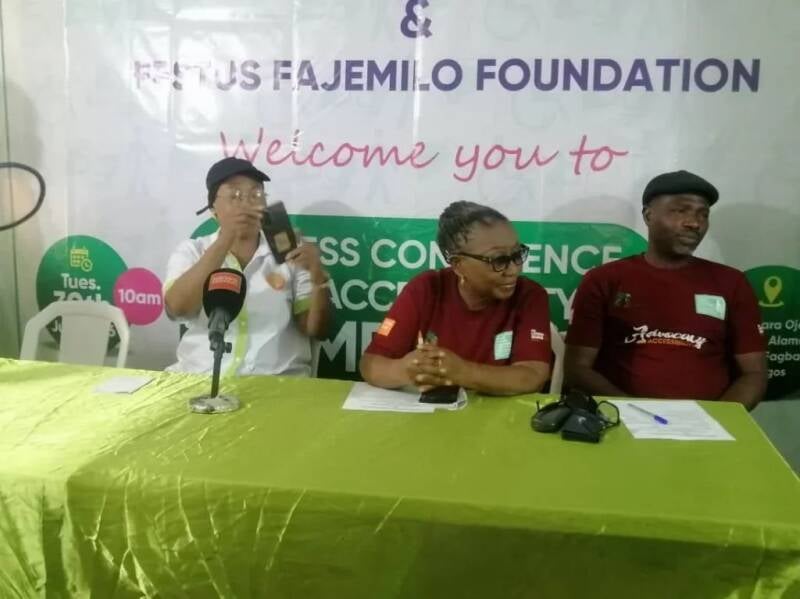
Disability rights organisations have accused the Lagos State Government and owners of public facilities of failing to enforce accessibility laws, warning that thousands of persons with disabilities remain shut out of essential services despite legal provisions guaranteeing equal access. The groups, under the auspices of the Down Syndrome Foundation Nigeria and the Festus Fajemilo Foundation, raised the concerns during a press conference held on Monday, 6 July 2026, to mark the end of a statewide accessibility advocacy project implemented across the nine disability clusters of the Joint Association of Persons with Disabilities in Lagos State. They warned that accessibility and disability inclusion would remain key issues in their engagement with political leaders as preparations for the 2027 general elections gather pace.
The organisations said findings from the advocacy project revealed widespread non-compliance with accessibility standards in public infrastructure, transportation systems and service delivery across the state. Speaking at the event, the National President of the Down Syndrome Foundation Nigeria, Mrs Rose Mordi, said the campaign aimed to ensure that persons with disabilities enjoyed rights already guaranteed under existing laws. "Our advocacy is about ensuring that persons with disabilities enjoy the rights already guaranteed under the law. Accessibility goes far beyond the construction of ramps. Every category of disability has unique accessibility requirements that must be considered if we are to build a truly inclusive society," Mordi said. She noted that many Nigerians were unaware of provisions contained in Article 9 of the United Nations Convention on the Rights of Persons with Disabilities, the Discrimination Against Persons with Disabilities (Prohibition) Act and the Lagos State Special People's Law, which guarantee accessible public spaces and equal participation for persons with disabilities.
The Executive Director of the Festus Fajemilo Foundation, Mr Afolabi Fajemilo, called for stricter enforcement of accessibility standards, saying accessibility should be incorporated into every public project from the planning stage. "Accessibility should be integrated from the planning and design stage of every public facility. When accessibility is ignored at the beginning, it creates barriers that exclude millions of Nigerians from education, healthcare, transportation, employment and other essential services," he said. Also speaking, the project's Technical Consultant, Mrs Modinat Tijani, said accessibility extended beyond wheelchair ramps to include facilities such as tactile paving for the visually impaired, accessible toilets, audio announcement systems, lowered service counters and appropriate signage. "Accessibility is comprehensive. It includes tactile floor paving for persons with visual impairment, audio announcement systems, accessible toilets, lowered service counters, appropriate signage and other features that allow everyone to use facilities safely and independently. Inclusive planning requires consulting organisations of persons with disabilities from the earliest stages of project development," Tijani said.
Representatives of the Spina Bifida and Hydrocephalus Association of Nigeria, National Association of the Blind, Spinal Cord Injuries Association and the Albinism Association of Nigeria recounted the difficulties their members face in accessing public buildings, transportation and other services across Lagos. The groups called for stricter enforcement of disability laws, increased public awareness and the involvement of organisations of persons with disabilities in the planning and implementation of public projects. They added that the findings and recommendations from the advocacy project would be submitted to the Lagos State Ministry of Youth and Social Development and other relevant stakeholders to improve compliance with accessibility laws.
The criticism comes despite the Lagos State Government's repeated commitments to disability inclusion. Governor Babajide Sanwo-Olu had in December 2025 unveiled a Lagos Disability Inclusion Compact, a policy framework aimed at strengthening the enforcement powers of the Lagos State Office for Disability Affairs (LASODA) while expanding inclusive education, upgrading accessible transport, enhancing digital access, and embedding accessibility into all new infrastructure. The government has also pledged inclusive housing development, with assurances that accessibility standards for persons with disabilities are being incorporated into housing projects across the state. In February 2026, the Lagos State Office for Disability Affairs engaged the Ministry of Housing to strengthen accessibility standards and promote inclusive housing development. Yet, disability rights advocates have consistently maintained that implementation remains weak due to inadequate funding, insufficient staffing of disability agencies and limited political will.
The concerns raised by the groups also reflect a broader pattern of exclusion documented across Nigeria. An investigation by Premium Times had earlier revealed that Nigerians with disabilities continue to experience discrimination despite existing laws, with the five-year transitional period for public buildings to become accessible having lapsed without meaningful compliance. In Lagos, persons with disabilities have repeatedly protested over inaccessible public infrastructure, including a May 2026 protest at the domestic airport over the continued closure of the 67-year-old Nigerian Framcraft Centre for the Blind. A physically challenged lawyer, Enor Agofure, had also dragged three Nigerian banks before the Federal High Court in Lagos over their inability to access bank halls freely due to the installation of Mantrap doors at their entrances.
As the 2027 elections approach, disability groups have made it clear that accessibility and inclusion will be central to their engagement with political leaders. The groups' demand for stricter enforcement, public awareness and the involvement of persons with disabilities in project planning reflects a growing determination to ensure that legal provisions translate into tangible improvements in the lives of millions of Nigerians living with disabilities. For the Lagos State Government, the challenge is clear: translate policy commitments into measurable action, or face the consequences at the ballot box.
📩 Stone Reporters News | 🌍 stonereportersnews.com
✉️ info@stonereportersnews.com | 📘 Facebook: Stone Reporters News | 🐦 X (Twitter): @StoneReportNew | 📸 Instagram: @stonereportersnews
Add comment
Comments