

Reported by: Ijeoma G | Edited by: Oravbiere Osayomore Promise.
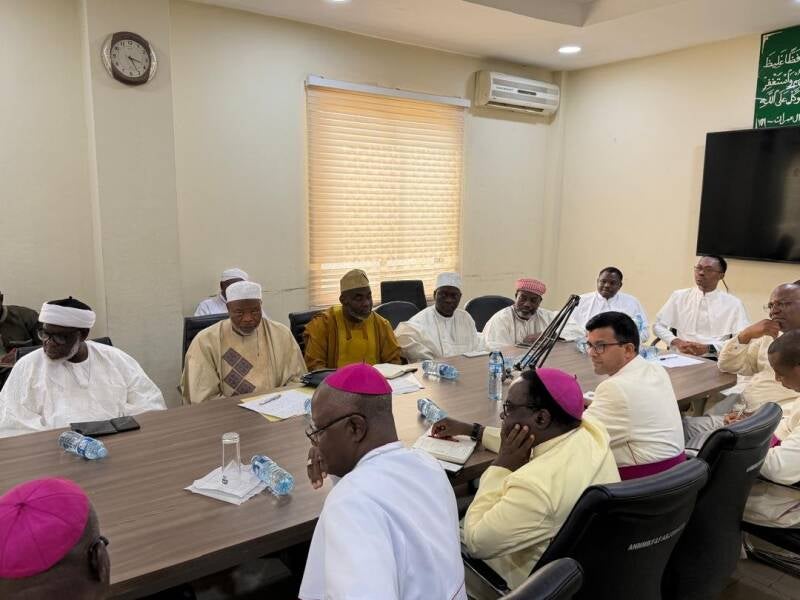
The Sultan of Sokoto and President-General of the Nigerian Supreme Council for Islamic Affairs (NSCIA), Muhammadu Sa'ad Abubakar III, has warned that rising religious intolerance and hate speech are undermining Nigeria's social cohesion, describing the twin evils as existential threats to the country's unity and peaceful coexistence. The monarch made the declaration on Monday, 6 July 2026, while receiving the Vatican's Secretary for Relations with States and International Organisations, Archbishop Paul Richard Gallagher, at the National Mosque in Abuja. The high-level meeting, which brought together senior leaders of the Catholic Church in Nigeria and officials from the Holy See, marked a significant moment in interfaith diplomacy, with both sides reaffirming their commitment to deepening collaboration between Muslim and Christian communities to address insecurity, misinformation, and moral decline.
Speaking through the Deputy Secretary-General of the NSCIA, Professor Salisu Shehu, the Sultan stressed that the essence of the visit was to promote mutual understanding and strengthen cooperation across religious communities in advancing peace, peaceful coexistence, and improved security, not only in Nigeria but globally. He said Muslim and Catholic leaders must strengthen interfaith cooperation to address insecurity and other challenges threatening peaceful coexistence in the country. The monarch lamented that hate speech has become a major source of division among religious groups, noting that it has fuelled distrust and strained relationships between faith communities. He also condemned the growing trend of insults directed at respected religious leaders, saying such conduct must be discouraged irrespective of religious affiliation.
The Sultan also cited fake news as another major threat to national stability, warning that misinformation continues to inflame tensions and trigger avoidable crises. "Hate speech has been most injurious to peaceful coexistence in the country. It has created perceptual and relational crises among faith communities," he said. "Fake news is another evil that is being used in the country to precipitate a lot of troubles, and therefore this is something that we need to fight." He added that the discussion also touched on concerns over moral decline and what he described as the increasing rejection of religion among young Muslims and Christians. He said both delegations agreed that sustained dialogue, mutual respect, and stronger collaboration through interfaith platforms remain critical to preserving Nigeria's unity and countering divisive narratives.
Professor Shehu, who briefed journalists after the closed-door meeting, disclosed that the Vatican envoy, who oversees the Holy See's diplomatic relations and international engagements, was accompanied by officials from the Vatican and senior leaders of the Catholic Church in Nigeria, including the Catholic Archbishop Emeritus of Abuja, Cardinal John Onaiyekan; the Catholic Archbishop of Abuja, Ignatius Kaigama; and the Bishop of the Catholic Diocese of Sokoto, Most Reverend Matthew Kukah. Shehu explained that the meeting was aimed at strengthening mutual understanding and fostering cooperation among faith communities in promoting peace and improving security in Nigeria and beyond.
According to Shehu, the Sultan warmly received the delegation and commended the Catholic community in Nigeria for its commitment to peaceful coexistence and its active participation in interfaith initiatives aimed at strengthening national unity. He said one of the major concerns raised during the meeting was the growing menace of hate speech, which both leaders identified as a major obstacle to harmonious relations among Nigeria's religious communities. "Hate speech has been most injurious to peaceful coexistence in the country. It has created what may be described as perceptual and relational crises among faith communities in Nigeria," Shehu said. He noted that both leaders condemned the increasing trend of individuals publicly insulting respected religious leaders, describing such conduct as dangerous and capable of inflaming religious tensions.
The meeting also highlighted the growing threat posed by fake news, with the religious leaders warning that the spread of false information has continued to fuel tension, mistrust, and conflict across the country. Shehu said both leaders agreed that religious organisations, government institutions, and the media must work together to curb misinformation and promote responsible public communication. The discussions further focused on what the participants described as worsening moral degeneration across the world. "To this end, religious institutions have a responsibility to promote sound moral values and provide ethical guidance capable of reversing the trend," Shehu stated. They also expressed concern over the growing rejection of religious values among young people, urging greater efforts to strengthen faith formation and moral education within Muslim and Christian communities.
In his remarks, Archbishop Gallagher described the engagement as "very frank and illuminating," adding that it reinforced his optimism about the role of religious leaders in fostering national cohesion. "The visit has been very, very good. I was delighted to be invited by His Eminence, the Sultan. We had a very frank and illuminating conversation, and it was good to hear that many of our positions regarding the role of religious leaders, both on the Catholic side and the Muslim side, coincide," Gallagher said. "For me, this is a reason for optimism regarding the religious cohesion of the country and our shared commitment to working for the good of all Nigerians." He added that there is a common view and a common conviction that Christians and Muslims, particularly their leaders, must work together for the common good of all Nigerians.
The meeting came a day after President Bola Tinubu received Archbishop Gallagher at the Presidential Villa in Abuja. During that visit, the President expressed Nigeria's desire to deepen relations with the Holy See and said he looked forward to welcoming Pope Leo XIV to the country. The Vatican envoy's visit to Nigeria is seen as part of broader efforts to strengthen ties between the Holy See and Nigeria, particularly in the areas of interfaith dialogue, peacebuilding, and humanitarian cooperation.
The Sultan's warning against religious intolerance and hate speech comes at a time when Nigeria is grappling with multiple security challenges, including insurgency in the North-East, banditry in the North-West, and communal clashes in the North-Central region. The growing use of inflammatory rhetoric and misinformation has further exacerbated tensions, making the call for interfaith collaboration more urgent than ever. The meeting between the Sultan and the Vatican envoy has been widely hailed as a positive step towards fostering greater understanding and cooperation between Nigeria's two largest religious communities, with many expressing hope that the renewed commitment to dialogue will translate into tangible action on the ground.
As the Sultan and the Vatican envoy both emphasised, the fight against hate speech, fake news, and moral decline requires a collective effort from religious leaders, government institutions, the media, and civil society. Their message is clear: the survival of Nigeria's unity depends on the ability of its diverse religious communities to coexist peacefully and work together for the common good. The meeting at the National Mosque may have been a single event, but its significance resonates far beyond the walls of that building, offering a glimmer of hope in a country that has often been divided along religious lines.
📩 Stone Reporters News | 🌍 stonereportersnews.com
✉️ info@stonereportersnews.com | 📘 Facebook: Stone Reporters News | 🐦 X (Twitter): @StoneReportNew | 📸 Instagram: @stonereportersnews
Add comment
Comments