

Reported by: Oahimire Omone Precious | Edited by: Oravbiere Osayomore Promise.
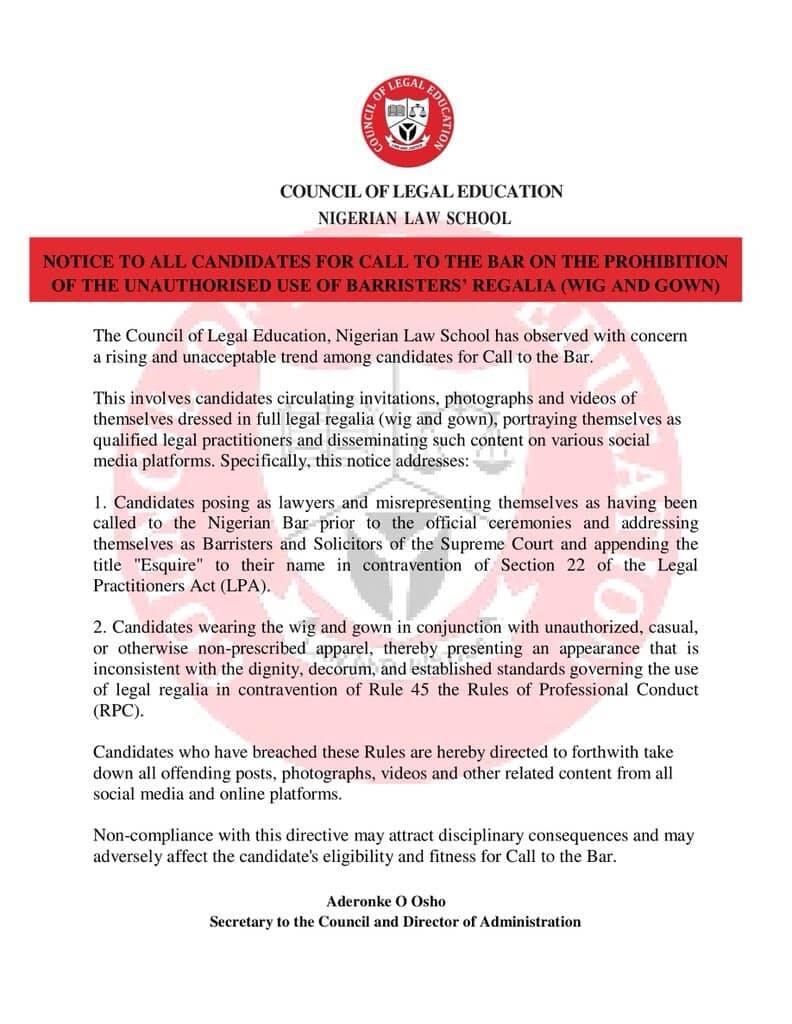
The Council of Legal Education has issued a stern warning to candidates awaiting the Call to the Bar, directing them to immediately stop wearing barristers' regalia and presenting themselves as qualified legal practitioners before their formal admission to the Nigerian Bar. The warning, contained in a notice signed by the Secretary to the Council and Director of Administration, Aderonke Osho, was issued by the Nigerian Law School and made available on Tuesday, 7 July 2026. The Council said it had observed with concern a "rising and unacceptable trend" of candidates circulating invitations, photographs, and videos of themselves dressed in full legal regalia—wig and gown—and portraying themselves as qualified lawyers on various social media platforms.
According to the notice, some candidates had also gone as far as addressing themselves as "Barristers and Solicitors of the Supreme Court" and appending the title "Esquire" to their names, even though they have not yet been formally called to the Bar. The Council stated that such actions contravene Section 22 of the Legal Practitioners Act, which regulates who may practise as a legal practitioner in Nigeria. The Act explicitly provides that only persons whose names are on the roll of legal practitioners are entitled to practise as barristers and solicitors in Nigeria. By wearing the wig and gown and assuming the titles reserved for qualified lawyers, candidates are not only violating the law but also misleading the public about their professional status.
The Council also frowned on candidates wearing wigs and gowns with unauthorised, casual, or non-prescribed clothing, describing the practice as inconsistent with the dignity and decorum expected of the legal profession. According to the Council, this conduct violates Rule 45 of the Rules of Professional Conduct, which sets out the standards of dress and appearance for legal practitioners. The notice emphasised that the legal profession is one of honour and integrity, and candidates who engage in such conduct risk bringing the profession into disrepute even before they are admitted to it.
In a strong directive, the Council ordered all affected candidates to immediately take down all offending posts, photographs, videos, and related content from social media and other online platforms. It warned that failure to comply could attract disciplinary measures and adversely affect a candidate's eligibility and fitness to be called to the Nigerian Bar. "Non-compliance with this directive may attract disciplinary consequences and may adversely affect the candidate's eligibility and fitness for Call to the Bar," the notice read. This warning underscores the seriousness with which the Council views the matter, as the Call to the Bar is not merely a ceremonial event but a formal admission into a regulated profession.
The Call to the Bar ceremony, which is scheduled to hold from Tuesday, 7 July to Friday, 10 July 2026, at the Body of Benchers Complex in Abuja, marks the culmination of years of rigorous legal education and training. Candidates who have successfully completed the Bar Part II examinations at the Nigerian Law School are formally called to the Bar and enrolled as legal practitioners. Until that moment, they remain law graduates and are not entitled to wear the barrister's gown and wig or to hold themselves out as qualified lawyers. The Council's warning serves as a reminder that the privilege of wearing the legal regalia is reserved for those who have been duly admitted to the Bar.
The warning comes amid growing concerns about the conduct of law graduates on social media, where many have been posting photos and videos of themselves in full legal attire, often with captions suggesting they are already practising lawyers. This trend has drawn criticism from senior members of the legal profession, who argue that it undermines the integrity of the Call to Bar ceremony and devalues the profession. The Council's intervention is therefore seen as a necessary step to restore discipline and ensure that candidates respect the traditions and regulations of the legal profession.
For the affected candidates, the message is clear: the wig and gown are not accessories for social media fame but symbols of a hard-earned professional status that must be worn with honour and only after formal admission. Candidates who fail to heed the Council's warning risk not only disciplinary action but also the possibility of being denied the Call to Bar, a consequence that would bring an abrupt and devastating end to their legal aspirations. As the Call to Bar ceremonies begin, all eyes will be on the candidates to see whether they comply with the Council's directive and uphold the dignity of the legal profession.
📩 Stone Reporters News | 🌍 stonereportersnews.com
✉️ info@stonereportersnews.com | 📘 Facebook: Stone Reporters News | 🐦 X (Twitter): @StoneReportNew | 📸 Instagram: @stonereportersnews
Add comment
Comments