

Reported by: Ijeoma G | Edited by: Oravbiere Osayomore Promise.
It was a routine flight from the Greek city of Thessaloniki to Memmingen in Germany, a short hop across the Balkans that should have been uneventful. But within minutes of takeoff, a Ryanair Boeing 737-800, operated by the airline's subsidiary Malta Air, became the scene of a mid-air nightmare that left passengers screaming and a 61-year-old man fighting for his life, his head and shoulders hanging outside the aircraft at 19,000 feet.
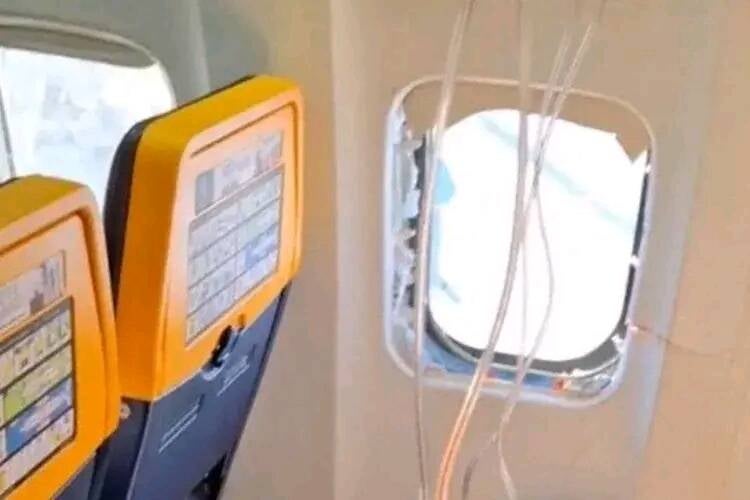
The flight, which departed Thessaloniki on the morning of Friday, 10 July 2026, was carrying dozens of passengers, many of whom had settled in for the short journey. Then came the bang. "Most of us had fallen asleep, we had closed our eyes. There was a noise, like a tire bursting," a fellow passenger told Radio Thessaloniki, as reported by CBS News and other outlets. That sound was the precursor to a catastrophe that would unfold in seconds. A piece of debris, believed to have detached from one of the plane's engines, smashed into the fuselage, shattering a cabin window.
The sudden decompression that followed was violent and instantaneous. Oxygen masks dropped from the ceiling, and a powerful suction force began pulling everything—and everyone—toward the gaping hole in the side of the plane. The passenger seated next to the broken window, identified as a 61-year-old Serbian tourist, was caught in the vortex. "The head and shoulders of one passenger were outside the window," the witness recounted. "Fortunately, he hadn't taken off his seat belt." That single detail—a seatbelt still fastened—may have been the difference between life and death.
For several agonising minutes, the man hung upside down, his upper body exposed to the icy wind and the deafening roar of the slipstream, his head and shoulders protruding as far out as his shoulders. The cabin was in chaos. "There were screams... for a moment I thought someone had accidentally opened the emergency door," another passenger, Christina, told Radio Thessaloniki. "The masks dropped and there was a strong smell." The smell, likely of hydraulic fluid or burning metal, added to the terror as passengers realised the plane was in serious trouble.
But in the midst of the panic, a group of passengers acted with remarkable courage. They grabbed hold of the man, who was being sucked outward by the immense pressure differential, and pulled him back inside the cabin. He was alive, but he had suffered friction burns from the force of the air rushing past him at hundreds of miles per hour. He was hospitalised in Thessaloniki but was otherwise in good condition, authorities confirmed.
Ryanair, in a brief statement, confirmed the incident, saying the flight "returned to Thessaloniki shortly after takeoff when a passenger window dislodged inflight". The aircraft landed normally, and the passenger received medical assistance on the ground. A replacement aircraft was later arranged to take the remaining passengers to Memmingen.
The incident, which occurred over North Macedonia, is now under investigation by Greek and Maltese aviation authorities, with the Irish Aviation Authority offering assistance. While Ryanair has not officially commented on the cause, Greek media reports have pointed to debris from one of the engines as the likely culprit, a piece of metal that broke off and struck the fuselage, shattering the window. The aircraft, estimated to be 18 years old, was operated by Ryanair's subsidiary Malta Air.
The incident has drawn inevitable comparisons to the 2018 Southwest Airlines flight 1380, where a passenger was partially sucked out of a broken window after an engine explosion and later died from her injuries. In that case, the passenger was not wearing a seatbelt. The Ryanair passenger's survival, experts say, is a testament to the life-saving importance of keeping seatbelts fastened throughout a flight, even when the seatbelt sign is off.
For the passengers on that Ryanair flight, the journey will be remembered not for its destination, but for the terrifying moments when the sky reached in and tried to take one of them. The 61-year-old Serbian tourist is now recovering from his injuries, but the psychological scars of being partially sucked out of a plane at 19,000 feet will likely linger much longer. As one passenger put it: "We immediately realised there had been a decompression... for a moment I thought someone had accidentally opened the emergency door". It was not a door, but a window—and it nearly cost a man his life.
📩 Stone Reporters News | 🌍 stonereportersnews.com
✉️ info@stonereportersnews.com | 📘 Facebook: Stone Reporters News | 🐦 X (Twitter): @StoneReportNew | 📸 Instagram: @stonereportersnews
Add comment
Comments