

Reported by: Ijeoma G | Edited by: Oravbiere Osayomore Promise.
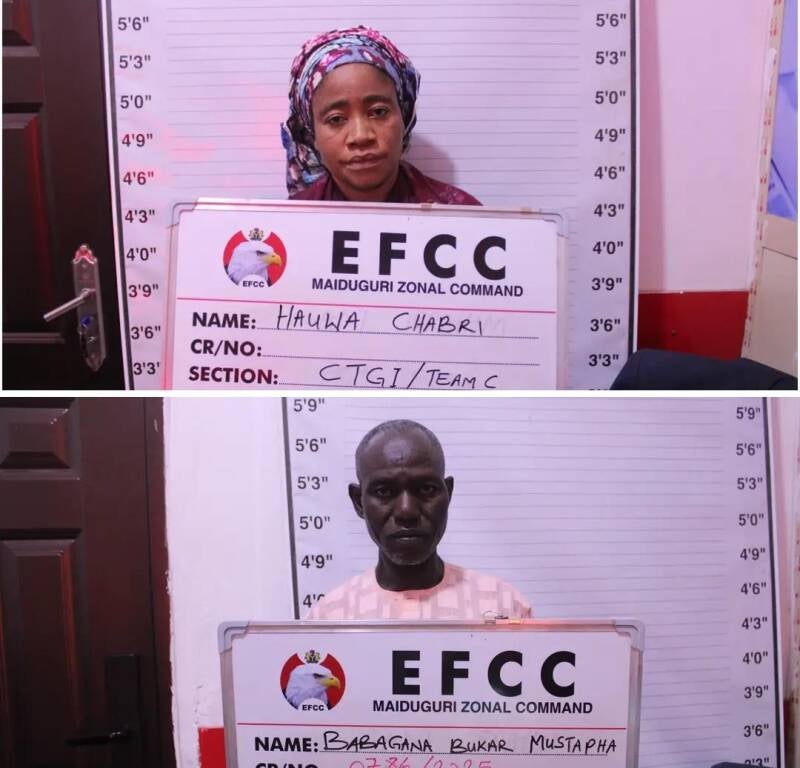
A Borno State High Court sitting in Maiduguri has convicted and sentenced two individuals to prison terms for criminal misappropriation of funds totalling N14.8 million in separate cases brought before the court by the Maiduguri Zonal Directorate of the Economic and Financial Crimes Commission. Justice B.T Zannah, presiding over the court on Monday, July 13, 2026, convicted Babagana Bukar and Hauwa Chabri after they pleaded guilty to charges of dishonestly converting funds entrusted to them for business transactions to their personal use. The convictions mark a significant victory for the anti-graft agency in its ongoing efforts to combat financial crimes in the North-East region.
Bukar was arraigned on a one-count charge for criminal misappropriation of N8.8 million belonging to Bunu Gambo Liman. According to the charge sheet, the offence occurred sometime in 2025 in Maiduguri, Borno State, when Bukar dishonestly misappropriated and converted to his own use the aggregate sum of N8.8 million entrusted to him through Babakura Umar and Bello Adamu. The money was given to Bukar specifically for the supply of 100 bags of IRS flour and 50 bags of BUA sugar, but he diverted the funds to his personal use without the consent of the petitioner. The prosecution stated that Bukar's actions contravened Section 296 of the Penal Code Law and are punishable under Section 297 of the same law.
Chabri, the second convict, faced a separate one-count charge for misappropriating N6 million belonging to Mohammed Samaila Yakubu. The money was given to her for the supply of beef, but she dishonestly converted the sum to her personal use. The charge stated that the offence occurred sometime in 2025 in Maiduguri and contravened Section 296 of the Borno State Penal Code Law, punishable under Section 297 of the same law. Both defendants pleaded guilty to their respective charges when they were read to them in court, a development that significantly expedited the trial process.
Following the guilty pleas, prosecution counsel A.D. Abdulmalik prayed the court to convict the defendants accordingly. Counsel to the first defendant, S. Mustapha, pleaded for leniency and informed the court that Bukar had fully restituted the petitioner, returning the full N8.8 million he had misappropriated. Mustapha further urged the court to temper justice with mercy upon his client and requested the option of a fine in lieu of imprisonment. Chabri, representing herself, also pleaded for leniency and informed the court that she promised to restitute the petitioner, though she did not provide evidence of repayment at the time of the proceedings.
Justice Zannah, after considering the submissions, delivered his judgment. Bukar was sentenced to one year imprisonment with an option of a N100,000 fine. The court effectively gave him the choice to serve the full prison term or pay the fine and secure his release. For Chabri, the court took a different approach, ordering her to restitute the full sum of N6 million to the petitioner or, in default, serve two years imprisonment. This ruling effectively ties Chabri's freedom to her ability to repay the stolen funds.
The convictions stem from a series of business transactions gone wrong. Bukar's journey to the correctional facility began when he collected N8.8 million for the supply of food items but diverted the funds for his personal use. Chabri similarly collected N6 million for beef supply and converted the funds to her own purposes, leaving her business partner without the promised goods or his money. The cases highlight the prevalence of business fraud in commercial transactions and the willingness of the EFCC to pursue such cases to their logical conclusion.
The EFCC Maiduguri Zonal Directorate has been active in prosecuting financial crimes across the North-East region, where insecurity has often complicated business operations and created opportunities for fraud. The convictions send a clear warning to individuals engaged in fraudulent business practices that the long arm of the law will catch up with them. The court's decision to grant Bukar an option of fine while requiring Chabri to make full restitution reflects the judicial approach to balance punishment with the recovery of stolen funds.
These convictions come as the EFCC continues to intensify its fight against economic and financial crimes across Nigeria. The commission has secured numerous convictions in various jurisdictions, targeting everything from advance fee fraud to money laundering and misappropriation. The Maiduguri cases demonstrate the EFCC's reach even in areas affected by insurgency and conflict. As business activity gradually returns to the North-East, the commission has made it clear that it will not tolerate fraudulent business practices that undermine trust in commercial transactions and deter investment in the region.
The convicts' journey to conviction serves as a cautionary tale for business people in Maiduguri and beyond. The cases highlight the importance of transparency and accountability in business dealings and the severe consequences of breaching trust in commercial relationships. As both convicts now face the prospect of imprisonment or significant financial penalties, the message is clear: the EFCC will not relent in its pursuit of justice for victims of fraud.
📩 Stone Reporters News | 🌍 stonereportersnews.com
✉️ info@stonereportersnews.com | 📘 Facebook: Stone Reporters News | 🐦 X (Twitter): @StoneReportNew | 📸 Instagram: @stonereportersnews
Add comment
Comments