

Reported by: Oahimire Omone Precious | Edited by: Oravbiere Osayomore Promise.
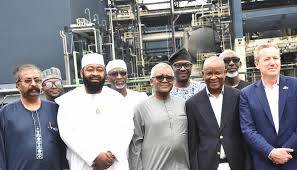
The Federal Government has described the Dangote Petroleum Refinery and Petrochemicals as a cornerstone of Nigeria's ambition to build a $1 trillion economy, pledging deeper collaboration with the private sector to accelerate industrialisation, job creation, and economic transformation. Minister of State for Industry, Senator John Owan Enoh, made the declaration on Wednesday, July 29, 2026, after leading a high-level delegation from the Ministry on an extensive tour of the 700,000 barrels-per-day Dangote Petroleum Refinery, Dangote Petrochemicals complex and Dangote Fertiliser Limited in Lagos.
The Minister described the integrated industrial complex as one of the most significant investments in Africa and a model for the type of industrial development required to drive Nigeria's economic growth aspirations. According to Enoh, the visit further reinforced the central role of large-scale manufacturing in the successful implementation of the Nigeria Industrial Policy, unveiled earlier this year. "You cannot be Minister in charge of Industry and not visit the Dangote Refinery," Enoh stated. "This facility matters because of what it represents for Nigerian industry, for our people and for the realisation of President Bola Tinubu's vision of a one trillion-dollar economy".
He said the refinery has emerged as a powerful symbol of value addition, industrial competitiveness and Nigeria's growing manufacturing capability. "The more a country adds value to its products, the more respect it earns globally. The Dangote Refinery stands today as one of the strongest demonstrations of that principle," he said. The Minister noted that the refinery has fundamentally changed global perceptions of Nigeria by helping to transform the country from a major importer of refined petroleum products into an exporter serving international markets. "When global supply disruptions occurred, Nigeria was able to export petroleum products to markets in the Middle East and beyond. That is an extraordinary achievement and one that deserves recognition," he added.
Enoh, who was accompanied by directors, regulators and heads of agencies under the Ministry, said the delegation gained a deeper appreciation of the scale, technological sophistication and strategic importance of the facilities. "I brought members of my team here because I wanted them to see firsthand what this investment represents. It has been a humbling and enlightening experience. We leave with greater knowledge and an even stronger commitment to supporting industrial development in Nigeria," he said.
He also dismissed concerns over the refinery's single-train configuration, noting that operations remained uninterrupted even during maintenance activities. "The issues surrounding the single-train configuration are much clearer now. Even during scheduled maintenance, operations continued," he said. The Minister pledged that the Ministry and its agencies would remain strong advocates of the refinery and the broader industrialisation agenda, adding that the government would continue to engage Dangote Industries Limited through the Industrial Revolution Work Group and ministerial roundtables to address challenges facing manufacturers, particularly access to affordable long-term financing.
He further commended Aliko Dangote for supporting the launch of the Nigeria Industrial Policy, describing him as "Nigeria's foremost industrialist" whose contributions would be vital to achieving the country's manufacturing targets. The policy aims to increase manufacturing's contribution to Nigeria's Gross Domestic Product (GDP) to approximately 20 per cent by 2030 and 25 per cent by 2035. "We want to be judged by the extent to which we implement this policy. Achieving these targets will require a strong partnership between government and industry leaders like Aliko Dangote," Enoh stated.
Speaking during the visit, President and Chief Executive of Dangote Industries Limited, Aliko Dangote, urged the federal government to place industrialisation at the centre of its economic strategy, insisting that no nation has attained prosperity without a strong manufacturing base. "There is no way to create jobs and prosperity without industrialisation," Dangote said. He called the 700,000-barrel-per-day refinery the biggest business risk of his career, revealing that financiers doubted the project would ever be finished. He disclosed that the project weathered the Covid-19 pandemic, foreign-exchange volatility and skepticism from lenders before coming online. "What we have achieved here has never been done before on this scale. Once one person succeeds, many others will be encouraged to follow," Dangote said.
At full capacity, the refinery will equal roughly 10 percent of United States refining capacity and consume about 2.5 percent of globally traded crude. Dangote pressed the government to keep backing indigenous investors, calling them the country's strongest source of jobs, foreign-exchange earnings and long-term economic resilience. He argued that policy consistency, more than incentives, is what draws capital. "When local investors thrive, they send a powerful signal that the environment is conducive for investment," Dangote said. Dangote also singled out Enoh's commitment as unusual among the ministers he has worked with over the years. "We have worked with many Ministers of Industry over the years, but I can confidently say that his commitment is exceptional," Dangote said.
The tour and the Minister's declaration come amid growing recognition that the Dangote Refinery has fundamentally shifted Nigeria's position in global energy markets. The facility, which is the largest single-train refinery in the world, has not only ended Nigeria's decades-long dependence on imported refined petroleum products but has also positioned the country as a net exporter capable of supplying international markets. The Federal Government's endorsement of the refinery as a cornerstone of its $1 trillion economy vision signals a strategic shift toward private-sector-led industrialisation and value addition, moving away from the resource export model that has historically defined Nigeria's economy.
As the government continues to implement the Nigeria Industrial Policy, the partnership between the public and private sectors will be critical to achieving the ambitious GDP targets set for 2030 and 2035. The Dangote Refinery stands as a powerful demonstration of what is possible when Nigerian entrepreneurs are given the support and policy consistency they need to succeed. For a nation long defined by its oil exports, the refinery represents a new chapter—one where Nigeria adds value to its own resources, creates jobs for its people, and earns respect on the global stage.
📩 Stone Reporters News | 🌍 stonereportersnews.com
✉️ info@stonereportersnews.com | 📘 Facebook: Stone Reporters News | 🐦 X (Twitter): @StoneReportNew | 📸 Instagram: @stonereportersnews
Add comment
Comments