

Reported by: Oahimire Omone Precious | Edited by: Oravbiere Osayomore Promise.
Justice Akintayo Aluko of the Federal High Court sitting in Ikoyi, Lagos, has delivered a series of convictions in two separate cases prosecuted by the Economic and Financial Crimes Commission (EFCC), sentencing one individual to four years' imprisonment for money laundering and four Bureau de Change (BDC) operators to 12 months each for engaging in illegal foreign exchange transactions. The rulings, delivered on Thursday, July 30, 2026, mark the latest victories in the anti-graft agency's sustained offensive against currency speculators and financial criminals undermining Nigeria's economy.
In the first case, Sunmonu Olasunkanmi Thaoban was arraigned by the Lagos Zonal Directorate 1 of the EFCC on a two-count charge bordering on money laundering. According to the charge sheet, Sunmonu, sometime in 2023, while acting as a middleman, indirectly disguised the origin of ₦16,000,000 (Sixteen Million Naira), being illicit gains accrued from his unlawful act, by converting the same to a black G-Wagon Jeep, 2018 model, with chassis number 1C4HJWEGJL893461. The vehicle was described as forming part of the proceeds of his unlawful activity, an offence contrary to Section 18(2)(a) and punishable under Section 18(3) of the Money Laundering (Prevention and Prohibition) Act, 2022.
The defendant pleaded guilty to both counts when they were read to him. Following his guilty plea, prosecution counsel H.U. Kofarnaisa reviewed the facts of the case and urged the court to convict and sentence him accordingly. Justice Aluko found Sunmonu guilty and sentenced him to four years' imprisonment, with an option of a ₦1.8 million fine. The court also ordered the forfeiture of the convict's black G-Wagon Jeep and mobile device to the Federal Government of Nigeria, sending a strong signal that proceeds of crime would not be allowed to remain in the hands of offenders.
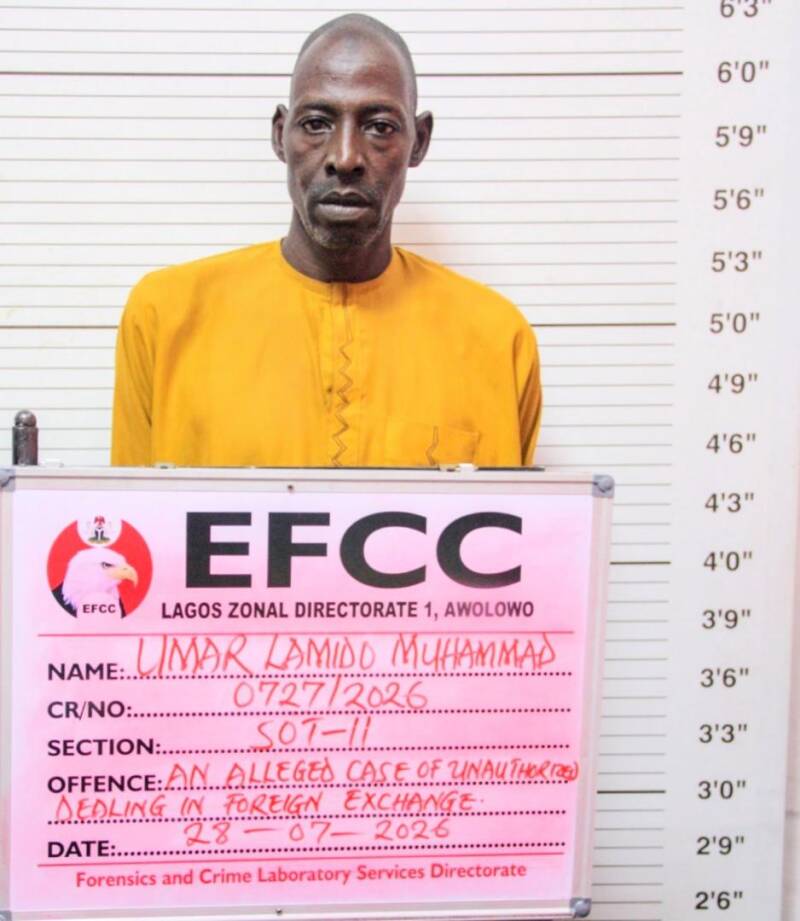
In a related development, the court also convicted and sentenced four Bureau de Change operators—Umar Muhammad Lamido, Yusuf Musa Yusuf, Abdulmuhimin Mahmud, and Muhammed Musa—to 12 months' imprisonment each for engaging in illegal foreign exchange transactions. The defendants were prosecuted by the EFCC's Lagos Zonal Directorate 1 on separate one-count charges bordering on illegal foreign exchange operations.
One of the charges against Abdulmuhimin Mahmud read: "That you, ABDULMUMIN MAHMUD, on the 23rd of July, 2026, in Lagos within the jurisdiction of this Honourable Court, engaged in a foreign exchange transaction other than through the official foreign exchange market and you thereby committed an offence contrary to Section 11(1)(a) of the National Economic Intelligence Committee Establishment (Etc.) Act, 1994 and punishable under Section 11(2) of the same Act." All four defendants pleaded guilty to their respective charges.
Following their guilty pleas, the prosecution counsel, H.U. Kofarnaisa, reviewed the facts of the cases and urged the court to convict and sentence them accordingly. Justice Aluko convicted the four defendants and sentenced each of them to 12 months' imprisonment, with an option of a ₦100,000 fine.
The convictions come amid heightened enforcement of foreign exchange regulations in Nigeria, where the Central Bank of Nigeria has repeatedly warned against illegal forex transactions that undermine monetary policy and fuel currency speculation. The EFCC, as the lead agency in the fight against economic and financial crimes, has intensified its crackdown on illegal BDC operators, currency speculators, and other economic saboteurs, warning that those engaged in such activities would face the full wrath of the law.
The prosecution of the four BDC operators under the National Economic Intelligence Committee Establishment Act, 1994, rather than the more commonly cited Central Bank of Nigeria Act or the Foreign Exchange (Monitoring and Miscellaneous Provisions) Act, highlights the broad powers available to law enforcement agencies in prosecuting economic offences. The Act, which established the National Economic Intelligence Committee, empowers the committee to collect, collate, and evaluate intelligence on economic crimes, and provides for the prosecution of individuals engaged in activities that undermine the nation's economic stability.
The conviction of Sunmonu Olasunkanmi Thaoban for money laundering and the forfeiture of his G-Wagon Jeep underscore the EFCC's determination to pursue individuals who attempt to disguise the origins of illicit funds through the acquisition of luxury assets. The case serves as a deterrent to others who may be tempted to engage in similar schemes, sending a clear message that proceeds of crime will be traced, seized, and forfeited to the government.
The convictions come just days after the EFCC secured a similar conviction against Saheed Zubair Danjuma, who was sentenced to 12 months' imprisonment or a N100,000 fine for engaging in foreign exchange transactions outside the official market. The agency has reaffirmed its commitment to the fight against economic and financial crimes and has urged members of the public to continue providing credible information that would assist in the prosecution of those who engage in activities that undermine the nation's economy.
The Lagos Zonal Directorate 1 of the EFCC has been particularly active in recent months, securing several high-profile convictions in cases involving money laundering, illegal forex trading, and other financial crimes. The agency has also intensified its efforts to recover stolen assets and return them to the government, with the forfeiture of the G-Wagon Jeep and mobile device in the Sunmonu case representing a significant recovery.
As the EFCC continues its crackdown on financial crimes, the convictions in Lagos serve as a stark warning to those who operate outside the bounds of the law. The agency has made it clear that it will not relent in its efforts to protect the nation's economy from the scourge of money laundering and illegal forex trading, and that those who engage in such activities will face the full weight of the law. The courts have also demonstrated their commitment to supporting the EFCC's efforts, with judges increasingly imposing stiff penalties on offenders and ordering the forfeiture of assets acquired through illicit means.
The convictions of the four BDC operators and the money launderer represent a significant victory for the EFCC and a major step forward in the fight against economic sabotage. As Nigeria continues to grapple with economic challenges, the enforcement of financial regulations is expected to remain a priority for the EFCC and other law enforcement agencies. The agency has urged members of the public to continue providing credible information that would assist in the prosecution of those who engage in activities that undermine the nation's economy, reaffirming its commitment to protecting the nation's financial system from criminals and saboteurs.
📩 Stone Reporters News | 🌍 stonereportersnews.com
✉️ info@stonereportersnews.com | 📘 Facebook: Stone Reporters News | 🐦 X (Twitter): @StoneReportNew | 📸 Instagram: @stonereportersnews
Add comment
Comments