

Reported by: Oahimire Omone Precious | Edited by: Oravbiere Osayomore Promise.
The United Nations has warned that about 35 million Nigerians – nearly one in seven people nationwide – will face acute hunger between June and August 2026, as worsening insecurity, rising food prices, economic hardship and severe funding shortages converge to create one of the world’s largest hunger crises. The UN Humanitarian Country Team in Nigeria, in a statement released on Friday, May 22, described the situation as alarming, noting that the lean season – the period before harvest when food supplies run low and prices typically spike – is expected to hit northern states hardest, particularly conflict‑affected areas in Borno, Adamawa and Yobe where insurgency has displaced hundreds of thousands of families and disrupted farming activities for years.
“Nearly one in seven people, that is 35 million people nationwide in Nigeria, are likely to face acute food insecurity during this year’s lean season, which runs from June to August,” the UN said. The warning makes Nigeria one of the world’s largest hunger crises, with the burden falling overwhelmingly on the northern part of the country. If assistance is further delayed, the UN cautioned, “millions of families will be forced to reduce meals further, sell assets, or withdraw their children from school with the long‑term impact that we know it has.”
The projection is not a sudden development. As early as January 2026, the World Food Programme (WFP) had warned that nearly 35 million people were projected to experience acute and severe food insecurity during the coming lean season, according to the Cadre Harmonisé, the equivalent of the Integrated Food Security Phase Classification (IPC) for West and Central Africa. That figure, which makes 2026 potentially the worst hunger year in a decade, is now being echoed by the broader UN system as the lean season looms just weeks away. Within that number, an estimated 15,000 people in Borno State are already at risk of catastrophic hunger, classified as IPC Phase 5 – a step away from famine.
The drivers of the crisis are multiple and mutually reinforcing. Insecurity remains the primary culprit, with attacks by armed groups across the north – from banditry in the north‑west to the Boko Haram and ISWAP insurgency in the north‑east – continuing to drive displacement, destroy food reserves and prevent farmers from accessing their fields. In the first four months of 2026 alone, renewed violence has forced an estimated 3.5 million people to flee their homes, with 80 percent of them located in the country’s north. Humanitarian access has also been severely constrained, leaving aid agencies unable to reach many of those most in need.
Economic pressures have compounded the crisis. Food inflation, which has risen steadily for three consecutive months, reached 16.06 percent in April, driven by increasing prices of essential staple foods. Food inflation now outpaces the headline inflation rate, eroding the purchasing power of already vulnerable households. At the same time, rising transportation costs and the high price of fuel have made it more expensive to move food from surplus to deficit areas. The cumulative effect has left poor households increasingly dependent on humanitarian assistance even as their own food stocks are depleted and income opportunities shrink.
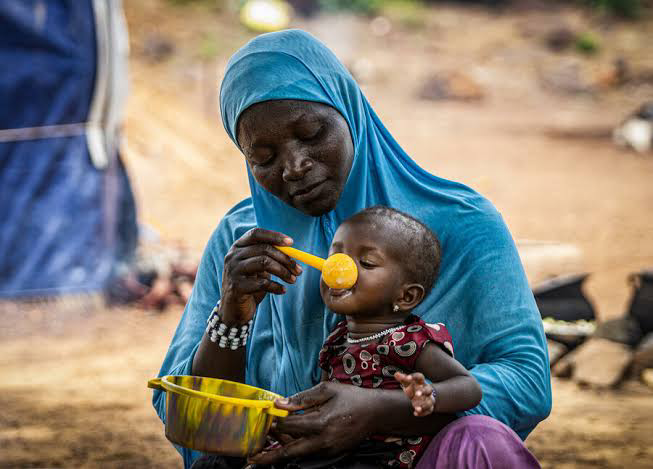
Across north‑west and north‑east Nigeria, the UN estimates that 6.4 million children are likely to be acutely malnourished this year – a figure that includes nearly three million children under the age of five who face life‑threatening severe acute malnutrition nationwide. “These are not statistics,” said UN Resident and Humanitarian Coordinator Mohamed Malick Fall. “These numbers represent lives, futures and Nigerians.” The warning comes at a time when malnutrition rates across several northern states have already reached what humanitarian agencies describe as ‘critical’ levels, and when health systems in the region are themselves under strain from years of underfunding and insecurity.
The international response, however, has lagged far behind the scale of the need. The UN has stressed that the already hyper‑prioritised $516 million Humanitarian Needs and Response Plan for Nigeria for 2026 is just over 40 percent funded. According to the latest humanitarian response plan report, only $215 million of the required $516 million had been received as of May 2026, leaving a funding gap of more than $300 million. The shortfall is already having concrete consequences. The WFP warned in January that more than one million people in north‑east Nigeria risked being cut off from emergency food and nutrition assistance within weeks unless new funding was received, and that for the first time in Nigeria, its assistance would be limited to only 72,000 people. In March, WFP was unable to deliver food assistance to affected communities at all in some areas, though it continued the management of moderate acute malnutrition across health facilities using specialised nutritious foods. With resources that were later received, WFP resumed food distributions in April across eight pre‑agreed locations in Yobe and Borno, but the overall funding situation remains precarious.
WFP’s Nigeria Country Director, David Stevenson, has warned that stopping food assistance now would lead to “catastrophic humanitarian, security and economic consequences for the most vulnerable people.” He noted that humanitarian solutions are still possible and that aid remains “one of the last stabilizing forces preventing mass displacement and regional spillover.” WFP has been providing food assistance in north‑east Nigeria since 2015, reaching nearly two million people each year in the hardest‑hit areas. But limited resources have now been exhausted, and WFP urgently requires $129 million to sustain its operations in the north‑east over the next six months. Without that funding, the organisation faces the risk of a full operational shutdown in the region. If WFP cannot continue supporting displaced populations in camps, Stevenson warned, “they will leave the sites in a desperate attempt to survive. They will try to migrate, or they may join insurgent groups to feed themselves and their families.”
Shrinking global aid budgets have worsened the crisis at every level. The UN Office for the Coordination of Humanitarian Affairs (OCHA) noted that resources from the Nigeria Humanitarian Fund have “jump‑started the response” but that far more is needed “to meet immediate life‑saving humanitarian needs.” The warning from the UN Humanitarian Country Team underscores that the window for action is closing rapidly. With June only days away, millions of Nigerian families face a stark choice: reduce meals further, sell off the few assets they still possess, or pull their children out of school – decisions that carry long‑term consequences for their health, education and ability to ever escape the cycle of poverty and hunger.
As the lean season begins, the number 35 million will hang over the country like a storm cloud. Behind the statistic are real people: farmers who have lost their harvests to violence, mothers who will watch their children waste away for lack of nutritious food, families who will eat once a day if they are lucky. The UN has made its appeal. Whether the world will answer before it is too late is the question that now hangs over Nigeria’s coming months.
📩 Stone Reporters News | 🌍 stonereportersnews.com
✉️ info@stonereportersnews.com | 📘 Facebook: Stone Reporters News | 🐦 X (Twitter): @StoneReportNew | 📸 Instagram: @stonereportersnews
Add comment
Comments