

Published by Oravbiere Osayomore Promise.
On the same Friday that a Federal High Court in Abuja adjourned his money laundering trial till June, former Attorney‑General of the Federation Abubakar Malami (SAN) moved a step closer to the 2027 governorship election in Kebbi State. The African Democratic Congress (ADC) has formally accepted his nomination, making him the party’s flag‑bearer for the state’s top executive office. Malami, who served as Nigeria’s chief law officer for the full eight years of the Muhammadu Buhari administration, is now positioned to challenge the incumbent APC government in Kebbi, even as he, his wife and his son face a 16‑count charge of conspiring to launder N8,713,923,759.49 – an amount the Economic and Financial Crimes Commission (EFCC) alleges was proceeds of unlawful activities.
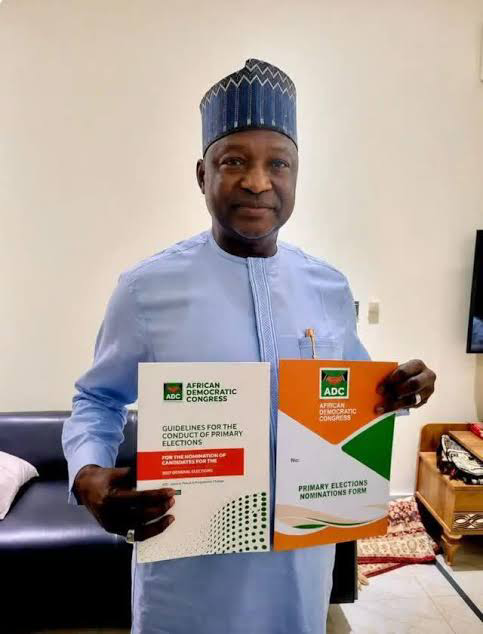
Malami obtained the ADC governorship nomination form on Saturday, May 9, 2026, in a move that immediately reshaped the political calculus of the North‑West state. In a lengthy statement released on the same day, the former minister declared a “State of Emergency on Misgovernance” in Kebbi, citing what he called rising insecurity, poverty, poor healthcare, declining education standards and economic hardship. He accused the current administration of misplaced priorities at a time when citizens are grappling with hardship, pointing to statistics that he said revealed over 67 percent of children between the ages of six and 15 are out of school, and more than 88 percent of children in the state live in multidimensional poverty. “There will be no retreat and no surrender in the collective struggle to rescue our state,” Malami declared.
The timing of Malami’s emergence is stark. On the same day that news of his party nomination broke, Justice Joyce Abdulmalik of the Federal High Court in Abuja adjourned his ongoing money laundering trial to June 23, 2026. Malami is being prosecuted alongside his wife, Hajia Bashir Asabe, and his son, Abubakar Abdulaziz Malami. The EFCC has charged the trio on an amended 16‑count charge of conspiracy, procuring, disguising, concealing and laundering proceeds of unlawful activities, contrary to the Money Laundering (Prevention and Prohibition) Act, 2022. The commission has alleged that the suspects conspired to launder N8,713,923,759.49 between 2015 and 2025, using shell corporate entities and high‑value property acquisitions to conceal the origin of the funds.
The defendants were re‑arraigned on February 27, 2026, and all pleaded not guilty. They were initially remanded in Kuje and Suleja correctional centres before being granted bail in March 2026, with the court imposing a bail condition of N200 million each. During the trial, a prosecution witness who testified as the Compliance Officer of a new‑generation bank told the court that the bank had flagged several transactions on Malami’s account and reported them to the Nigerian Financial Intelligence Unit (NFIU) as suspicious.
Despite the gravity of the allegations, Malami has consistently maintained his innocence, and his counsel, Joseph Daudu (SAN), has argued that the charges are politically motivated. On May 22, the prosecution informed the court that the defence had applied for an adjournment via a letter from Daudu’s law firm. The lead prosecutor, J.S. Okutepa (SAN), told the judge that while he was prepared to proceed, he did not want to stall proceedings and noted that the defendants had used only one of their five permitted adjournments. Justice Abdulmalik granted the adjournment, stressing that the absence of the lead defence counsel should not ordinarily halt the case, given the number of lawyers in his chambers, but allowed the request because the defence still had room.
Malami’s entry into the Kebbi governorship race is not his first attempt at the seat. In 2014, he vied for the APC governorship ticket in Kebbi but lost the primaries to former Governor Abubakar Atiku Bagudu. After that defeat, he was appointed by President Buhari as Minister of Justice and Attorney‑General of the Federation in 2015, a position he held until the end of the administration in 2023. For eight years, Malami was at the centre of the country’s legal and anti‑corruption apparatus, a period marked by high‑profile prosecutions and, critics say, selective enforcement of the law. After leaving office, he initially remained in the APC before defecting to the African Democratic Congress in July 2025, citing the ruling party’s failure to address the core challenges facing Kebbi State.
His defection and subsequent nomination have drawn sharp criticism from civil society groups. The Network Against Corruption and Trafficking (NACAT) issued a statement on May 22, describing the clearance of a politician under active corruption investigation as “deeply shocking and profoundly outrageous”. NACAT called on the ADC to reject Malami’s nomination and distance itself from what it termed “alleged looters”. Nevertheless, the ADC National Secretariat has not shown any indication that it intends to reverse its decision, and Malami has continued to campaign across Kebbi, positioning himself as an outsider determined to rescue the state from a government he describes as failing on all fronts.
Political analysts in Birnin Kebbi say Malami’s candidacy could reshape the 2027 election in a state that has been a stronghold of the APC since the advent of the Fourth Republic. Governor Nasir Idris, who was elected on the APC platform in 2023, has downplayed Malami’s defection, but the former AGF retains a network of loyalists across the eight‑year Buhari administration and has deep roots in the state’s legal and political elite. His promise to prioritise security, quality education, improved healthcare, agricultural revival and youth empowerment is clearly aimed at the rural and agrarian population that has borne the brunt of banditry and economic decline.
As Malami moves from the opposition ADC platform, the EFCC case against him remains a ticking clock. The trial is scheduled to resume on June 23, 2026, barely seven months before the governorship election. If the court enters a final judgment before the polls – particularly an unfavourable one – it could derail his campaign. Conversely, if the case continues to drag on, he may be able to keep his candidacy alive while challenging the admissibility of the prosecution’s evidence on appeal. For now, however, the former chief law officer of the Federation is officially a candidate for governor, and the people of Kebbi are watching a courtroom drama and a campaign unfold side by side.
One thing is certain: the 2027 Kebbi governorship race is no longer a simple APC affair. Malami has thrown down the gauntlet, and a man fighting N8.7 billion money laundering charges is daring to govern a state that is itself fighting poverty, illiteracy and banditry. Whether the electorate will see him as part of the solution or a continuation of the problems he now promises to solve will be one of the most closely watched questions of the 2027 cycle.
📩 Stone Reporters News | 🌍 stonereportersnews.com
✉️ info@stonereportersnews.com | 📘 Facebook: Stone Reporters News | 🐦 X (Twitter): @StoneReportNew | 📸 Instagram: @stonereportersnews
Add comment
Comments