

Reported by: Oahimire Omone Precious | Edited by: Oravbiere Osayomore Promise.
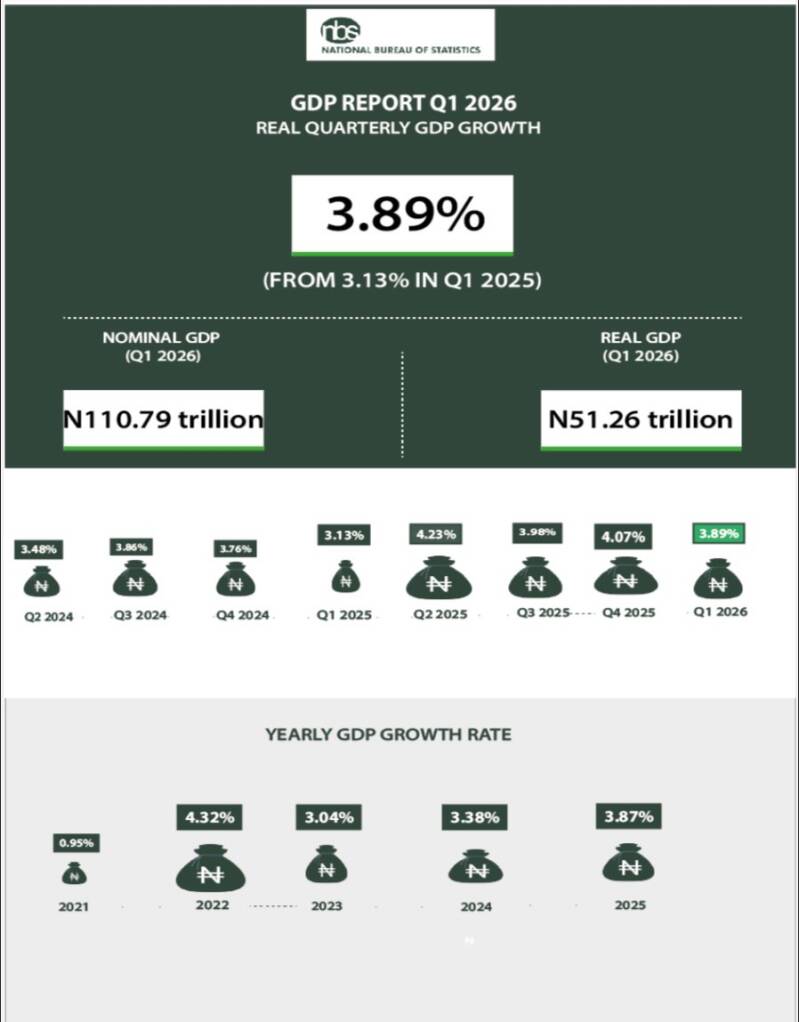
Nigeria’s real Gross Domestic Product (GDP) grew by 3.89% year‑on‑year in the first quarter of 2026, according to data released Monday by the National Bureau of Statistics (NBS). The figure represents a modest acceleration from the 3.13% recorded in Q1 2025 but a slight deceleration from the 4.07% growth in the fourth quarter of 2025. While the headline number suggests an economy gradually stabilising after the shock of subsidy removal and exchange‑rate unification, a closer look reveals a services‑driven expansion that has done little to ease the crushing cost‑of‑living crisis facing most Nigerian households. The services sector grew by 4.31% and accounted for 57.73% of real GDP, cementing its role as the dominant engine of economic activity. Telecommunications, financial services and trade were the main drivers, while the industrial sector remained sluggish, with manufacturing posting only modest gains and the electricity subsector contracting sharply. Agriculture staged a recovery, growing 3.15% after near‑stagnation in the same period last year, but this was not enough to offset persistent food inflation driven by insecurity, high input costs and logistics bottlenecks.
The non‑oil sector expanded by 3.94% and accounted for 96.08% of real GDP, underscoring the country’s continued reliance on consumption‑based, import‑dependent activities rather than on productive manufacturing or value‑added exports. Oil production averaged 1.55 million barrels per day during the quarter, down from 1.62 mbpd in Q1 2025, yet the oil sector still recorded a real growth of 2.57% – an improvement from 1.87% a year earlier. But the sector’s contribution to total GDP fell slightly to 3.92%, highlighting its diminishing weight in the overall economy despite higher global crude prices. Nominal GDP rose to a record N110.79 trillion, a 17.79% year‑on‑year increase, but that expansion is largely driven by price effects and exchange‑rate depreciation rather than by increased production of goods and services that directly benefit households.
The disconnect between macroeconomic growth and household welfare is stark. Although headline inflation has moderated from over 24% in early 2025 to around 15% by February 2026, the decline in the rate of price increases does not mean prices have fallen. Food inflation, which accounts for the largest share of household budgets, remains stubbornly high, fuelled by ongoing insecurity in farming communities, poor rural infrastructure and rising transport costs. The Centre for the Promotion of Private Enterprise (CPPE) warned that a “classic lag effect” separates macroeconomic stabilisation from tangible relief, noting that weak consumer demand – a direct consequence of eroded real incomes – remains a major constraint on retail trade and manufacturing. The World Bank has similarly observed that while Nigeria’s economy strengthened in 2026, “household incomes have not grown fast enough to offset still‑elevated inflation, and poverty has yet to begin declining”. A PwC analysis projected that poverty levels could reach 62% of the population in 2026, reflecting legacy policy gaps and the short‑term costs of ongoing reforms.
The Q1 2026 GDP report reveals a persistent structural weakness: an economy that depends on a narrow, services‑led expansion while manufacturing and agriculture remain undercapitalised and underproductive. The telecommunications subsector grew by 10.98% and contributed a record 11.31% to real GDP, but this growth does not generate mass employment in the way that a revived industrial or agro‑processing sector would. With lending rates still high and access to credit restricted, small and medium enterprises – the traditional engine of job creation – are unable to expand. Development economists have repeatedly warned that positive GDP numbers can coexist with rising poverty if growth is not employment‑intensive. The Q1 data confirms that, despite five consecutive quarters of positive growth, millions of Nigerians continue to face severe economic hardship, with high living costs, weak purchasing power and structural inefficiencies blunting the impact of the recovery.
The Federal Government has projected stronger growth for the remainder of 2026, banking on improved oil production, sustained foreign exchange inflows and continued services expansion. But risks abound. Renewed geopolitical tensions in the Middle East have pushed crude prices above $100 per barrel, a double‑edged sword that could boost export earnings while driving up domestic fuel costs and reigniting inflation. Insecurity in food‑producing regions continues to disrupt agricultural output and supply chains, keeping food prices elevated. The CPPE has warned that the fragile gains recorded so far could come under renewed pressure if inflation resurges or if foreign exchange volatility returns. The gap between headline GDP expansion and household welfare remains the defining economic challenge of the Tinubu administration. Without a concerted push to diversify the productive base, improve energy supply and reduce the cost of logistics and credit, the recovery will remain a statistical artefact rather than a lived reality for most Nigerians.
📩 Stone Reporters News | 🌍 stonereportersnews.com
✉️ info@stonereportersnews.com | 📘 Facebook: Stone Reporters News | 🐦 X (Twitter): @StoneReportNew | 📸 Instagram: @stonereportersnews
Add comment
Comments