

Reported by: Oahimire Omone Precious | Edited by: Oravbiere Osayomore Promise.
Few days before Nigerian Muslims are to celebrate Eid‑el‑Kabir, the harsh economic realities of 2026 have reached the market stalls, leaving many families struggling to afford even the most modest festivities. The price of a good‑sized ram has climbed as high as N1.2 million in some urban centres, while a basket of pepper now costs N45,000 – a staggering 200 percent jump from N15,000 a year ago. Across Lagos, Abuja and other major cities, traders and buyers alike paint a picture of a festival season muted by inflation, insecurity and a cost‑of‑living crisis that is rapidly reshaping the traditional rites of Sallah.
At the Iyana Oba Market in Lagos, a tomato and pepper seller who gave his name as Ashiru told Vanguard that the steep rise in food prices had been sudden and punishing. “A basket of tomatoes is now N80,000. It used to be N52,000 or N53,000 before. A basket of pepper is now N45,000 whereas before it was sold for N15,000,” he said. His experience was echoed by Mrs Ruth Lawal, a foodstuff trader, who noted that basic staples such as rice and cooking oil had also moved far beyond the reach of many average Nigerians. “Before, a bag of rice, the common brands like My Food and Blessed, were sold for N52,000, but now it is N65,000. For groundnut oil, the price for 25 litres was N50,800 but now it is N61,200,” she explained.
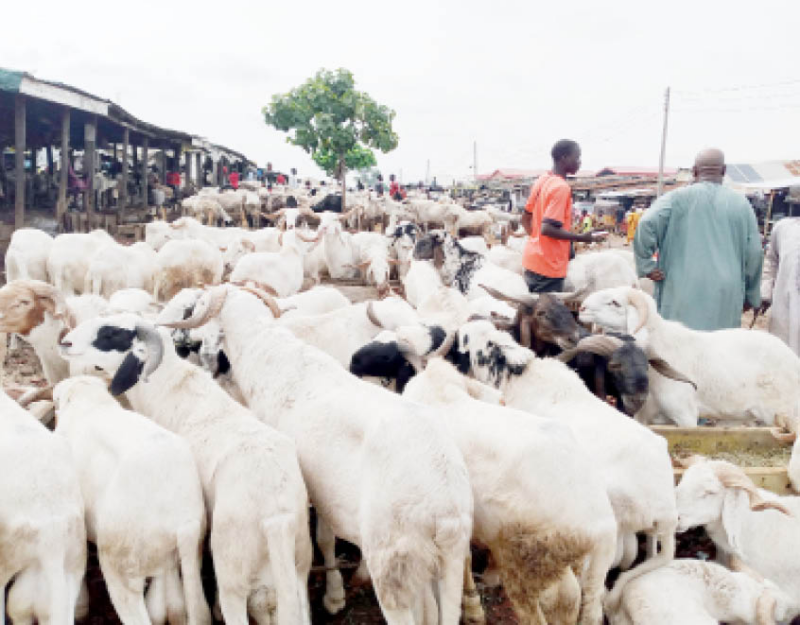
Livestock sellers face the same pressures, with the cost of transport, animal feed and insecurity along supply routes driving up the price of sacrificial animals. At the Orange Market in Abuja, livestock trader Musa Ibrahim described a somber scene. “Everything is expensive now – transportation, feeding, even the cost of bringing the animals from places like Kano and Sokoto. Last year people bought quickly, but this year many people just come to price and leave,” he said. The figures confirm his observation. According to a market survey by Nairametrics, small‑sized rams that were priced around N200,000 during the 2025 Sallah season now sell for between N230,000 and N250,000. Medium‑sized animals have jumped from about N200,000 last year to between N350,000 and N400,000 this year, while premium breeds can fetch as much as N1.5 million in Abuja.
The same trend is visible across the country. In Lagos, a livestock seller, Afeez Awal, who buys directly from northern Nigeria, told Vanguard that the price of a small goat had risen from N150,000 to between N200,000 and N300,000, while a large goat that once sold for N300,000 now commands up to N700,000. A cow that sold for N500,000‑N700,000 last season is now priced between N1.2 million and N1.5 million. In the Nyanya area of Abuja, roadside livestock seller Abdullahi observed that the same ram that went for around N700,000 a year ago is now approaching N1 million. At the Zuba Market, the cheapest ram available after bargaining as of May 24, 2026, still cost N275,000, while a fully grown male goat sold for about N120,000.
The economic strain is forcing families to make difficult choices. Yunus Akanji, an Islamic teacher in Abuja who usually travels with his family to Oyo State for Eid, told Al Jazeera that this year he would not travel at all, nor would he buy a ram. “I have concluded that we will just celebrate with whatever we have,” he said. A civil servant, Ibrahim Sani, noted that some households were now considering buying a ram jointly with neighbours or relatives. “People still want to perform the sacrifice because it is spiritually important, but the prices are becoming too high for average earners. Some families may have to contribute money together to buy one ram,” he said.
The causes of the price surge are manifold: persistent inflation, which rose to 15.69 percent in April 2026; high diesel costs that have made transporting animals from the north to the south prohibitively expensive; worsening insecurity along the key supply routes; and the rising price of animal feed, which has affected herders across the Sahel belt. Economist Dr Almarouf Ojelabi of the University of Abuja explained that when inflation persists at elevated levels, every sector becomes affected, including livestock. “Transportation, feeding, veterinary services and insecurity all contribute to higher market prices,” he said. Financial analyst Yusuf Ahmed added that the high cost of diesel, transportation and logistics was feeding directly into food and livestock prices, while insecurity in food‑producing and grazing areas was reducing supply and increasing risk for traders.
As the Sallah holiday approaches, the cumulative effect is a palpable shift in mood. Many families who used to celebrate with a full house, new clothes and a slaughtered ram are now scaling back. Some have abandoned the idea of travel altogether; others are turning to cheaper alternatives such as frozen chicken or turkey. In Lagos, a food items trader, Mrs Ruth Lawal, told Intel Region that the rising price of rice and cooking oil had made basic feeding difficult for average families. A farmer, Temitope Abel, said she had already given up on buying a ram this year. “With the cost of food items, I can’t buy anything again. I won’t be able to buy ram like I usually do. I will go for a carton of turkey which is a bit cheaper,” she told Vanguard.
Traders themselves are not immune to the hardship. Many report slower customer traffic, with buyers spending more time bargaining or simply walking away. At the Kubwa livestock market in Abuja, Malam Ibrahim, a livestock seller who has been in the trade for years, sat near the feed and watched most of his customers leave empty‑handed. “People come, ask for prices, and walk away,” he said. He pointed to a medium‑sized ram nearby, with black‑and‑white markings, and said it was selling for ₦600,000. “Last year, the same size was below ₦350,000.” If sales remain slow, he worries that the animals will stay unsold after Eid, when their value drops sharply. “We do not pray to take them back home, but with this situation, that might happen,” he lamented.
For millions of Nigerian Muslims, the 2026 Eid‑el‑Kabir will therefore be a festival of adaptation. Families are pooling resources, buying in groups or simply choosing to honour the sacrifice in spirit rather than in practice. Some are heeding the advice of Islamic scholars, who remind worshippers that the core of the celebration is not the size of the animal or the luxury of the feast, but gratitude, prayer and togetherness. Yet, the hollowed‑out markets and the empty hands of shoppers tell a different story: one of a country where even the most sacred traditions are being reshaped by the relentless pressure of economic hardship.
📩 Stone Reporters News | 🌍 stonereportersnews.com
✉️ info@stonereportersnews.com | 📘 Facebook: Stone Reporters News | 🐦 X (Twitter): @StoneReportNew | 📸 Instagram: @stonereportersnews
Add comment
Comments