

Reported by: Ijeoma G | Edited by: Oravbiere Osayomore Promise.
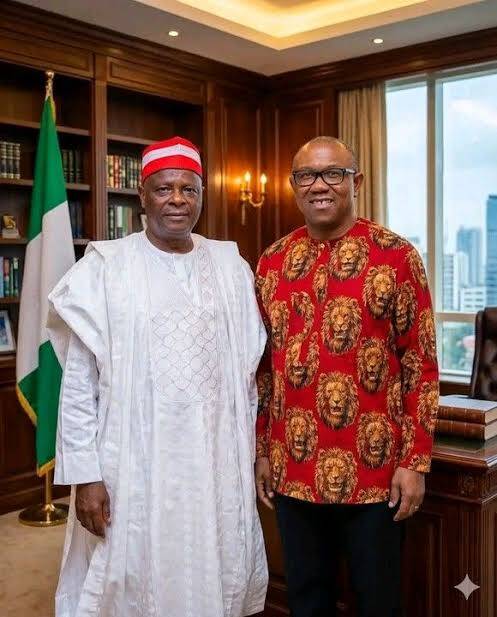
The presidential candidate of the Nigeria Democratic Congress (NDC), Peter Obi, has formally accepted the party’s ticket for the 2027 election, pledging to drastically reduce the cost of governance and eliminate corruption if elected president of Nigeria. Obi made the declaration on Saturday, May 30, 2026, during the NDC’s special national convention held at the Le Finesse Event Centre and Garden in Abuja, where he was formally ratified as the party’s flagbearer. The convention, which was witnessed by officials of the Independent National Electoral Commission (INEC), also saw Senator Victor Umeh move a motion for Obi’s ratification, seconded by former Deputy Senate President Ovie Omo‑Agege. Shortly after accepting the nomination, the former Anambra State governor announced former Kano State governor, Senator Rabiu Musa Kwankwaso, as his running mate, describing him as a trusted partner who would play a central role in governance rather than serving as a ceremonial deputy.
In his acceptance speech, Obi declared that the moment was a call to national renewal rather than a personal political achievement. “This pivotal moment transcends the individual ambitions of Peter Obi; it concerns the essence of our nation and the future of our children. It is about rekindling hope for millions who have faced adversity yet remain committed to Nigeria,” he told the jubilant crowd of party leaders, delegates, and supporters. He warned that Nigeria was standing at a dangerous crossroads, “enveloped in uncertainty”, with families anxious about their safety, parents concerned for their children’s futures, and talented youth increasingly questioning their prospects in their homeland. He lamented that businesses are struggling, communities are suffering, and an alarming number of citizens have lost faith in the very concept of governance. Despite the grim assessment, he insisted that national despair was not inevitable, repeatedly anchoring the phrase “A New Nigeria is Possible” as both a conviction and a political mission.
Central to Obi’s address was a sharp critique of public spending and governance inefficiency. He pledged that his administration would use its single four‑year term to tackle wastage in public spending through a deliberate reduction in the cost of governance. “We will drastically reduce the cost of governance and corruption. This waste must stop,” Obi said. He argued that public resources currently “wasted on luxuries” would be redirected to critical sectors of the economy, and that corruption could only reduce significantly if public officials and their families refrained from abusing public resources. Obi further pledged to uphold the rule of law, noting that his administration would end government interference in the judiciary and ensure that court judgments are based strictly on legal interpretation. He said respect for the rule of law is critical to attracting investment and restoring confidence in Nigeria’s institutions. Recalling his own experience as a sitting governor in Anambra, he told the gathering that he successfully challenged electoral and tenure disputes through the courts without influencing judges or offering bribes. “When the rule of law prevails, the country will work,” he added.
The NDC candidate also used the platform to accuse the current administration of suppressing opposition parties. He alleged that the NDC had encountered difficulties securing a venue for its convention after being turned down at several locations, and that opposition groups are being treated like criminals, harassed and intimidated. “Our government will not suppress the opposition. We will encourage them. We will make sure they exist because that is what democracy should be,” Obi promised. He stressed that his administration would protect political pluralism and create an environment where opposition parties can operate freely, arguing that democracy must truly reflect the will of the people. “It must be a government of the people, by the people and for the people. The people must be the ones determining what is happening,” he said.
On security, Obi highlighted Nigeria’s worsening global terrorism rankings, noting the country’s rise from eighth in 2022 to sixth in 2024 and fourth in 2026 among the nations most affected by terrorism. He contrasted this with Nigeria’s earlier reputation as a global peacekeeping leader, referencing the country’s role in missions across Africa and the Middle East, as well as the leadership of Nigerian officers in multinational operations. Obi lamented that citizens now live in trepidation and stressed that the primary responsibility of government is to ensure the safeguarding of lives and property. He pledged to implement an intelligence‑driven, technology‑enhanced and community‑focused security architecture that would also tackle the root causes of insecurity, including poverty, unemployment and marginalisation. In healthcare, he described Nigeria’s system as deeply broken, noting its global ranking of 157th and stating that only 10 to 20 per cent of the country’s estimated 30,000 primary healthcare centres are fully functional. He promised that his administration would increase health insurance coverage above 20 per cent, raise healthcare spending to at least 10 per cent of GDP from below 5 per cent, and ensure that at least half of the nation’s primary healthcare facilities are restored to full operation within four years.
Obi placed education at the centre of his vision for national revival, insisting that no country can grow beyond its educational system. He promised greater investment in schools, teachers, technology and vocational training, and said that Nigerian youths should be equipped not only to seek jobs but also to create employment opportunities through innovation and entrepreneurship. On electricity, he described Nigeria’s power situation as unacceptable, noting that about 100 million Nigerians lack access to electricity while the country generates and distributes only about 4,000 megawatts. He compared Nigeria’s output unfavourably with that of South Africa and Egypt, both of which generate more than 40,000 megawatts despite having significantly smaller populations, and pledged that his government would raise power generation and distribution to at least 10,000 megawatts within four years. He also dismissed the country’s official unemployment figure of four per cent, insisting that real unemployment and underemployment remain above 30 per cent while youth unemployment exceeds 40 per cent. Obi said his administration would aggressively tackle joblessness by supporting micro, small and medium enterprises through tax incentives, policy support and access to affordable credit, citing Indonesia as an example where small businesses account for over 90 per cent of employment because entrepreneurs can access loans at competitive interest rates.
Obi also addressed food security and agriculture, arguing that Nigeria has no business ranking among the world’s hungriest nations despite its vast agricultural potential. He lamented that the country produces less than 10 per cent of the rice output of countries such as India, Bangladesh and Vietnam despite having more land per capita. His administration, he said, would shift the country from consumption to production, and he declared that Nigeria should be exporting rice rather than relying on imports. “We can make more money from the vast land in the North than we make from oil,” Obi asserted. The convention ended with party leaders expressing confidence that the Obi–Kwankwaso ticket would offer Nigerians a credible alternative in the 2027 presidential election.
📩 Stone Reporters News | 🌍 stonereportersnews.com
✉️ info@stonereportersnews.com
📘 Facebook: Stone Reporters News
🐦 X (Twitter): @StoneReportNew
📸 Instagram: @stonereportersnews
Add comment
Comments