

Published by Oravbiere Osayomore Promise.
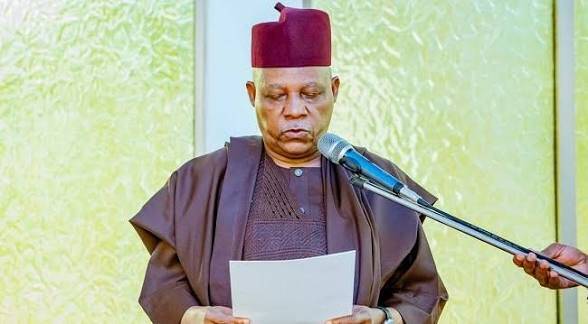
The Federal Government of Nigeria and the World Intellectual Property Organisation (WIPO) have agreed to significantly deepen their collaboration to turn the nation’s intellectual property into tangible financial assets, with Vice President Kashim Shettima declaring that the future belongs to nations which understand the dignity of the mind and the economy of ideas.
The commitment was made on Monday, 1 June 2026, during a high-level meeting at the Presidential Villa in Abuja. The delegation was led by Vice President Kashim Shettima and WIPO Director-General Daren Tang, with key government officials, including ministers, also in attendance.
The agreement focuses on commercialising research outputs from Nigerian universities, supporting the country’s burgeoning creative economy, strengthening technical cooperation, expanding capacity-building across key sectors, and providing deeper institutional support for intellectual property (IP) development. Shettima, in a statement issued by his spokesman, Stanley Nkwocha, noted that the administration of President Bola Ahmed Tinubu is laying the foundation for an economy where ideas, innovation, and creativity are not just protected but translated into wealth.
The Vice President drew the delegation’s attention to Nigeria’s unmistakable ambition to build an “intellectual property system that serves the inventor and the investor, the researcher and the entrepreneur, the artiste and the industrialist, the farmer and the software engineer”. He also welcomed WIPO’s decision to open its first office in Abuja, which he described as the first in Sub-Saharan Africa and one of only seven worldwide.
Shettima recalled that the Federal Executive Council, in November 2025, had approved the National Intellectual Property Policy and Strategy (NIPPS). This provides Nigeria with its first comprehensive framework for the development, protection, promotion, management, and commercialisation of intellectual property. “As we deepen our collaboration with WIPO, we do so with gratitude and with great expectation,” the Vice President said. “We look forward to stronger technical cooperation, deeper institutional support, expanded capacity-building, and practical pathways for the commercialisation of Nigerian creativity and research.”
He said the Tinubu administration is building an economy where investors will feel satisfied that innovation is protected, disputes are resolved with confidence, and intellectual assets can be converted into wealth. Shettima described the Renewed Hope Agenda as being anchored in unlocking productivity, expanding economic opportunities, attracting investment, creating jobs, and positioning Nigeria for long-term prosperity.
The Vice President noted that value in today’s economy is increasingly created through ideas, technology, innovation, data, brands, culture, and knowledge. “The countries that will lead this century are those able to create, protect, commercialise, and scale intellectual assets,” he asserted. He reiterated Nigeria’s commitment to innovation diplomacy and to WIPO’s mission of creating a balanced international system.
Shettima also directed the Ministers of Justice, Industry, Trade and Investment, and Art, Culture, Tourism and the Creative Economy to work out a roadmap for a robust engagement with WIPO. For his part, WIPO Director-General Daren Tang, who was visiting Nigeria for the first time, assured that his organisation remains committed to being part of Nigeria’s growth and prosperity. He stressed that his visit was based on two milestones: the opening of the first WIPO office in Abuja and the launch of the NIPPS. Tang revealed that over 3,000 Nigerian startups, including seven unicorns, are attracting significant investment, underscoring the growing role of intellectual property in emerging economies.
In separate remarks, other key ministers present at the meeting lent their support to the initiative. Attorney-General of the Federation and Minister of Justice, Lateef Fagbemi, said the collaboration would strengthen Nigeria’s legal and institutional framework. He added that a robust intellectual property system would enhance technology transfer and position Nigeria as a leading IP hub in Africa. Minister of Art, Culture, Tourism and the Creative Economy, Hannatu Musa Musawa, said the government is leveraging the sector to create jobs and drive economic growth. Minister of Industry, Trade and Investment, Jumoke Oduwole, noted that the establishment of the Abuja office reinforces Nigeria’s commitment to innovation-led development.
The strengthened partnership signals a strategic push by Nigeria to harness its creativity, research, and innovation as drivers of economic transformation and global competitiveness.
📩 Stone Reporters News | 🌍 stonereportersnews.com
✉️ info@stonereportersnews.com
📘 Facebook: Stone Reporters News
🐦 X (Twitter): @StoneReportNew
📸 Instagram: @stonereportersnews
Add comment
Comments