

Reported by: Ijeoma G | Edited by: Oravbiere Osayomore Promise.
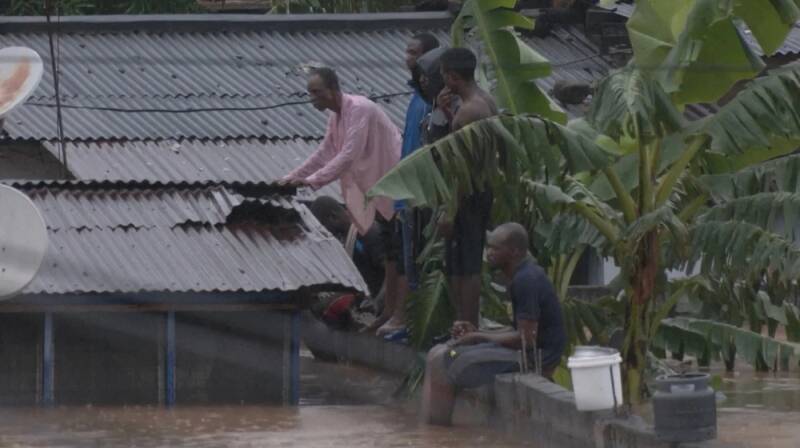
Torrential rains that began late on Sunday, June 28, 2026, and continued through Monday morning unleashed catastrophic flooding across Ghana's capital, Accra, killing at least three people and paralyzing the city of more than five million. The rains, described by President John Dramani Mahama as among the highest in several years, transformed the bustling metropolis into a landscape of submerged roads, stranded vehicles, and flooded homes.
In the low-lying Alajo district, the tragedy was particularly devastating. Three victims died when floodwaters surged into their homes and came into contact with electrical installations, leading to fatal electrocution. Personnel from the National Disaster Management Organisation (NADMO) recovered the bodies, which were conveyed to the Maamobi Polyclinic. There were unconfirmed reports of a fourth fatality.
The flooding was widespread and severe. Major arteries, including the N1 Highway, the Accra-Kasoa stretch at Weija, and the Kwame Nkrumah Interchange, were submerged, causing major traffic delays and leaving thousands of commuters stranded. In the eastern suburb of Tse Addo, emergency responders and volunteers used boats to rescue at least 15 children and an infant.
The Ghana National Fire Service (GNFS) reported rescuing or safely evacuating 479 people across Accra, Tema, and neighbouring communities. However, the scale of the disaster also led to other emergencies, including multiple fire outbreaks and a building collapse. The Ghana Grid Company (GRIDCo) and the Electricity Company of Ghana (ECG) temporarily shut down power substations in Mallam and Achimota after floodwaters affected the facilities, a precautionary measure to prevent further electrocutions.
Beyond the tragic loss of life, the floods inflicted immense hardship on residents and businesses. Retired journalist Philip Mensah, 67, told AFP his "1970s collection of vinyl records is now underwater". Schoolteacher Patience Naa Adjeley Adjei described her ordeal: "I have mopped my room more than eight times. I can't even step out because my room is flooded, and outside is flooded". The Ghana School of Law postponed its examinations scheduled for Monday.
President Mahama, after conducting an aerial tour of the affected areas, attributed the disaster to a confluence of factors: climate change, unchecked urbanisation, and human behaviour. He noted that about 140 millimetres of rain fell on Accra in a single day, compared to a peak of 56 millimetres recorded last year. "That aspect of the problem is beyond our control because it is driven by changing climatic conditions," he said.
Data from the Ghana Meteorological Agency shows a steady increase in rainfall intensity, with June totals rising from 85 millimetres in 2024, to 172 millimetres in 2025, and 333 millimetres in 2026. Mahama warned that Accra's drainage systems are overwhelmed. "This means that our waterways no longer have sufficient time to recover before more rain falls," he stated.
However, he also pointed to "engineering and human factors". Accra's geography, lying between the Akwapim mountain range and the Atlantic Ocean, has been severely compromised by unplanned development that has blocked the city's natural waterways. "Whenever government begins removing structures built in waterways, some people accuse us of being inhumane," Mahama lamented. "Yet when disasters such as today's flooding occur, the consequences affect everyone".
In response to the crisis, President Mahama ordered a coordinated crackdown on drainage blockages and announced emergency relief funding from the Contingency Fund. He directed Metropolitan, Municipal, and District Assemblies to identify and remove all obstructions in drainage channels. He also stressed the need for long-term structural reforms, including a plan to decongest Accra by developing a new growth centre outside the city.
For the people of Accra, Monday's floods are not an isolated incident but a grim reminder of a pattern that has persisted for over a decade. The city has experienced major floods in 2010, 2015, 2016, 2022, 2023, 2025, and 2026. The deadliest occurred on June 3, 2015, when floodwaters mixed with leaking fuel, triggering an explosion that killed more than 200 people.
As the floodwaters recede, the question remains whether this latest disaster will finally galvanise the political will and collective action needed to break Accra's cycle of devastation. For now, the city mourns its dead and begins the arduous task of recovery, acutely aware that the next storm could be just days away.
📩 Stone Reporters News | 🌍 stonereportersnews.com
✉️ info@stonereportersnews.com | 📘 Facebook: Stone Reporters News | 🐦 X (Twitter): @StoneReportNew | 📸 Instagram: @stonereportersnews
Add comment
Comments