

Reported by: Ijeoma G | Edited by: Oravbiere Osayomore Promise.
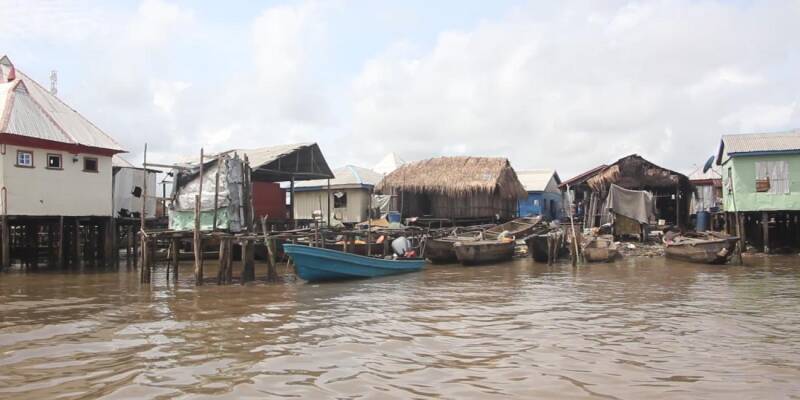
According to an investigation conducted by Sahara Reporters, across more than ten affected communities, including Awoye, Mese, Odofado, Opakaba, Ikuyimino, Nati, Anehin, Ogbeyangban, Akinsolu, Jinrinwo, Gbagira, and Molutehin, the signs of destruction are impossible to miss. Thousands of homes have either been destroyed or abandoned. Entire families have been forced to relocate. Livelihoods built around fishing and trading have been disrupted. Residents said more than 70 per cent of Odofado community has already been consumed by the sea, while Gbagira and Meseh have virtually disappeared beneath advancing waters. Several communities have already gone extinct, and displaced residents continue moving from one threatened settlement to another in search of safety.
In Molutehin community, the crisis is especially visible. Pregnant women, nursing mothers, and children now sleep inside churches after losing their homes to ocean incursions. One displaced resident, identified simply as Ife, spoke emotionally about the hardship confronting residents. “Malokun has taken over our community. We have nowhere to sleep except the church. Both in the morning and at night, we stay inside the church. If we want to cook, we do it in the church,” she said. “We do not have a health centre. As a pregnant woman, there are no drugs for us and nowhere to receive antenatal care. We do not have clean water to drink, cook, or wash with. The only water available is salty and dirty. Whenever children drink the water, they often become sick. I am tired of this situation.”
In Awoye community, the reporter encountered dozens of displaced residents crowded inside a church building, including nursing mothers, children, and elderly persons who said they had nowhere else to go. One resident, Omomoro, lamented: “We are tired of everything. We have nowhere to sleep. Sea incursion has disrupted our lives economically and socially. The water has taken away all our belongings. We are begging the government to come to our rescue.” A nursing mother carrying newborn twins added: “My babies do not have clean water to drink or bathe with.”
Residents who spoke with this reporter blamed years of environmental degradation, coastal erosion, and dredging activities they alleged were linked to Chevron's oil operations for worsening the crisis. They said the destruction of natural barriers that once shielded their communities from the Atlantic Ocean has left entire settlements exposed to devastating sea incursions.
A foremost leader from Awoye community, Prince Philemon Ebiesuwa, said the environmental disaster has reached alarming levels. Standing beside a widening canal that residents say was dredged during oil exploration activities, he warned that entire communities could soon disappear. “This canal you can see here is the Njeriwo Canal, which leads directly into the Atlantic Ocean. The situation poses an imminent danger to this community. If urgent action is not taken, Njeriwo could be wiped off the map,” he said. “When you look out toward the Atlantic Ocean, you can see oil wells, rigs and other petroleum facilities in the distance. These are oil-producing communities, yet residents say they have not benefited adequately from the resources extracted from their land.”
Ebiesuwa linked the worsening erosion to decades of oil exploration by Chevron, which fundamentally altered the area's ecosystem. “What is now part of the Atlantic Ocean was once a creek that connected communities such as Meseh, Awoye, Ikuyimino and Molutehin. This body of water was once the site of a Chevron wellhead. The area was dredged and connected to the Atlantic Ocean. Saltwater subsequently entered the freshwater ecosystem, destroying economic trees such as mahogany and abura. After oil exploration activities ended and the well was abandoned, the canal continued to widen over time, leading to extensive erosion and the destruction of nearby communities.”
The anger and frustration directed at Chevron are rooted in decades-old grievances. In 1998, members of the Ilaje ethnic group staged a protest at a Chevron offshore oil platform, accusing the company of causing environmental and economic devastation through its oil-producing activities. The protesters arrived in small boats and carried out what witnesses described as a peaceful occupation of the platform. They were unarmed, and no oil workers were harmed. Armed Nigerian Navy personnel remained stationed at the facility throughout the protest.
According to reports, an internal Chevron memo sent the day after the occupation began acknowledged that the protesters “have thus far been peaceful.” However, residents and activists allege that the situation changed dramatically after Chevron reportedly invited Nigerian security operatives to intervene. The following morning, soldiers and police officers allegedly transported in Chevron helicopters arrived at the platform and opened fire on the protesters. Autopsy reports indicated that two protesters were killed — one shot four times in the back, another shot three times in the side. Several others were arrested, while some allegedly suffered torture. Chevron later reportedly acknowledged that the military personnel involved were “closely supervised by” company security personnel.
The Baale of Molutehin, Chief Amapopomi Nomiye, described how repeated sea incursions have forced multiple relocations. “This is the fifth location to which we have relocated after some of our ancestral lands were swallowed by sea incursions caused by Chevron's activities. Our people have become refugees in their own community,” he said. “We are appealing to Governor Lucky Orimisan Aiyedatiwa, who is from Ilaje, and President Bola Ahmed Tinubu to help us. Our old men and women have nowhere to sleep. They are sleeping inside the church. We cannot eat or drink properly.”
A traditional chief from Meseh community, Chief Engr. Isreal Ilumobayo, the Baale of Meseh, described repeated displacement caused by advancing ocean waters. “This is the third place we have moved to. The first and second settlements have already been swallowed by the sea. If we lose this place, we have nowhere else to go. Where we previously lived, more than five housing clusters have been completely washed away. The affected people have become refugees. Their livelihoods have been destroyed. We have nothing left because of the activities associated with oil exploration in our area.”
Failed Promises and Silence from Authorities
In April 2025, the Ondo State Oil Producing Areas Development Commission (OSOPADEC) assured residents that access to clean and sustainable water would soon become a reality. During an inspection tour of projects including the ₦1.7 billion 1,000-metre concrete walkway in Obe-Nla and the Molutehin Mini Water Scheme, OSOPADEC Chairman Prince Biyi Poroye declared: “Access to clean water is not a luxury; it is a right.” The water scheme, then reportedly 85 per cent completed, was designed to produce 20,000 gallons of potable water daily through reverse osmosis technology. However, residents told investigators that the project remains unfinished, and they still depend largely on unsafe water sources.
When the journalist contacted the spokesperson for OSOPADEC, the Director of Media and Corporate Affairs, Mr. Godson Ewata, said he was not authorised to speak and would need approval from his superiors. When asked, “Are you not Mr. Godson Ewata, the spokesperson?” he replied: “Yes, I'm the spokesperson and the Public Relations Officer of the commission. The commission is a bureaucratic setting; it is a civil service commission and it operates with laws, regulations and rules.” A day later, when the journalist called him again, he refused to pick up the calls and did not respond to the message sent to him.
Efforts to obtain a response from Chevron were also unsuccessful. Laura Hurst, External Affairs Advisor for Africa and Latin America, Corporate Affairs, Chevron International Exploration and Production Company, acknowledged the journalist's message but said her colleagues were in a better position to respond. However, none of them responded. In her message, she said: “Thank you for your message. I'm connecting you to my colleagues in Lagos, who may be able to help. Apologies, I copied my colleague in the message, so I'm not sure why it's not showing up. It's Victor Anyaegbudike.”
From Awoye to Molutehin, from Odofado to the now-vanished Mese settlement, residents painted a consistent picture of environmental devastation, displacement, and neglect. Across the affected communities, churches have become refugee camps. Pregnant women sleep on church floors. Children drink salty water. Fishermen watch their homes disappear into the sea while oil installations continue to operate offshore.
Community leaders insist that unless urgent shoreline protection measures, environmental remediation, healthcare interventions, potable water projects, and resettlement support are implemented, several more Ilaje communities could soon be wiped off the map. For the people of Ilaje, the crisis is no longer a future threat. It is a disaster already unfolding before their eyes.
📩 Stone Reporters News | 🌍 stonereportersnews.com
✉️ info@stonereportersnews.com | 📘 Facebook: Stone Reporters News | 🐦 X (Twitter): @StoneReportNew | 📸 Instagram: @stonereportersnews
Add comment
Comments