

Reported by: Oahimire Omone Precious | Edited by: Oravbiere Osayomore Promise.
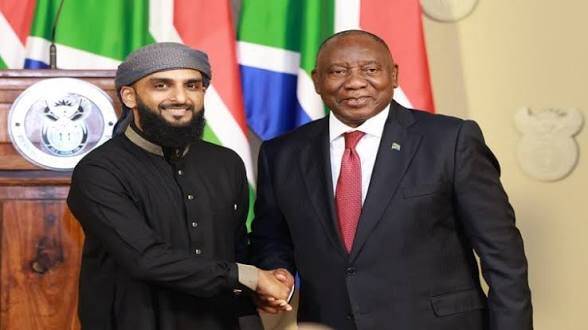
South African President Cyril Ramaphosa has come under intense fire after appointing Yusuf Cassim, a politician of Indian heritage, as the country's new Deputy Minister of Higher Education, a decision that has sparked a wave of xenophobic and anti-immigrant outrage, with critics labelling the born-and-bred South African a "foreigner" and even a "terrorist" in a coordinated social media disinformation campaign.
The appointment, announced on June 30, 2026, and confirmed by the Presidency on July 1, forms part of a broader Government of National Unity (GNU) cabinet reshuffle following restructuring demands from the Democratic Alliance (DA). Cassim, 36, a fourth-generation South African of Indian descent who was born and raised in Uitenhage (Kariega) in the Eastern Cape, has been a prominent DA figure, serving as the party's Federal Leader of its student organisation and as Eastern Cape provincial chairperson.
Despite his deep South African roots and long record of public service, which includes serving as the DA's youngest Member of Parliament at just 22 years old, Cassim's heritage was immediately weaponised by nationalist factions and right-wing internet groups. Within hours of the announcement, he became the target of a wave of vitriolic online attacks, with critics falsely labelling him a "foreigner" and a "terrorist." The baseless accusations, amplified by individuals seeking to exploit the country's ongoing anti-immigrant protests, have drawn widespread condemnation from civil society organizations, political leaders, and ordinary South Africans.
The backlash has been particularly fierce, with over 3,000 comments on the Presidency's official X post, most of which were Islamophobic and anti-migrant in nature. Critics have branded Ramaphosa a "visionless president" for appointing Cassim at a time when anti-foreigner sentiment is at a boiling point in the country. The appointment comes amid volatile anti-immigrant protests and rising xenophobic tensions sweeping South Africa. The high-stakes appointment has been weaponised on social media by nationalist factions using the broader context of local anti-foreigner sentiment to incorrectly label Cassim as an outsider.
The reshuffle also saw other notable changes, including the appointment of John Steenhuisen as Deputy Minister of Trade, Industry and Competition, and the controversial return of former minister Dina Pule as Minister of Social Development, a move that has also drawn sharp criticism. Pule's return has been slammed by opposition parties, with ActionSA stating that her appointment "proves that the office of deputy minister exists to cushion the fall of disgraced former ministers rather than serve the public."
Despite the social media noise, Cassim has maintained that his focus remains entirely on operational reform, stating that his primary goal is to advocate for underprivileged students and stabilise a critical government sector. In his first interview after his appointment, Cassim said he had no intention of becoming a ceremonial figure in one of the government's most troubled portfolios, warning that he would not remain silent if he was prevented from making a meaningful impact.
"I made it very, very clear that I'm not interested in going into this position in order to go around and cut ribbons and perform ceremonial roles that make no impact on the communities that I have pledged to serve," Cassim told Sunday Times. His appointment places him alongside higher education minister Buti Manamela in a department battling governance failures at the National Student Financial Aid Scheme (NSFAS), persistent corruption allegations involving Sector Education and Training Authorities (Setas), and growing concern that South Africa's skills pipeline is failing to meet the demands of a changing economy.
Supporters of the newly appointed deputy minister have decried the attacks as xenophobic, racially charged, and deeply unpatriotic, pointing to Cassim's long-standing record of public service and his unwavering commitment to youth education and skills development. Many have taken to social media to highlight his academic credentials, his years of dedicated parliamentary work, and his grassroots activism on behalf of students from disadvantaged backgrounds.
"Yusuf Cassim is a South African patriot who has served this country with distinction for over a decade," said one prominent commentator. "These attacks are not just an assault on one individual—they are an assault on the values of our Constitution and the vision of a united, non-racial South Africa."
Political analysts have suggested that using Cassim's heritage to stoke anti-immigrant rhetoric highlights how easily legitimate public anxieties over immigration and local economic stagnation can be manipulated. Cassim, who first rose to prominence in local politics as the Student Representative Council (SRC) President at Nelson Mandela University in Gqeberha, has a long history of fighting for student access and success.
The Department of Higher Education, which faces pressing challenges including student funding shortages, university infrastructure backlogs, and the youth unemployment crisis, will require all of Cassim's energy and political acumen. For now, the appointment stands as a testament to the GNU's commitment to inclusivity and meritocracy—even as the online noise threatens to overshadow the substantive work that lies ahead.
📩 Stone Reporters News | 🌍 stonereportersnews.com
✉️ info@stonereportersnews.com | 📘 Facebook: Stone Reporters News | 🐦 X (Twitter): @StoneReportNew | 📸 Instagram: @stonereportersnews
Add comment
Comments