

Reported by: Oahimire Omone Precious | Edited by: Oravbiere Osayomore Promise.
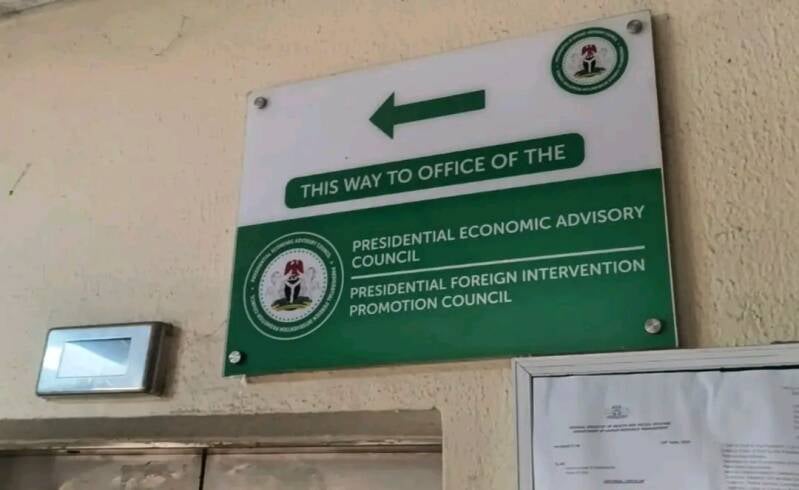
The controversy surrounding the purported Presidential Foreign Intervention Promotion Council (PFIPC) has taken a fresh and embarrassing turn, as a physical signage directing visitors to the council's office remains mounted at the Federal Secretariat Complex in Abuja, weeks after the Presidency publicly disowned the agency as non-existent and dismissed its self-styled Director-General as a fraudster. A visit to the Federal Secretariat on Monday, 6 July 2026, confirmed that the directional sign, painted in white and green and bearing the Nigerian Coat of Arms, is still prominently displayed on the floor housing the Federal Ministry of Health, pointing visitors to the office of the controversial council. The inscription on the signage reads: "This way to office of the Presidential Economic Advisory Council, Presidential Foreign Intervention Promotion Council". The discovery comes a week after the Presidency, through the Special Adviser on Information and Strategy, Bayo Onanuga, distanced itself from the PFIPC following explosive allegations made by the council's purported Executive Secretary, Prince Adeniyi Adeyemi Matthew.
The persistence of the signage raises fundamental questions about the government's claims that the agency never existed and that Adeyemi operated a fraudulent, fictitious body entirely on his own. How could a single individual secure office space at the Federal Secretariat, obtain official stationery, host meetings, and project himself as a recognised government institution without any internal collaboration or institutional oversight? The physical evidence of the signage directly contradicts the Presidency's narrative and suggests that the PFIPC, whether legitimate or not, enjoyed a level of official recognition that enabled it to function for months without detection.
The scandal erupted when Adeyemi accused the Chief of Staff to the President, Femi Gbajabiamila, of allegedly demanding 48 per cent of the council's take-off grant, which he claimed amounted to N27.4 billion. He also alleged that Gbajabiamila received N400 million through a proxy to facilitate his appointment as Executive Secretary, with an outstanding balance of N200 million still unpaid. Following the allegations, the Presidency denied the existence of the PFIPC, describing Adeyemi as an "irredeemable con artist" attempting to drag Gbajabiamila into his criminal enterprise. However, in its rebuttal, the Presidency failed to explain how the name of this supposedly "non-existent" agency appeared in official government records, received a budgetary allocation approved by the National Assembly, and was ultimately assented to by President Bola Tinubu.
Documents from the 2026 Appropriation Act indicate that the Presidential Foreign Intervention Promotion Council received a budgetary allocation of N1,302,978,784, which was signed into law by President Tinubu. The allocation included recurrent expenditure of N1,002,978,784 and capital expenditure of N300,000,000, covering salaries, allowances, logistics for a World Investment Summit, and strategic investment negotiations. The supposedly non-existent agency had also operated from a physical office space at the Federal Secretariat and maintained a Treasury Single Account with the Central Bank of Nigeria. Adeyemi has questioned how a supposedly non-existent agency found its way into official government documentation, obtained both a domiciliary account and a Treasury Single Account at the Central Bank of Nigeria, and eventually received a budgetary allocation approved by the National Assembly and signed into law by President Tinubu.
The controversy has drawn widespread condemnation from civil society organisations, opposition figures, and political groups. The Socio-Economic Rights and Accountability Project (SERAP) has demanded certified documents relating to the approval of the N1.3 billion allocation, including records of committee proceedings and details of officials who defended the proposal before lawmakers. Former Vice President Atiku Abubakar has criticised the Federal Government over the controversy, urging President Tinubu to order an independent investigation and identify those responsible for creating and funding the alleged agency. The Nigeria Democratic Congress (NDC) has asked President Tinubu to suspend Gbajabiamila to allow for an impartial investigation, while the Committee for the Defence of Human Rights (CDHR) has called on Gbajabiamila to temporarily step aside while an independent probe is conducted.
The Senate is also expected to deliberate on the controversy when lawmakers reconvene for plenary on Tuesday, amid fresh revelations over how the body reportedly gained official recognition within government circles. According to sources, the controversial N1.3 billion allocation was inserted into the 2026 Appropriation Act without representatives of the council appearing before the Senate Committee on Establishment and Public Service to defend its budget proposal, a National Assembly insider alleging that the provision was included alongside other submissions originating from the Presidency, thereby avoiding the normal budget defence process. The allocation of office space at the Federal Secretariat allegedly gave the council credibility, enabling it to operate with official stationery, host meetings and project itself as a recognised government institution.
As the signage to the PFIPC office continues to greet visitors to the Federal Secretariat, the lingering physical evidence serves as a stark reminder of the institutional failures that allowed a "non-existent" agency to secure a N1.3 billion budget allocation, open accounts with the Central Bank, and operate from government premises for months. The presence of the sign, weeks after the Presidency's denial, underscores the urgent need for a thorough and transparent investigation into how this phantom agency penetrated the heart of Nigeria's administrative machinery. For the Nigerian public, the PFIPC saga has become a symbol of the deep-seated accountability and transparency challenges that continue to plague the country's governance architecture—a scandal that refuses to fade, even as the government insists the agency never existed.
📩 Stone Reporters News | 🌍 stonereportersnews.com
✉️ info@stonereportersnews.com | 📘 Facebook: Stone Reporters News | 🐦 X (Twitter): @StoneReportNew | 📸 Instagram: @stonereportersnews
Add comment
Comments