

Reported by: Oahimire Omone Precious | Edited by: Oravbiere Osayomore Promise.
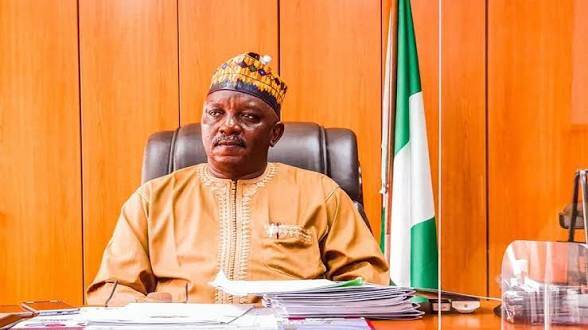
In a memo released today by the EFCC, the Federal High Court in Abuja has ordered the forfeiture of five additional properties linked to convicted former Minister of Power, Saleh Mamman, who is currently serving a 75-year prison term for corruption and money laundering. Justice James Omotosho, who presided over the case, issued the ruling on Thursday, 2 July 2026, while considering an application filed by the Economic and Financial Crimes Commission (EFCC) seeking the permanent forfeiture of assets allegedly acquired through proceeds of unlawful activities.
The properties affected by the forfeiture order include Walijam Apartments, located at No. 43 Plot 435, Lobito Crescent, Wuse 2, Abuja; Bloom Luxury Suites Nigeria Limited, situated at No. 5 Amana Crescent, New Estate, Unguwan Rimi, Kaduna State; two mansions on Misratah Street, Wuse 2, Abuja, at Nos. 11 and 13; and A.U.A Plaza, located at Plot 734 Kade Street, Wuse 2, Abuja.
Delivering his ruling, Justice Omotosho ordered the permanent forfeiture of Walijam Apartments, holding that the EFCC had established during the criminal trial that Mamman acquired the property using unlawfully obtained funds. However, the judge ordered only interim forfeiture of the remaining four properties, ruling that the commission had not sufficiently established that Mamman, who is currently serving his prison term, owned or held interest in them. He directed the EFCC to publish the interim forfeiture order in a national newspaper within seven days, giving interested parties the opportunity to appear before the court to show cause why the four properties should not be permanently forfeited to the Federal Government.
Justice Omotosho rejected an argument by Mamman's lawyer, Femi Atteh, SAN, that the court had become functus officio—meaning it no longer had jurisdiction—after sentencing the former minister following his conviction. The judge held that Section 321 of the Administration of Criminal Justice Act, 2015, empowers courts to issue restitution orders even after conviction. EFCC lawyer Abba Mohammed, arguing the motion, stated that although judgment had already been delivered and Mamman convicted, the court remained empowered to hear the forfeiture application. He noted that the judgment found that the convict diverted N22 billion, rather than the N33.8 billion originally alleged in the charges, and that of that amount, the EFCC had so far recovered less than N2 billion following an earlier forfeiture order.
The EFCC had prosecuted Mamman on an amended 12-count charge bordering on money laundering and acquisition of properties worth billions of naira outside the financial system, involving over N33.8 billion. The charges were linked to the diversion of funds meant for the Mambilla and Zungeru Hydroelectric Power Projects, two major infrastructure initiatives undertaken during his tenure as Minister of Power under former President Muhammadu Buhari. Justice Omotosho convicted him on all counts on 7 May 2026 and sentenced him in absentia to a total of 75 years imprisonment on 13 May 2026. The court sentenced the former minister to seven years' imprisonment on 10 counts, while counts four and five attracted sentences of three years and two years, respectively.
Following his conviction and sentencing, Mamman went into hiding, fleeing Abuja for Kaduna State, where he was eventually arrested by EFCC operatives on 19 May 2026 in the Rigasa area of Kaduna. According to court testimony, Mamman had travelled from Abuja to Kaduna by taxi shortly after his conviction and had been receiving traditional medical treatment while hiding. A relative, Shamsudeen Mohammed, who was found with him at the time of his arrest, told the court that Mamman had been brought to Kaduna by a taxi and that he had been helping him take traditional medicine. The EFCC subsequently transferred Mamman to the Kuje Correctional Centre to begin his sentence, following an order by Justice Omotosho.
In the judgment delivered in the criminal case, Justice Omotosho had ordered the final forfeiture of properties located in prime areas of Abuja, along with funds recovered in various currencies during the EFCC's investigation. The latest forfeiture order represents a significant expansion of the asset recovery effort, targeting five additional properties that the EFCC alleged were acquired with proceeds of unlawful activities. The properties, which include commercial and residential assets in Abuja and Kaduna, were identified during the commission's ongoing investigation into Mamman's financial dealings.
The case has drawn attention to Nigeria's efforts to recover assets stolen through corruption and to hold public officials accountable for the misappropriation of public funds. The EFCC has described the recovery of assets linked to Mamman as part of its broader mandate to combat corruption and ensure that crime does not pay. The commission has reiterated its commitment to pursuing all avenues to recover proceeds of crime and to bring perpetrators to justice. As the interim forfeiture order is published and interested parties given the opportunity to challenge the forfeiture, the legal battle over Mamman's assets is likely to continue. However, the ruling represents a significant victory for the EFCC in its ongoing efforts to recover public funds and demonstrate that corruption carries severe consequences, both in terms of imprisonment and the loss of ill-gotten wealth.
📩 Stone Reporters News | 🌍 stonereportersnews.com
✉️ info@stonereportersnews.com | 📘 Facebook: Stone Reporters News | 🐦 X (Twitter): @StoneReportNew | 📸 Instagram: @stonereportersnews
Add comment
Comments