

Reported by: Ijeoma G | Edited by: Oravbiere Osayomore Promise.
The National Agency for the Prohibition of Trafficking in Persons (NAPTIP) has issued a stern warning to secondary school students in Ogun State, cautioning them against the rising threat of human trafficking through social media platforms, where traffickers are increasingly using deceptive tactics such as fake job offers, promises of greener pastures abroad, romance scams, and blackmail to recruit young victims for forced labour, sexual exploitation, and organ harvesting.
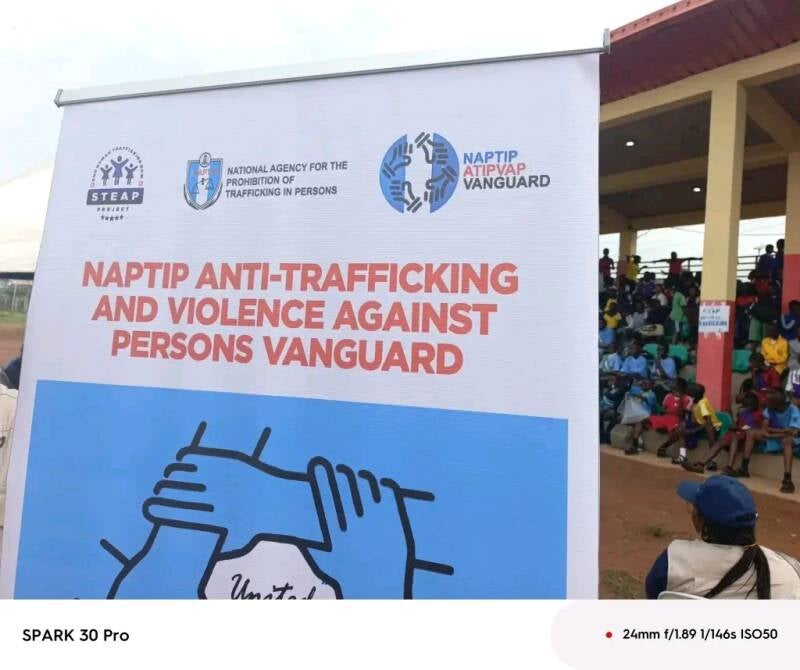
The warning was delivered by the Ogun State Commander of NAPTIP, Mrs Bosede Jimoh, during a sensitisation event at Adeola Odutola College in Ijebu-Ode, part of the Schools Anti-Trafficking Education and Advocacy Project (STEAP) implemented in partnership with the International Centre for Migration Policy Development (ICMPD) and funded by the Government of the Netherlands. The initiative aims to create safe learning environments by empowering students to educate their peers on the dangers of human trafficking and other forms of violence.
Jimoh warned students against falling victim to traffickers through fake job offers, promises of greener pastures abroad, and other deceptive recruitment tactics. According to her, traffickers exploit vulnerable persons for commercial sexual exploitation, organ harvesting, debt bondage, child labour, and sextortion through social media platforms. She noted that traffickers are now using sophisticated digital tactics, including posing as friends online or offering false opportunities such as employment, sports scholarships, and romantic relationships to build trust before exploiting their victims.
A growing concern noted by the agency is the rise of "sextortion," where criminals coerce victims into sharing intimate images only to use those materials for blackmail and financial gain. NAPTIP officials stressed that human trafficking involves the recruitment and exploitation of individuals through coercion, fraud, or deception. They encouraged students to remain vigilant, particularly when interacting with strangers online, and warned against the life-threatening risks associated with illegal migration attempts, which often involve hazardous travel across the Sahara Desert and the Mediterranean Sea.
The warning comes as NAPTIP intensifies its campaign to protect secondary school students in Ogun State, where over 40,000 students across 32 selected secondary schools have so far been sensitised on the dangers of human trafficking. The initiative, which targets 50 selected schools in Ogun State, is also being implemented in Edo, Benue, Enugu, and Delta States. The first phase of the project ran from March to May 2025, covering 10 schools and reaching about 21,000 learners. The second phase took place in February 2026, covering 11 schools and reaching more than 13,000 learners. The third phase, currently being implemented, covers 11 additional schools, bringing the total number of students reached to over 40,000.
As part of the campaign, 30 students from each of the 32 schools visited so far have been inducted into Anti-Trafficking and Violence Against Persons Vanguard Clubs, bringing the total number of Vanguard members across the schools to nearly 1,000 students. The clubs were established to create safe learning environments by empowering students to educate their peers on the dangers of human trafficking and other forms of violence. The students were presented with T-shirts, school bags, and other educational materials. The project also extends beyond student sensitisation to strengthen the education system through teacher capacity building and infrastructure development. In May 2026, 150 teachers—three teachers from each of the 50 schools—were trained on how to effectively teach the newly introduced anti-human trafficking content in their respective subjects, following the integration of human trafficking education into the national curriculum through the collaboration of ICMPD, NAPTIP, and the Nigerian Educational Research and Development Council.
Jimoh stated that the inauguration of the Vanguard Club in the third phase brings the number of inaugurated clubs to 32, with nearly 1,000 student members serving as peer educators against human trafficking while over 40,000 learners across the state have also been sensitised on the dangers of human trafficking. She explained that the clubs were established to create safe learning environments by empowering students to educate their peers on the dangers of human trafficking and other forms of violence.
The NAPTIP commander credited the federal government and inter-agency collaboration with the Police, NSCDC, DSS, and Immigration for enabling swift responses to trafficking cases. She also confirmed that NAPTIP provides rescued victims with counselling, empowerment, and educational support, with some survivors even joining the agency's workforce. Stakeholders, including school administrators and state officials, continue to emphasise that a collaborative approach between government agencies, educators, and parents is essential to safeguarding children from criminal exploitation.
Jimoh reiterated that the agency would leave no stone unturned to win the war against human trafficking, saying that prevention remained one of the agency's key strategies in tackling the menace in the state and the country at large. The warning comes as part of a renewed commitment by the Director-General of NAPTIP, Binta Bello, to intensify public awareness and crackdown on the menace of human trafficking. As the campaign continues, students and parents are urged to remain vigilant and report any suspicious activities to the authorities, as traffickers increasingly exploit the digital space to prey on vulnerable young people.
📩 Stone Reporters News | 🌍 stonereportersnews.com
✉️ info@stonereportersnews.com | 📘 Facebook: Stone Reporters News | 🐦 X (Twitter): @StoneReportNew | 📸 Instagram: @stonereportersnews
Add comment
Comments