

Reported by: Ijeoma G | Edited by: Oravbiere Osayomore Promise.
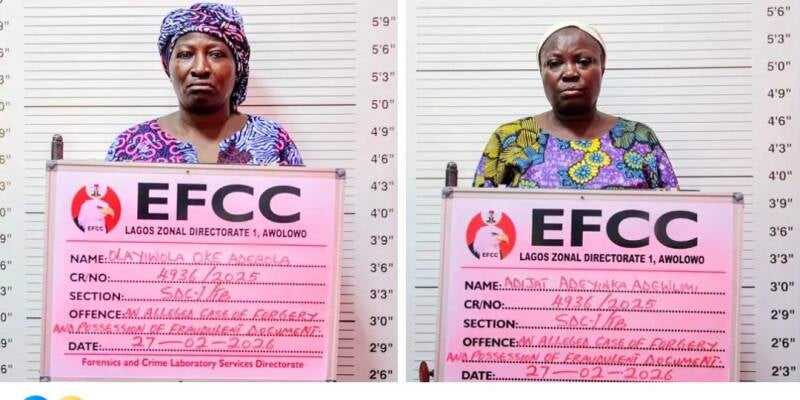
The Federal High Court sitting in Lagos has convicted and sentenced two women to three months' imprisonment each for forgery, presentation of forged documents, and misrepresentation of identity, following separate prosecutions by the Economic and Financial Crimes Commission. Justice Daniel Osiagor and Justice D.I. Dipeolu handed down the sentences on Wednesday, July 15, 2026, after both defendants pleaded guilty to the charges brought against them by the Lagos Zonal Directorate 1 of the EFCC.
The defendants, Olayiwola Bola Oke and Adijat Adewunmi Adeyinka, were arraigned separately on one-count charges bordering on forgery and the presentation of forged documents. The charge against Olayiwola reads: "That you, OLAYIWOLA BOLA OKE (female), adult, sometime in 2026, in Lagos State, within the jurisdiction of this Honourable Court, forged documents, to wit: Certificate of Occupancy Number 73/73/73/1982F, wherein you misrepresented yourself as one Alhaji Sule Adebodun; Certificate of Occupancy Number 67/67/67/1998F, wherein you misrepresented yourself as one Mrs. Loretta Aiyerina Jibowu; and Certificate of Occupancy Number 84/84/1996R, wherein you misrepresented yourself as one Sulaimon Kayode Olaiya, knowing the same to be false and with intent to defraud, and you thereby committed an offence contrary to and punishable under Section 1(2)(c) of the Miscellaneous Offences Act, Cap. M17, Laws of the Federation of Nigeria, 2004."
Similarly, the charge against Adeyinka reads: "That you, ADIJAT ADEWUNMI ADEYINKA (female), adult, sometime in 2026, in Lagos State, within the jurisdiction of this Honourable Court, presented to operatives of the Economic and Financial Crimes Commission a forged document, to wit: Lagos State Certificate of Occupancy Number 9/9/1990AG, wherein you misrepresented yourself as one 'Kudirat Olukotun,' knowing the same to be false, with the intent that the operatives of the Economic and Financial Crimes Commission, in the belief that it was genuine, would be induced to allow you to stand as a surety for the bail of Khaled Said Sabeer Muhammad at the Commission, and you thereby committed an offence contrary to and punishable under Section 1(2)(c) of the Miscellaneous Offences Act, Cap. M17, Laws of the Federation of Nigeria, 2004."
Both defendants pleaded guilty to the charges when they were read to them in court. Following their guilty pleas, prosecution counsel H.U. Kofarnaisa reviewed the facts of the cases and tendered the defendants' statements and the forged documents as exhibits before the courts. Kofarnaisa urged the courts to convict and sentence the defendants accordingly. In his judgment, Justice Osiagor convicted Olayiwola and sentenced her to three months' imprisonment without the option of a fine. Similarly, Justice Dipeolu convicted Adeyinka and sentenced her to three months' imprisonment without the option of a fine.
The convictions highlight the continued efforts of the EFCC to tackle forgery and the presentation of forged documents, offences that undermine public trust in official records and facilitate fraud. The sentences, though relatively short, serve as a deterrent to others who may be tempted to engage in similar illegal activities. The EFCC has consistently pursued cases of forgery, identity theft and fraud, securing numerous convictions across the country. The commission has urged members of the public to ensure that all official documents are genuine and to report any suspected cases of forgery to the appropriate authorities.
The court's decision to impose sentences without the option of a fine underscores the seriousness with which the judiciary views forgery offences. The judgment aligns with the EFCC's broader campaign against financial crimes, which includes the prosecution of individuals involved in the creation and use of fraudulent documents to deceive government agencies, financial institutions and the public. The convictions are also a reminder that the presentation of forged documents to law enforcement agencies, as in Adeyinka's case, is treated as a serious offence under Nigerian law. The EFCC has reaffirmed its commitment to investigating and prosecuting all forms of financial crimes, ensuring that perpetrators are held accountable for their actions.
📩 Stone Reporters News | 🌍 stonereportersnews.com
✉️ info@stonereportersnews.com | 📘 Facebook: Stone Reporters News | 🐦 X (Twitter): @StoneReportNew | 📸 Instagram: @stonereportersnews
Add comment
Comments