

Reported by: Ijeoma G | Edited by: Oravbiere Osayomore Promise.
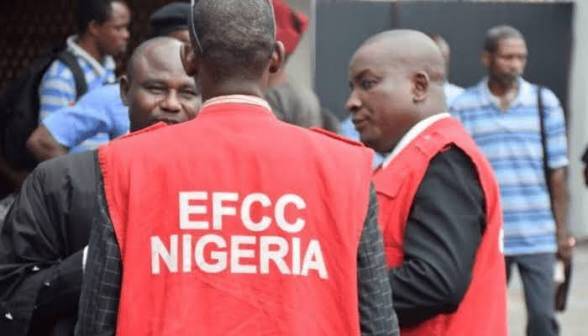
The Economic and Financial Crimes Commission (EFCC) is facing a growing credibility crisis over its decision to directly manage the electronic auction of seized vehicles, with the Nigeria Association of Auctioneers (NAA) accusing the anti-graft agency of a conflict of interest that could erode public confidence in the asset recovery process. The controversy, which erupted in late July 2026, has reignited long-standing concerns about transparency, accountability, and due process in the disposal of assets forfeited to the Federal Government.
At the heart of the dispute is the EFCC's plan to conduct an e-auction of vehicles in its custody through a platform it intends to manage itself. The commission had recently invited members of the public to participate in an electronic auction of abandoned vehicles forfeited to the Federal Government, directing interested bidders to its designated online platform to inspect the vehicles and submit bids. The EFCC maintained that the exercise was being conducted in line with the EFCC (Establishment) Act, 2004, the Public Procurement Act, 2007, and the Proceeds of Crime (Recovery and Management) Act (POCA), 2022. However, the NAA has vehemently opposed the move, arguing that the commission lacks the legal authority to serve as both custodian and seller of assets recovered from suspected criminals.
Speaking at a press conference in Abuja over the weekend, the National President of the NAA, Auct. Engr. Benjamin Abhulimen Isibor, insisted that allowing the EFCC to investigate financial crimes, seize assets, retain custody of them, and subsequently conduct their sale amounts to a conflict of roles capable of undermining the integrity of the entire asset recovery process. "The EFCC is now trying to act as a custodian and seller of assets, which is totally unlawful," Isibor declared. "This same issue happened during former EFCC chairman Ibrahim Magu. Magu said he was going to bring in foreigners to sell these assets. But it was stopped after our outcry. Now, this same thing is about to happen in another way".
The auctioneers' body pointed out that the EFCC had previously engaged licensed auctioneers to dispose of forfeited assets, with some of those exercises still incomplete. According to Isibor, many vehicles sold through earlier auctions were never released to successful bidders, raising questions about why a new disposal exercise was being initiated before the previous one was concluded. "We were appointed by the Commission in previous exercises, and we delivered commendable results. In many instances, the winning bids significantly exceeded the reserve prices. However, that auction process for some of the auctioneers remains inconclusive because many of the vehicles were never released to the successful bidders," he said.
Isibor further argued that the Proceeds of Crime (Recovery and Management) Act, 2022, does not envisage a situation where the same government agency serving as custodian of forfeited assets also performs the role traditionally assigned to licensed auctioneers. "What auctioneers observed from the EFCC advertisement and the information published on its website is that the Commission appears to be assuming the functions of professional auctioneers by directly conducting the sale of assets under its custody," he remarked. He maintained that while the association fully supports the lawful disposal of forfeited assets, the process must comply with established legal and professional standards to ensure transparency, accountability, and competitiveness.
The NAA also expressed concern that auctioneers had invested heavily in building digital auction platforms after being formally engaged by the EFCC, only to be sidelined. "We have previously partnered with the EFCC, and auctioneers invested significant resources in building platforms for transparent auctions. It is surprising that the commission now wants to conduct the process itself. We believe that is illegal," Isibor added. He warned that the planned arrangement violated established legal principles governing the disposal of forfeited assets, including the Due Process Act and the POCA law.
The controversy comes amid broader scrutiny of the management of recovered assets in Nigeria. On July 22, 2026, the House of Representatives called for an audit of all seized and recovered assets since 1999, citing concerns over the lack of transparency, poor record-keeping, weak valuation procedures, and inadequate chain-of-custody systems. The Human Rights Writers Association of Nigeria (HURIWA) had also urged President Bola Tinubu to ensure that all forfeited assets are managed through a transparent and independently monitored framework.
The EFCC, however, has defended its position, maintaining that the e-auction is being conducted in accordance with the relevant laws. Commission Chairman Ola Olukoyede had earlier hailed the Proceeds of Crime Act for strengthening asset recovery and management, stating that the EFCC had strengthened integrity, transparency, and accountability in recovered asset disposal by transitioning from physical auctions to electronic platforms. He had also tasked auctioneers to be guided by probity, fairness, and accountability in assets disposal. However, the commission has not responded to the specific allegations raised by the NAA regarding the proposed e-auction.
The dispute has significant implications for Nigeria's asset recovery framework. The EFCC has traditionally disposed of forfeited assets, including houses, vessels, and vehicles, through public auctions conducted by licensed auctioneers after obtaining final forfeiture orders from the courts. The process is intended to prevent recovered assets from depreciating while ensuring proceeds are remitted to the Federal Government. However, the current standoff over whether the commission should directly manage the auction process or continue to rely on independent auctioneers in line with established procurement and asset disposal procedures threatens to undermine the credibility of the entire system.
As the debate intensifies, the NAA has made it clear that its intervention should not be interpreted as an attack on the EFCC but as a professional call for strict adherence to due process and internationally accepted best practices. "Public assets must be disposed of transparently, and Nigerians must have confidence in the process," Isibor said. For now, the EFCC faces a critical test of its commitment to transparency and accountability—principles it has long championed in its fight against corruption. The outcome of this dispute will likely shape the future of asset recovery and disposal in Nigeria for years to come.
📩 Stone Reporters News | 🌍 stonereportersnews.com
✉️ info@stonereportersnews.com | 📘 Facebook: Stone Reporters News | 🐦 X (Twitter): @StoneReportNew | 📸 Instagram: @stonereportersnews
Add comment
Comments