

Reported by: Ijeoma G | Edited by: Oravbiere Osayomore Promise.
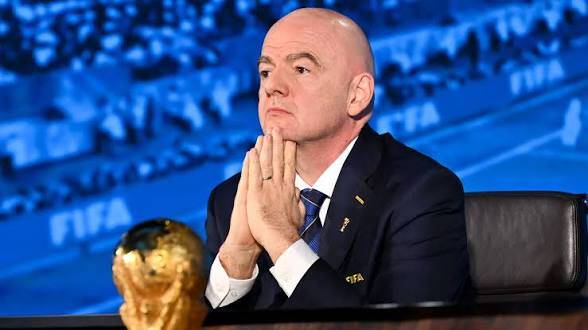
FIFA President Gianni Infantino has performed a dramatic U-turn on his controversial proposal to sell a minority stake in the commercial rights to the World Cup and other flagship tournaments, abandoning the plan just four days after it was unveiled following fierce resistance from regional confederations and the resignation of his senior adviser. The plan, which sought to raise up to $4.2 billion by selling approximately 20 per cent of a newly created commercial subsidiary valued at $20 billion, would have opened the door to private investors including the Kushner family, but instead exposed deep divisions within world football and intensified scrutiny of Infantino's leadership ahead of his expected bid for another term as FIFA president.
The proposal, announced on Tuesday, July 28, 2026, envisioned the creation of FIFA Forward Enterprise (FFE), a commercial entity that would oversee the men's and women's World Cups, Club World Cups, and other FIFA events. External investors would have held a minority, non-controlling stake while FIFA retained control, with the governing body arguing that the investment would generate billions of dollars for football development programmes worldwide. Infantino had even offered all 211 member associations $40 million (£30 million) each if they backed the proposal. However, the plan quickly ran into a storm of opposition from regional confederations, which complained they had not been consulted on a move that could fundamentally reshape the commercial structure and governance of global football.
UEFA, the governing body for European football, led the resistance. On Thursday, July 30, all 55 UEFA member associations unanimously voted to boycott the World Cup and all other FIFA competitions unless the proposal was withdrawn. In a scathing statement, UEFA accused FIFA of putting the "soul" of football up for sale and declared that the World Cup "cannot be treated as an investment product". The Confederation of North, Central America and Caribbean Association Football (CONCACAF), representing 41 national associations, also rejected the proposal during meetings on Thursday. By Friday, the Asian Football Confederation (AFC), with its 47 member associations, publicly aligned itself with UEFA and CONCACAF. Together, the three confederations account for 143 of FIFA's 211 member associations—comfortably more than the majority needed to block the proposal.
The backlash also exposed growing frustration over FIFA's decision-making process. AFC President Sheikh Salman bin Ebrahim Al Khalifa welcomed FIFA's decision to withdraw the plan but stressed that any proposal capable of reshaping world football must involve broader consultation. "The future of global football must always be shaped through proper consultation, collective dialogue and respect for the established governance structures of our game," Sheikh Salman said. Football Australia chairman Anter Isaac struck a similar note, warning against bypassing core governance principles. "Some principles, however, should never change. Integrity. Independence. Good governance. Transparency. Meaningful consultation. Due process," Isaac said.
The controversy took a personal toll on Infantino's inner circle. Carlos Cordeiro, the FIFA president's senior adviser on global strategy and governance who had represented FIFA on the White House task force for the 2026 World Cup, resigned with immediate effect on Friday, calling the plan "a bad deal for football" that would "mortgage football's future". Cordeiro urged other senior FIFA staff to speak out against the proposal. Hours later, FIFA Chief Operating Officer Kevin Lamour issued a statement revealing that staff had been "deceived" by Infantino's lack of openness in planning the sale over recent months. Lamour, a longtime colleague of Infantino at both FIFA and UEFA, described the scheme as "the project of one person" and declared that "the time has now come for football political leaders to ask themselves the right questions and make the right decisions".
Facing mounting opposition and defections from within his own administration, Infantino acknowledged defeat on Friday, July 31, 2026. "Having listened carefully to all the views, it has become clear that the project has created divisions of a nature that, regardless of the level of support, are no longer in the interest of the objective set out in the first place," Infantino said in a statement. "Our purpose has always been—and will always be—to unite and improve. As a result, this proposal will not proceed". He added that FIFA would instead seek to rebuild consensus with its stakeholders and bring all interested parties back together "in the spirit of shared interest in our game".
The swift reversal has raised serious questions about Infantino's political capital as he prepares to seek re-election for a fourth term as FIFA president at the FIFA Congress in March 2027. The deadline to enter the presidential race is November 18, 2026, and the controversy has already prompted calls for greater oversight of decisions that could reshape the governance and commercial future of the sport. UK Prime Minister Andy Burnham said Infantino was "the wrong man" to lead FIFA, while sources indicated that the vast majority of associations from the CONCACAF region are losing, or have lost, faith in the FIFA president.
The plan's collapse also represents a significant setback for the proposed anchor investor, a New York-based investment firm created by Joshua Kushner, the younger brother of U.S. President Donald Trump's son-in-law, Jared Kushner. FIFA had insisted earlier on Friday that "nobody is selling football" and that the initiative was intended to generate additional funding for member associations. However, the overwhelming opposition from three continental confederations made it mathematically impossible for Infantino to secure the backing of the required majority of FIFA's 211 member associations—106 votes needed in favour. With UEFA's 55 votes, CONCACAF's 35, and Asia's 46 aligned against the proposal, Infantino faced the prospect of 136 nations voting against his plan had it proceeded to a vote.
The governing bodies in Africa (CAF) and Oceania (OFC) had said they would discuss the plan in August, while CONMEBOL, South American football's governing body, had requested additional information and clarifications. The opposition also drew support from the UK government, with Prime Minister Andy Burnham declaring that Infantino was "the wrong man" to lead FIFA. Human rights groups had also criticised the proposal, arguing that it would undermine efforts to hold FIFA accountable on governance and human rights issues.
As the dust settles on one of the most significant policy reversals of Infantino's presidency, the controversy has reignited calls for transparency and meaningful consultation in FIFA's decision-making processes. The governing body's next competition, the Women's Under-20 World Cup, is scheduled to begin on September 5 in Poland—a tournament that UEFA members had threatened to boycott. Whether Infantino can rebuild trust with the football community and secure a fourth term remains uncertain, but the collapse of his World Cup sell-off plan has left his leadership deeply damaged and exposed a global football community unwilling to surrender the sport's most cherished asset to private investors.
📩 Stone Reporters News | 🌍 stonereportersnews.com
✉️ info@stonereportersnews.com | 📘 Facebook: Stone Reporters News | 🐦 X (Twitter): @StoneReportNew | 📸 Instagram: @stonereportersnews
Add comment
Comments