

By L. Stone
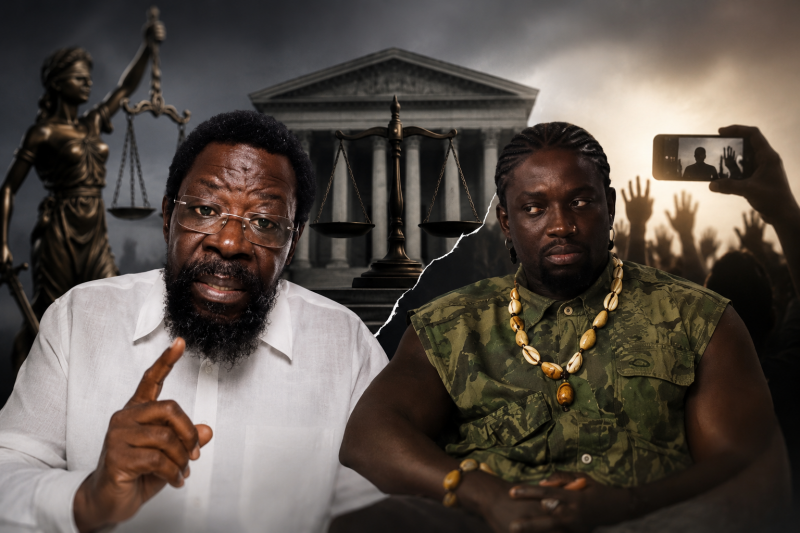
A statement attributed to Nigerian lawyer and human rights advocate Dele Farotimi has reignited debate over public confidence in Nigeria’s police and judicial institutions, after he reportedly argued that the growing influence of controversial social media activist Martins Vincent Otse, popularly known as VeryDarkMan or VDM, reflects deeper weaknesses in the country’s justice system.
In the widely circulated remarks, Farotimi was quoted as saying that a society with a functional police system and courts would have less need for a figure such as VeryDarkMan. He reportedly described VDM as a reflection of Nigerian society, arguing that ordinary citizens increasingly find it easier to pursue grievances through influential social-media campaigners than through established institutions.
The remarks strike at a long-running question in Nigeria: whether citizens believe formal institutions can provide justice quickly, fairly and affordably. Farotimi has previously been publicly critical of the Nigerian judiciary. At a Nigerian Bar Association human-rights conference, he argued that Nigeria’s judicial system had become better at delivering judgments than guaranteeing substantive justice, describing problems within the judiciary as part of wider institutional and societal failures.
VeryDarkMan has emerged as one of Nigeria’s most prominent and divisive online activists. Through videos watched by large audiences, he regularly raises allegations involving public officials, businesses, celebrities and private individuals. Supporters regard his interventions as a form of citizen advocacy capable of drawing attention to cases that might otherwise receive limited public scrutiny. Critics, however, argue that social-media activism cannot replace professional investigations, due process or independent courts.
That distinction has become particularly important amid VDM’s latest confrontation with the Nigeria Police Force. During the Nigerian Bar Association’s 2026 Annual General Conference in Port Harcourt, VDM made serious allegations about insecurity and the conduct of some security personnel, including claims that some police officers provide information to kidnappers. The police subsequently invited him to substantiate those allegations, saying claims of such gravity required evidence.
VDM responded by maintaining that he possessed evidence but would rather present it before a court than hand it to investigators. He challenged the police to prosecute him if authorities believed his statements were unlawful, while also arguing that poor welfare and remuneration were contributing to problems within the police service. His accusations against security personnel remain allegations and have not been established as fact by a court.
The Nigeria Police Force has pushed back against suggestions that social-media pressure should determine criminal investigations. In a recent statement concerning separate allegations raised by VDM against a senior police officer, the Force said criminal cases must be handled according to due process and determined by courts rather than through public campaigns. Police authorities also confirmed that an Assistant Inspector-General implicated in allegations raised by VDM had been invited for questioning under internal accountability procedures.
The controversy illustrates the tension at the centre of Farotimi’s reported intervention. Nigeria’s courts have traditionally been described as the “last hope of the common man,” reflecting their constitutional role in protecting citizens and checking abuses of power. Nigerian judicial authorities have historically emphasised that courts have a responsibility to protect individuals where state power is exercised unlawfully. Yet prolonged proceedings, costs and concerns about institutional credibility have contributed to public frustration.
Social media has increasingly created an alternative arena in which Nigerians seek intervention. A complaint that once might have been directed exclusively to a police station, regulator or court can now become a national discussion within hours. Influencers with millions of followers can pressure companies and government agencies to respond publicly, while videos documenting alleged wrongdoing can generate enormous attention before investigators have established the facts.
That power carries significant risks. Allegations made online can damage reputations before accused individuals have an opportunity to respond. Public opinion can also move faster than investigations, while viral narratives may omit evidence later presented in court. For that reason, legal and law-enforcement institutions continue to insist that accusations must ultimately be tested through evidence and established procedures rather than popularity.
VDM himself has repeatedly encountered Nigeria’s criminal justice system. He has previously faced arrests, investigations and legal disputes arising from allegations including cyberstalking and defamation. In May 2025, the Economic and Financial Crimes Commission detained him following petitions containing allegations of cyberstalking, with the agency saying at the time that he had been taken into custody to respond to complaints.
Farotimi’s reported comments therefore go beyond an endorsement of one activist. Their central argument is that the prominence of figures such as VDM should be understood as evidence of institutional distrust. Where people believe established mechanisms respond slowly or inadequately, they may turn to individuals capable of mobilising public attention.
But describing any activist as the “last hope of the common man” also raises an important democratic question. Sustainable justice cannot depend on the popularity, personality or discretion of an individual. Police institutions are expected to investigate allegations impartially, prosecutors to assess evidence independently and courts to determine disputes according to law.
The debate surrounding VeryDarkMan consequently presents Nigeria with a broader challenge: rebuilding confidence in institutions so citizens do not feel that justice depends on making their grievances viral. Social-media advocacy can expose alleged wrongdoing and demand accountability, but it cannot provide the safeguards, evidential standards and impartial adjudication expected from a functioning justice system.
Whether Nigerians agree with Farotimi’s reported assessment or reject VDM’s confrontational methods, the controversy has again placed police accountability, judicial credibility and access to justice at the centre of national conversation. Ultimately, the strength of Nigeria’s justice system will be measured not by the influence of those demanding accountability online, but by whether ordinary citizens can approach established institutions and reasonably expect their complaints to be heard, investigated and resolved fairly.
📩 Stone Reporters News | 🌍 stonereportersnews.com
✉️ info@stonereportersnews.com | 📘 Facebook: Stone Reporters News | 🐦 X (Twitter): @StoneReportNew | 📸 Instagram: @stonereportersnews
Add comment
Comments