

By: L:Stone
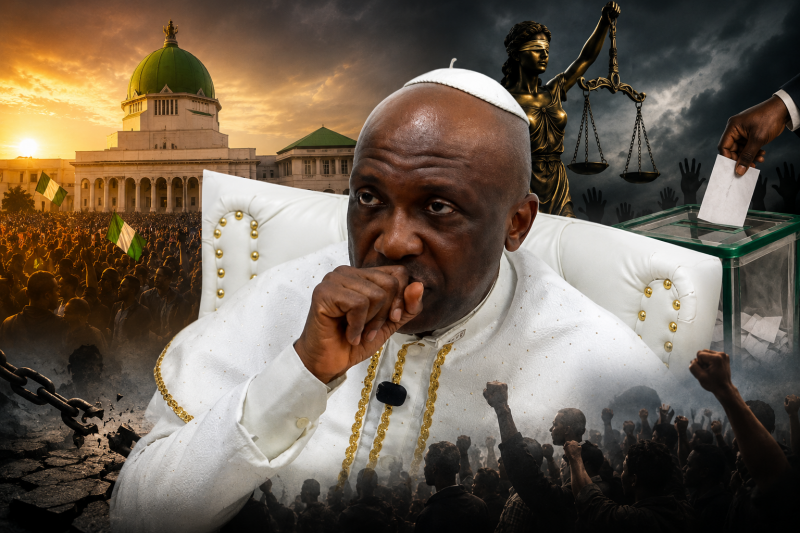
The leader of the INRI Evangelical Spiritual Church, Primate Elijah Ayodele, has issued another warning about President Bola Ahmed Tinubu’s re-election prospects, predicting that the All Progressives Congress could face a significantly tougher battle in the 2027 presidential election than its political strength currently suggests.
Ayodele, who regularly comments on Nigerian politics through what he describes as prophetic revelations, argued that dissatisfaction with the ruling party is growing and warned APC leaders against assuming that their existing political structures would guarantee another presidential victory. His comments come as political manoeuvring and opposition realignment intensify ahead of the next general election.
In remarks attributed to the cleric, Ayodele said the APC’s electoral position was becoming increasingly uncertain. “APC’s victory is shaking. You won’t understand until the 2027 election,” he said, while predicting an especially difficult presidential contest in Lagos. He also claimed that Nigerians were tired of the governing party and increasingly wanted political change.
One of his most striking assertions concerned Lagos, President Tinubu’s longstanding political base. Ayodele predicted that the presidential election in the state would be highly competitive. Lagos carries considerable symbolic significance for Tinubu, who governed the state from 1999 to 2007 and subsequently became one of its most influential political figures.
The warning has particular resonance because Tinubu lost Lagos State during the 2023 presidential election despite his longstanding political influence there. Labour Party candidate Peter Obi secured 582,454 votes in Lagos, narrowly defeating Tinubu, who received 572,606 votes, according to the results announced by the Independent National Electoral Commission. Tinubu nevertheless won the presidential election nationally and was subsequently declared president.
Ayodele also directed attention towards northern Nigeria, claiming that voters in the region were turning against the APC. His assertion that “the Northerners have said no to the APC” should, however, be understood as his political and prophetic assessment rather than an established measure of northern public opinion. Northern Nigeria contains tens of millions of voters across numerous states, ethnic groups and political constituencies, making any single description of its electoral position difficult to substantiate before voting takes place.
The cleric further introduced a spiritual dimension to his warning, saying he believed “something is wrong with the APC spiritually,” particularly in relation to the political branding surrounding Tinubu as the “City Boy.” Such statements represent Ayodele’s religious interpretation and cannot be independently verified as factual political evidence. The eventual outcome of the 2027 election will be determined by voters and the electoral process rather than prophetic declarations.
His latest remarks are nevertheless consistent with warnings he has issued recently. In a statement reported on August 28, Ayodele warned that what he described as excessive confidence within the APC could become a significant weakness. He argued that money and political structures alone would not guarantee victory if voters remained dissatisfied over economic hardship and insecurity.
Ayodele has also previously warned Tinubu against depending too heavily on governors and political allies to deliver votes. In another recent intervention, he claimed that not every governor aligned with the president would necessarily deliver his state and suggested that political sentiment in northern Nigeria could become particularly important as the election approaches.
The political significance of such warnings lies beyond their prophetic character. The 2027 election is developing against continuing public debate over the cost of living, insecurity, employment, government reforms and the economic consequences of policies introduced since Tinubu took office in May 2023. These issues are expected to feature prominently as both the government and opposition attempt to persuade voters.
Tinubu’s administration has defended its economic reforms as necessary measures intended to correct longstanding structural problems. Among the most consequential decisions was the removal of the petrol subsidy shortly after the president assumed office, alongside reforms affecting Nigeria’s foreign-exchange system. While the government has argued that difficult reforms are required to stabilise the economy and create sustainable growth, households have faced substantial pressure from higher living and transportation costs.
For the APC, the challenge will therefore be to persuade voters that those reforms are producing sufficient improvements before the presidential election. For opposition parties, economic dissatisfaction provides an obvious campaign issue, but converting frustration into electoral victory will require organisation, credible candidates and the ability to build support across Nigeria’s diverse regions.
Ayodele has repeatedly argued that opposition strategy could determine Tinubu’s prospects. He has suggested that a fragmented opposition could strengthen the president’s chances, while a strategically organised challenge could make re-election considerably more difficult. That assessment reflects a broader political reality: Nigeria’s presidential system requires candidates to build geographically widespread support rather than rely solely on overwhelming strength in a few areas.
Lagos and northern Nigeria will consequently remain important battlegrounds. Lagos is Nigeria’s commercial centre and one of its largest voting territories, while northern states collectively account for a substantial share of the national electorate. Any significant movement in voting patterns across these areas could influence the calculations of both the APC and its challengers.
There is, however, considerable time for political circumstances to change before Nigerians vote. Alliances can shift, economic conditions can improve or deteriorate, and campaign strategies can alter voter perceptions. Predictions made months before an election therefore cannot reliably establish its eventual result.
Ayodele’s intervention should consequently be viewed as a combination of religious prophecy and political commentary rather than evidence that the APC has already lost particular regions or the 2027 election. The APC and Tinubu retain substantial political structures nationally, while their opponents still face the task of translating public dissatisfaction into votes.
What the remarks do highlight is the emerging battle over the central question of 2027: whether Nigerians believe Tinubu and the APC should receive another four years to continue their programme, or whether economic and security concerns will produce sufficient demand for political change.
Ultimately, neither political confidence nor prophecy will decide that question. When Nigerians return to the polls, the verdict will belong to the electorate.
📩 Stone Reporters News | 🌍 stonereportersnews.com
✉️ info@stonereportersnews.com | 📘 Facebook: Stone Reporters News | 🐦 X (Twitter): @StoneReportNew | 📸 Instagram: @stonereportersnews
Add comment
Comments