

By: L. Stone
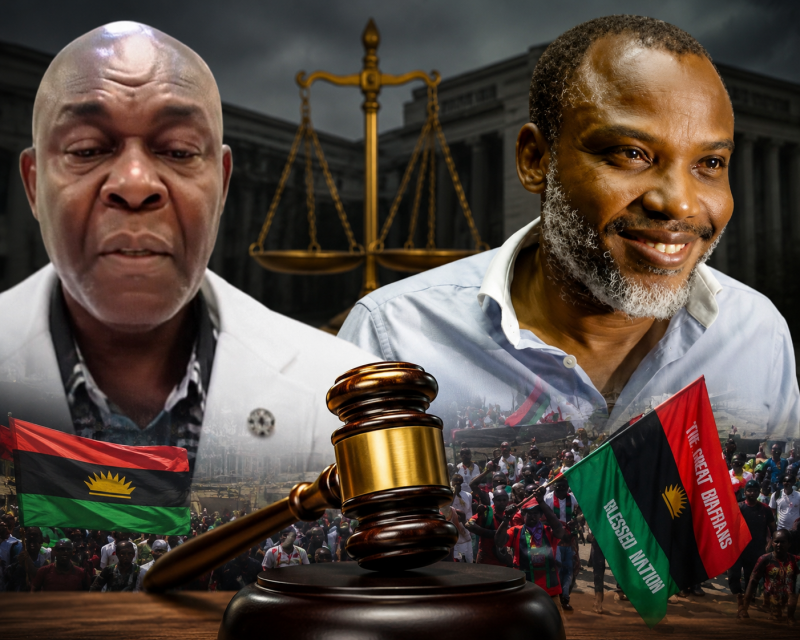
The Indigenous People of Biafra has threatened to boycott Nigeria’s 2027 general elections if the appeal filed by its detained leader, Mazi Nnamdi Kanu, is not listed for hearing within 14 days, escalating pressure on the judiciary over delays surrounding his challenge to a life sentence imposed last year.
The warning was attributed to Mazi Chris Nwaọgụ, who heads the fourth administration of IPOB’s Directorate of State. Stone Reporters News has not independently located the full statement containing the 14-day election-boycott ultimatum on IPOB’s recognised public channels, but the demand comes amid a documented campaign by Kanu’s family and supporters for the Court of Appeal to urgently schedule his case.
Nwaọgụ emerged as head of a reconstituted Directorate of State earlier this year amid an internal leadership dispute within IPOB. In June, the organisation’s Media and Publicity Secretary, Emma Powerful, said the new administration headed by the United States-based Nwaọgụ had been constituted under Kanu’s authority. A rival leadership associated with Chika Edoziem disputed that position, highlighting continuing divisions within the separatist movement.
The immediate dispute centres on Kanu’s appeal against his conviction and life sentence. He was convicted by the Federal High Court in Abuja on November 20, 2025. His legal team subsequently began the appeal process, with lawyer Aloy Ejimakor saying in April that a notice and grounds of appeal had been filed in February and that the case was proceeding through the required appellate stages.
Court-related records cited by Kanu’s family indicate that the Record of Appeal was transmitted on March 9, 2026, while his Appellant’s Brief of Argument was filed on June 5 and served on the Federal Government. The family says the period available to the government to file its Respondent’s Brief has passed, while the substantive appeal has yet to be listed for hearing.
Kanu has also personally sought intervention from senior judicial authorities. In August, he wrote to the President of the Court of Appeal requesting expedited listing of his pending motion, application for bail pending appeal and substantive appeal. He separately wrote to the Chief Justice of Nigeria seeking the listing of proceedings before the Supreme Court challenging the legality of its December 15, 2023 decision that returned his criminal case for trial.
His family has repeatedly invoked events in October 2022 to argue that the judiciary is capable of acting more quickly. On October 13 that year, the Court of Appeal discharged Kanu and quashed the charges then before it. The Federal Government subsequently obtained a stay of execution on October 28, preventing his release while the legal battle continued. Kanu’s family says the roughly two-week interval demonstrates why prolonged delays in listing his present cases should not be accepted.
The family has stressed that it is not demanding a predetermined judgment in Kanu’s favour, but a hearing at which both sides can present their legal arguments. It has called on the Federal Government to defend the conviction and other judicial decisions on which Kanu’s continued detention rests, while urging the courts to give matters involving his liberty urgent attention.
The reported IPOB ultimatum introduces the 2027 elections into a legal dispute that has already become one of Nigeria’s most politically sensitive cases. IPOB campaigns for an independent state of Biafra, primarily in the South-East, and has remained a major factor in political and security debates in the region. Nigerian authorities proscribed the organisation in 2017, while IPOB has continued to describe its campaign as a self-determination struggle.
Kanu’s detention has for years generated calls for both judicial and political intervention. Political leaders, traditional rulers and civil society figures from the South-East have at different times urged the Federal Government to pursue a resolution, although successive legal proceedings have continued. The government has maintained its reliance on the courts in prosecuting the case.
The prospect of an election boycott is particularly sensitive because voter participation in parts of the South-East has previously been affected by insecurity, separatist agitation and public distrust. Any organised campaign urging residents not to vote in 2027 could therefore become a significant political issue. However, the practical impact of such a call would depend on public response, the position of other political and civic organisations and developments in Kanu’s legal case before polling begins.
Election boycotts are also being discussed elsewhere in Nigeria for unrelated reasons. Earlier in 2026, the Inter-Party Advisory Council warned that political parties could boycott the 2027 general elections unless disputed provisions of the Electoral Act were amended. Some opposition figures have separately raised boycott arguments over concerns about the electoral process, demonstrating that participation in the next national vote is already the subject of wider political contention.
For IPOB, however, the reported ultimatum is specifically tied to Kanu’s appeal and the demand for a hearing rather than an immediate order releasing him. Listing an appeal would place the case formally before the appellate court for consideration but would not determine its outcome. The court would still have to hear the parties and decide the legal grounds raised against the conviction.
There has been no verified public indication that the Court of Appeal has responded to the reported 14-day ultimatum or fixed a hearing date because of it. There has also been no confirmed response from the Federal Government or the Independent National Electoral Commission to the threatened boycott as of the time of this report.
The next development will therefore depend heavily on whether the appellate court schedules Kanu’s case and how IPOB responds if no hearing date emerges within the period it has reportedly set. The controversy is also likely to test how political actors balance judicial independence, electoral participation and continuing demands for Kanu’s release. With Nigeria’s 2027 political season gathering momentum, the intersection of Kanu’s legal battle, separatist politics and electoral participation could place renewed attention on both the judiciary and political leadership in the weeks ahead.
📩 Stone Reporters News | 🌍 stonereportersnews.com
✉️ info@stonereportersnews.com | 📘 Facebook: Stone Reporters News | 🐦 X (Twitter): @StoneReportNew | 📸 Instagram: @stonereportersnews
Add comment
Comments