

Published by Osasere Edomwonyi Ikpoba
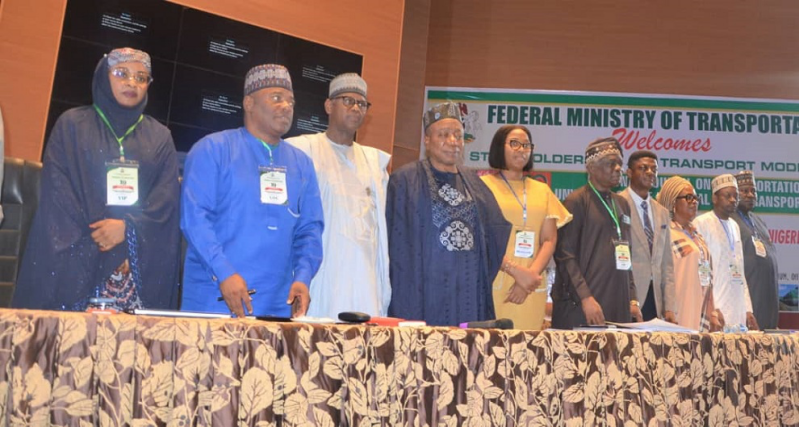
The Federal Government has unveiled an aggressive plan to safeguard the nation’s critical transport infrastructure and strengthen its intermodal system, declaring that the escalating vandalism of roads, bridges, and rail assets will no longer be tolerated. The Permanent Secretary of the Ministry of Transportation, Engr. Olufunso Adebiyi, made the declaration at the just-concluded 19th National Council on Transportation (NCT) in Abuja, where he revealed that the council would recommend stiffer penalties for the criminal act, describing it as a major threat to safety and service delivery.
Vandalism of transport infrastructure has become a pervasive menace across Nigeria, with critical assets such as the Lagos–Calabar Coastal Highway, major bridge corridors, and railway installations suffering repeated attacks. The First Niger Bridge, a vital national artery linking Anambra and Delta states, was recently shut down for emergency repairs after vandals allegedly removed bolts, iron rods, and expansion-joint components. The Abuja-Kaduna-Zaria-Kano superhighway has also come under assault, prompting the government to deploy security guards to protect newly constructed sections.
Adebiyi, whose presentation was made available to the News Agency of Nigeria on Friday, stressed that the criminal act has resulted in loss of lives, destruction of public assets, and life-altering injuries to many Nigerians. “Protecting infrastructure was key to achieving a seamless intermodal transport system,” he declared. The permanent secretary also emphasised the need for transparent public-private partnerships, robust funding mechanisms, and innovative asset-recycling models to accelerate the development, rehabilitation, and sustainable management of transport infrastructure nationwide.
The 19th National Council on Transportation, a four-day event themed “Developing an Effective Transportation System for Nigeria: The Role of Intermodal Transportation,” brought together key stakeholders from across the transport sector. The theme underscores the government's ambition to create a transportation ecosystem where road, rail, inland waterways, and air transport operate in seamless harmony, reducing travel time, lowering logistics costs, and boosting economic productivity. However, this vision remains elusive as long as vandals continue to dismantle the very infrastructure upon which such a system depends.
The council’s recommendation for stiffer penalties signals a significant shift in the government's approach to infrastructure protection. Previously, vandals often faced relatively lenient sanctions, which did little to deter the lucrative trade in stolen metal components. Between 2021 and 2025, over 200 incidents of vandalism were recorded by the Transmission Company of Nigeria alone. The new push for harsher punishment reflects growing frustration within government circles over the inability of existing legal frameworks to curb the scourge.
Beyond the immediate threat of vandalism, the government's intermodal vision faces other structural challenges. Stakeholders have called for the Warri-Itakpe standard gauge rail line to be linked to inland ports and road networks to create a truly seamless multimodal transport system. Poor design, neglect, and vandalism have also endangered the $3.4 billion national railway modernisation project, which remains marred by execution challenges a decade after its commencement.
The Senate Committee on Land Transportation, chaired by Senator Adamu Aliero, has thrown its weight behind the ministry's efforts while also addressing broader governance issues. Aliero commended Adebiyi for tackling what he called an “administrative anomaly” involving the award of a railway construction contract to the Ministry of Finance Incorporated (MoFI) without technical input from the Ministry of Transportation. While acknowledging MoFI's role as a financing and investment vehicle, Aliero insisted that the technical aspects of railway infrastructure development—including construction, supervision, and sectoral coordination—fall within the statutory mandate of the Ministry of Transportation.
The lawmaker also praised President Bola Tinubu for intervening through the Office of the Secretary to the Government of the Federation to restore appropriate institutional responsibility for the project. “The National Assembly will not support arrangements that sideline core statutory ministries in favour of entities without the requisite technical mandate and operational capacity to supervise critical national infrastructure projects,” Aliero stated emphatically. He assured that the legislature would continue to support the ministry in its rail development initiatives.
The government's resolve to tackle vandalism comes at a critical juncture. Nigeria's transport infrastructure is the backbone of its economy, facilitating the movement of goods and people across the vast nation. Every act of vandalism—whether the theft of railway sleepers, the dismantling of bridge components, or the sabotage of highway guardrails—represents not just a financial loss but a direct attack on the nation's productivity and the safety of its citizens. The recent closure of the First Niger Bridge for emergency repairs, for instance, forced thousands of motorists to divert through alternative routes, causing significant economic disruption.
The push for stiffer penalties will likely face scrutiny from human rights advocates concerned about the proportionality of punishment. However, government officials argue that the scale of the problem demands a robust response. The Minister of Works, Senator David Umahi, had earlier announced plans to deploy security guards along the Abuja-Kaduna-Zaria-Kano superhighway following attempts by vandals to damage newly constructed sections. Similar measures are expected to be extended to other vulnerable corridors as part of the broader strategy to protect national assets.
Adebiyi’s call for innovative asset-recycling models suggests that the government is also exploring ways to fund infrastructure maintenance without relying solely on budgetary allocations. By recycling assets—such as repurposing decommissioned rail lines or reusing materials from old infrastructure—the government hopes to stretch its resources further while ensuring that new developments are built to last. Transparent public-private partnerships, meanwhile, could attract private capital to fill the funding gap that has long plagued the transport sector.
For Nigerians, the promise of a seamless, safe, and efficient intermodal transportation system remains a distant dream, but the government’s renewed focus on infrastructure protection offers a glimmer of hope. The 19th National Council on Transportation has set the stage for a more coordinated and aggressive approach to tackling vandalism, one that combines legislative action, institutional accountability, and innovative financing. Whether these measures will be enough to turn the tide remains to be seen, but the message from Abuja is clear: the era of impunity for those who destroy the nation’s transport assets is drawing to a close.
📩 Stone Reporters News | 🌍 stonereportersnews.com
✉️ info@stonereportersnews.com | 📘 Facebook: Stone Reporters News | 🐦 X (Twitter): @StoneReportNew | 📸 Instagram: @stonereportersnews
Add comment
Comments