

Published by Oravbiere Osayomore Promise.
The simmering conflict between the United States and Iran erupted into a new and dangerous phase over the weekend, as Iran launched a swift and defiant retaliation against American forces just hours after the U.S. military struck and permanently disabled three Iranian oil tankers. The Islamic Revolutionary Guard Corps claimed on Saturday that it attacked three U.S.-affiliated ships and three oil tankers transiting the Strait of Hormuz. The following day, Iran escalated further, announcing that its forces had attacked a U.S. naval drone attempting to enter the strategic strait. This rapid cycle of strikes and counter-strikes marks a significant escalation in a conflict that has now dragged on for six months, disrupting global energy supplies and drawing increasing opposition from an American public weary of war.
The latest round of hostilities was triggered by a decisive U.S. action on Saturday, September 5, 2026. U.S. Central Command said it struck three Iranian oil tankers after the IRGC launched ballistic missiles at two U.S. Navy warships. In a statement, CENTCOM said it "permanently disabled" the IRGC crude oil carriers M/T Downy off the coast of Kharg Island, M/T Stark 1 near Jask, and M/T Kylo in the Gulf of Oman. Admiral Brad Cooper, head of CENTCOM, issued a stark warning: "Let the message to the IRGC be clear: If you shoot at two of our ships, we will impose an even higher economic cost — taking out three of yours".
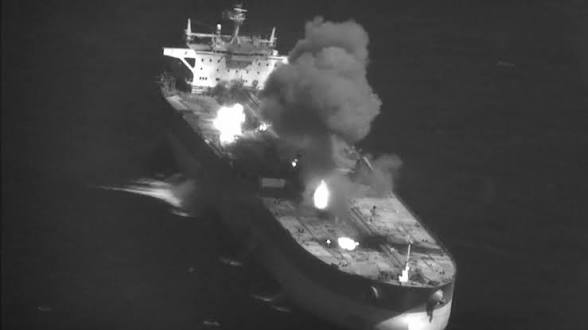
The American strikes were devastating. The IRGC-linked vessels were part of a multibillion-dollar shadow network used to fund the Revolutionary Guard and its regional proxies. CENTCOM released video footage showing large fireballs and billowing flames as the projectiles struck the ships. The M/T Kylo was completely destroyed in the Gulf of Oman after its crew was directed to abandon ship. While Iranian state media reported no casualties and said the crew of one tanker was being evacuated, the attack was a crippling blow to Iran's oil smuggling operations.
Iran did not wait to respond. The IRGC claimed on Saturday that its naval forces had already retaliated, targeting three oil tankers in the Strait of Hormuz and three U.S.-affiliated ships. The IRGC issued a direct threat to all shipping in the strait, warning vessels not to use unauthorized routes "otherwise, you will be targeted". In a further escalation, the IRGC announced it had attacked a U.S. aircraft carrier and a destroyer with ballistic missiles, though the U.S. has not confirmed this claim.
The fighting continued into Sunday, September 6. Iran's state media announced that the IRGC had attacked an American military unmanned surface vessel attempting to enter the Strait of Hormuz. This attack on a U.S. naval drone is a significant escalation in the technological dimension of the conflict.
The tit-for-tat strikes are the latest episodes in a conflict that has become a grinding stalemate. The U.S. has maintained a naval blockade of Iranian ports since Tehran effectively shut the Strait of Hormuz, a critical waterway that once carried one-fifth of the world's oil supply. In response, Washington continues to roll out sanctions on entities with financial links to the Islamic Republic. For its part, Iran has maintained its stranglehold on the Strait of Hormuz, daring the U.S. to escalate further.
Iran's Khatam-al Anbiya central military command has now warned that if the U.S. continues its attacks, Tehran's retaliation against U.S. warships will be "more severe than before, and there is a possibility of their expansion". The conflict has already had a significant economic impact, with Brent crude futures closing at $96.28 a barrel on Friday, their highest level since July, as tensions drive global supply concerns.
The U.S. administration, however, has sought to downplay the significance of the six-month conflict. President Donald Trump has called the war "small potatoes" for Washington, a characterization that appears increasingly at odds with the escalating violence and economic disruption. As both nations exchange blows, the world watches with bated breath, wondering when, and if, the cycle of retaliation will end.
📩 Stone Reporters News | 🌍 stonereportersnews.com
✉️ info@stonereportersnews.com | 📘 Facebook: Stone Reporters News | 🐦 X (Twitter): @StoneReportNew | 📸 Instagram: @stonereportersnews
Add comment
Comments