

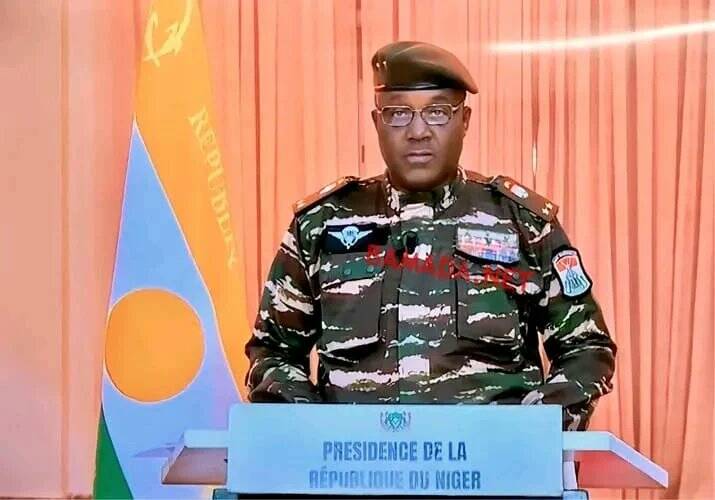
Niger’s military authorities have appointed General Maman Sani Kiau as the new Chief of Staff of the Armed Forces, replacing General Moussa Salaou Barmou after an attempted mutiny shook the capital, Niamey, late last month.
The appointment was announced on state television on Friday, September 11, 2026, after a decree signed by Niger’s military ruler, General Abdourahamane Tiani, named General Kiau to lead the armed forces. General Kiau had previously served as Chief of Staff of the Nigerien Army.
The change is part of a wider reshuffle in the country’s military command, announced less than two weeks after armed clashes involving soldiers and forces loyal to the authorities at key locations in Niamey.
General Abdourahmane Abou Zataka was appointed as the new Chief of Staff of the Army, replacing General Kiau in that role. General Ismail K. Sidi Omar was named Deputy Chief of Staff of the Air Force, while Colonel-Major Ibrahim Abdourazak Ben became Deputy Chief of Staff of the Army.
The decrees did not state why General Barmou was removed from the top armed forces position. He had held the role during the attempted uprising and the subsequent operation to restore control of the military base near Niamey’s international airport.
The unrest began during the night of August 28 into August 29, when a group of soldiers reportedly took positions at Base 101, a strategic military facility located beside Niamey’s airport. Gunfire was heard in several parts of the capital, including areas near the presidential palace and the airport.
Niger’s Defence Ministry initially described the incident as a “movement of anger” by soldiers. Authorities later referred to it as an attempted destabilisation of the country, while the military authorities said loyal forces had gradually regained control of the affected areas.
State television was briefly disrupted during the violence before broadcasting resumed. Residents in Niamey reported hearing sustained exchanges of gunfire and explosions as security forces moved to contain the situation.
The military base at the airport is of strategic importance to Niger and the wider Alliance of Sahel States, which brings together Niger, Mali and Burkina Faso. The three countries are led by military governments and have formed a regional alliance centred on security cooperation.
Reports from the aftermath of the mutiny said the confrontation involved elements of the Special Reconnaissance Battalion under the Special Operations Command and troops who remained loyal to the Nigerien authorities.
Three members of the Presidential Guard were reported killed during the clashes. Authorities also said they recovered vehicles and a large quantity of weapons after the operation, including 382 AK-47 rifles, 36 RPG-7 launchers and 30 PKM machine guns.
The government has not publicly released a full account identifying those involved in the attempted mutiny, nor has it given a final casualty figure for all sides. There has also been no public announcement of charges against individuals linked to the incident.
Niger’s authorities said the country’s armed forces, supported by partners, restored control of the base after the confrontation. Russia’s Africa Corps, a Moscow-linked military force operating in Niger, was reported to have assisted Nigerien forces during the response.
Russia’s Foreign Ministry said Nigerien troops repelled the attack with assistance from the Africa Corps. Algeria also announced that it had sent fighter jets and other equipment to support Niger in countering what it described as an attempt to destabilise the country.
The involvement of foreign security partners has drawn attention to Niger’s changing military alliances since General Tiani seized power in a July 2023 coup that removed the elected president, Mohamed Bazoum.
Following the coup, Niger’s military government moved away from longstanding security partnerships with France and the United States. It has instead expanded cooperation with Russia, particularly through the Africa Corps, as the country continues to confront armed groups operating across the Sahel.
Nigerien authorities later accused France of helping to incite the August mutiny. The allegation was contained in a government statement broadcast on national television, which said officials had compiled evidence relating to the attack. France had not publicly accepted the accusation.
The authorities have not presented evidence publicly linking France to the events in Niamey. The claim remains the position of Niger’s military government.
The attempted mutiny represented the most serious internal military challenge to General Tiani’s administration since it took power. The government has faced continuing pressure from armed violence in several parts of Niger, including attacks linked to groups affiliated with al-Qaeda and the Islamic State.
The country’s military has suffered repeated losses in its campaign against armed groups, particularly in western and southeastern regions. The situation has contributed to insecurity for communities, disrupted travel and placed further demands on the armed forces.
General Kiau now takes charge of the armed forces at a time when the military leadership is reorganising its command structure following the crisis in Niamey. His appointment places a former army chief at the head of the wider military hierarchy.
The reshuffle also places new officers in senior positions within the Army and Air Force, signalling an effort by the authorities to rebuild and strengthen the chain of command after the internal confrontation.
General Tiani has not made a detailed public statement on the reasons for the changes. State television presented the appointments as official decrees issued by the head of state.
The government has continued to call for calm following the August unrest. Security measures in Niamey were tightened during and after the clashes, while normal activity gradually resumed in the capital.
The new military leadership is expected to oversee Niger’s continuing security operations against armed groups, as well as efforts to maintain discipline and cohesion within the armed forces.
For now, the appointment of General Maman Sani Kiau marks the clearest leadership change since the failed mutiny, with the military government replacing the country’s top armed forces commander and installing new officers across key command posts.
📩 Stone Reporters News | 🌍 stonereportersnews.com
✉️ info@stonereportersnews.com | 📘 Facebook: Stone Reporters News | 🐦 X (Twitter): @StoneReportNew | 📸 Instagram: @stonereportersnews
Add comment
Comments