

Reported by: Oahimire Omone Precious | Edited by: Oravbiere Osayomore Promise.
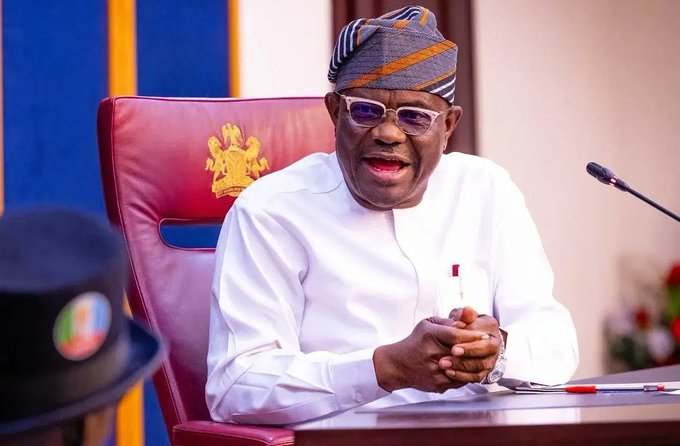
FCT Minister Nyesom Wike has dismissed allegations by the African Democratic Congress that it was denied access to Eagle Square in Abuja for a planned political event, insisting that no formal application was received and that the venue remains open to all groups that comply with established procedures.
The opposition party had earlier alleged that it was obstructed from using the facility for its convention-related activities, sparking public debate over access to one of Abuja’s most prominent public event spaces. The claim quickly circulated in political circles, prompting questions about whether due process or political considerations influenced the decision.
Speaking during an inspection tour of ongoing infrastructure projects in Abuja, Wike rejected the allegations, describing them as unfounded and suggesting they were intended to generate sympathy. He said he was unaware of any denial of access and challenged the basis of the claims.
He explained that the use of Eagle Square is governed by administrative procedures handled through the Abuja Investments Company Limited, which oversees bookings, approvals and associated payments. According to him, all groups are required to follow formal application channels and meet stipulated conditions before any reservation is confirmed.
He maintained that the facility is a public revenue-generating asset and insisted that access is not arbitrarily denied to any political party or organisation that complies with the rules. Wike added that he had not been informed of any pending application from the party making the allegation.
No formal application, he said, had been submitted for the event in question, contrasting the situation with previous bookings by other political parties which, according to him, adhered strictly to established protocols.
He further clarified that the Moshood Abiola National Stadium Velodrome is not under the Federal Capital Territory Administration but is managed by the National Sports Commission.
On recent concerns over damage to the Kugbo Bus Terminal, Wike attributed the incident to a windstorm that dislodged roofing sheets, noting that the structure itself remains intact and safe for use. He dismissed reports of a collapse and said no casualties were recorded.
The minister also provided updates on ongoing infrastructure projects across the capital, stating that several road works are expected to be completed by mid-May, followed by the installation of streetlights toward the end of the month.
He also visited the Wassa artisan site, a designated relocation hub for mechanics and informal sector operators, describing it as part of a long-standing plan to provide structured facilities for their activities.
The minister’s remarks came amid heightened political sensitivity over venue access for party activities in Abuja, with public attention focused on how administrative rules are applied across competing political interests. He reiterated that the FCT Administration seeks to balance access with regulatory compliance and revenue generation objectives.
He emphasized that access to public facilities is guided by institutional frameworks designed to ensure transparency and order in scheduling. According to him, the system is structured to prevent conflicts between competing users while ensuring that public assets generate revenue for maintenance and development.
Public discourse around the issue has largely centred on the broader question of political party access to government-owned venues, a recurring topic in Abuja’s political environment where major gatherings often require coordination with federal agencies.
The Abuja Investments Company Limited, which manages bookings for Eagle Square, is responsible for ensuring that requests are processed in line with established administrative guidelines. This includes verifying availability, confirming payment obligations and coordinating event logistics with relevant authorities.
He explained that the structural issue at the Kugbo Bus Terminal was caused by extreme weather conditions that lifted portions of the roofing, stressing that the underlying framework was not compromised and that repair works were already underway to restore full functionality.
According to the minister, ongoing road rehabilitation projects across several districts in Abuja are progressing steadily, with contractors working under revised timelines aimed at accelerating delivery and improving urban mobility within the capital territory.
The Wassa artisan relocation initiative, he noted, is intended to formalise informal economic activities by providing dedicated infrastructure for mechanics and related trades, thereby reducing congestion in unauthorised urban spaces and improving planning outcomes.
The FCT Administration has consistently maintained that its approach to venue allocation and infrastructure management is guided by administrative neutrality, with emphasis placed on adherence to procedures rather than political affiliation.
Wike also reiterated that public facilities such as Eagle Square are designed not only for civic and political engagements but also as revenue-generating assets for the government, helping to support maintenance and operational costs.
The minister urged the public to rely on verified administrative processes when assessing claims regarding access to federal venues, stressing that transparency and due process remain central to the management of public infrastructure in the Federal Capital Territory.
The controversy comes at a time of heightened political activity in Nigeria’s capital, where opposition parties and ruling party stakeholders frequently organise large-scale events requiring access to major public venues, often leading to scrutiny of allocation procedures.
Officials say such processes are governed by institutional checks intended to ensure fairness, prevent unauthorised use, and maintain order in the scheduling of public infrastructure across the Federal Capital Territory.
In clarifying the distinction between federal agencies managing different venues, the minister underscored that responsibility for specific facilities lies with designated institutions, each operating under separate administrative mandates.
He added that continued investment in infrastructure and orderly management of public assets remains a priority for the administration, as it seeks to balance development needs with efficient governance and public accountability.
Observers note that the ongoing debate reflects broader tensions in Nigeria’s urban governance, particularly in balancing political freedoms with regulatory frameworks that govern shared public facilities. While Wike has maintained that no political actor is being singled out, the issue continues to attract attention as parties prepare for upcoming events in the capital, underscoring the importance of clear communication and adherence to established procedures in preventing disputes over venue access.
Analysts say adherence to procedure remains central to avoiding disputes and ensuring predictable use of public venues framework
📩 Stone Reporters News | 🌍 stonereportersnews.com
✉️ info@stonereportersnews.com | 📘 Facebook: Stone Reporters News | 🐦 X (Twitter): @StoneReportNew | 📸 Instagram: @stonereportersnews
Add comment
Comments