

Reported by: Oahimire Omone Precious | Edited by: Oravbiere Osayomore Promise.
Hundreds of youths from Toru-Orua community in Sagbama Local Government Area of Bayelsa State have called on political leaders and stakeholders in Sagbama Constituency One to respect an existing rotational arrangement for the State House of Assembly seat ahead of the 2027 general elections.
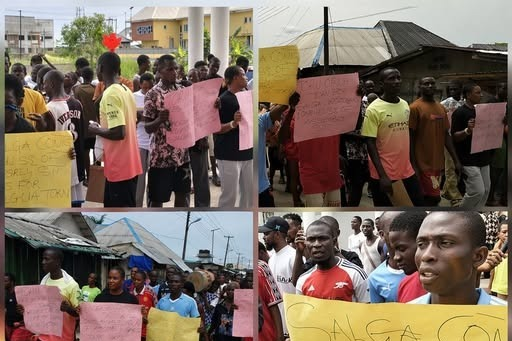
During a weekend peaceful rally, the demonstrators, numbering over one hundred, marched through major streets of the community carrying placards with inscriptions such as Equity, Fairness, Justice and Respect the Rotation, insisting that the arrangement has been central to peace and unity among the six constituent communities.
The youth president of the community, Comrade Fanibia Adidatimi Wisdom, who led the rally, said that since the return to democratic rule in 1999 the rotational policy has ensured inclusiveness and balanced representation across the constituency.
According to him, four of the six communities have already produced representatives leaving only Angiama and Toru-Orua yet to occupy the seat.
He argued that in line with equity and natural justice political parties preparing for the 2027 elections should restrict their candidates to the two remaining communities, particularly Toru-Orua.
Delivering an address at the palace of the Amananaowei of Toru-Orua, His Royal Highness G F Tounaregha, the youth president said the arrangement was designed by visionary leaders along community lines rather than political wards as being suggested in some quarters.
He urged the traditional ruler to use his influence to caution against attempts to reinterpret the arrangement, warning that such moves could cause political tension within the constituency.
Wisdom also commended past and present representatives of the constituency for their contributions to development, including Chief O O Osusu, Hon Timi Fanama, Dr Peter Akpe and the incumbent Dr Godbless Onyuike.
He stressed the need for more dynamic and people oriented representation in 2027, saying the constituency requires a vibrant competent and professionally grounded individual who understands youth aspirations.
He also called for peaceful political engagement as elections approach, urging stakeholders to avoid actions capable of triggering tension or division within the constituency.
He said the rotational policy was conceived by forward thinking leaders prioritising unity, fairness and stability, and was based on communities rather than wards, adding that any attempt to distort it is driven by selfish ambition.
Our constituency deserves a representative in tune with modern realities committed to collective interests, and we are ready to support credible candidates from Toru-Orua or Angiama who fit this description.
We believe this is our turn, having supported all other communities in the past, and we call for reciprocity, noting that politics should not be a do or die affair but a contest of ideas.
He further appealed to youth groups in other communities to support the rotational principle, describing it as a tested mechanism for fairness stability and inclusive governance.
The Amananaowei of Toru-Orua commended the youths for their peaceful conduct, acknowledging their concerns as genuine while noting that candidate selection lies with political parties, and urging parties to maintain existing norms in the interest of peace.
Also the Chairman of the Community Development Committee Mr Odogwu Vincent commended the youths for their peaceful approach and promised to amplify their voices to ensure the status quo is respected.
Political observers in Bayelsa State note that rotational arrangements have long been used in several constituencies as informal mechanisms to balance representation among communities and reduce intra-communal rivalry particularly in riverine areas where ethnic and clan sensitivities often shape electoral competition.
The 2027 general elections are expected to intensify political negotiations across constituencies as aspirants and parties position themselves with local stakeholders increasingly emphasizing zoning arrangements as a means of maintaining stability and preventing post-election disputes.
Security analysts say that community-driven agreements such as rotation pacts can reduce electoral violence if respected but may also become sources of tension when competing interpretations emerge among political actors.
Stakeholders in Sagbama Constituency One continue to watch developments closely as political consultations deepen with calls for restraint dialogue and adherence to long standing community understanding dominating local discourse ahead of party primaries.
Youth participation in local politics in Bayelsa has increasingly become a defining feature of grassroots mobilisation with groups often acting as pressure blocs to influence candidate selection policy priorities and community consensus building.
Political leaders argue that such youth-led advocacy reflects growing civic awareness though they caution that it must remain peaceful and within democratic norms to avoid undermining public order.
The Independent National Electoral Commission is expected to maintain neutrality during candidate selection processes as party primaries and zoning debates unfold across constituencies in the state.
Community leaders continue to emphasize that peace and cohesion remain essential for development especially in oil producing regions where political competition has historically triggered tensions and disputes over representation.
Analysts note that while rotation systems are not formally enshrined in Nigeria’s constitution they continue to play a significant role in local politics particularly in managing diversity and fostering inclusivity among closely linked communities.
Authorities maintain that continued engagement between security agencies and community stakeholders will be essential in sustaining peace and ensuring that political competition does not escalate into violence.
Ultimately the situation in Sagbama Constituency One reflects broader dynamics in Nigerian local politics where informal agreements community expectations and evolving democratic practices intersect to shape electoral outcomes candidate emergence and governance priorities. While youth groups continue to assert their demand for adherence to established rotation principles political actors are balancing these expectations with party structures legal frameworks and the realities of competitive elections. The coming months are likely to see intensified consultations among traditional rulers party executives community leaders and youth organisations as they attempt to harmonise competing interests and preserve stability. Observers say that the effectiveness of dialogue in resolving these tensions will be critical in determining whether the constituency experiences a peaceful and widely accepted electoral process in 2027 or whether disagreements over zoning arrangements will become a source of division. For now the emphasis remains on maintaining calm respecting community understanding and ensuring that political participation continues within peaceful and lawful boundaries across Sagbama and its surrounding communities.
Weeks ahead will test the maturity of local democratic engagement as stakeholders seek to reconcile tradition with contemporary political realities while maintaining the delicate balance between representation fairness and peaceful coexistence in the constituency.
Election observers and civil society groups are expected to continue monitoring developments closely to ensure transparency accountability and peaceful conduct throughout the electoral process in Bayelsa State.
📩 Stone Reporters News | 🌍 stonereportersnews.com
✉️ info@stonereportersnews.com | 📘 Facebook: Stone Reporters News | 🐦 X (Twitter): @StoneReportNew | 📸 Instagram: @stonereportersnews
Add comment
Comments