

Reported by: Oahimire Omone Precious | Edited by: Oravbiere Osayomore Promise.
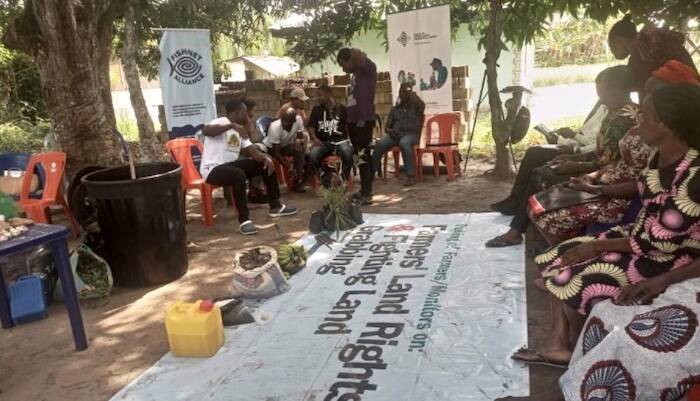
Coastal communities in Eket and Ibeno local government areas of Akwa Ibom State have resolved to take legal action against international oil companies accused of decades of environmental devastation, unveiling a strategic roadmap to push out polluters and hold them accountable for health crises, collapsing fisheries and contaminated farmlands. The decision was announced at a town hall meeting organised by the Community Development Advocacy Foundation (CODAF) in Akwa Ibom State to mark the end of the Africa Week of Action, themed “Kick Polluters Out of Nigeria.” Participants at the meeting singled out TotalEnergies, ExxonMobil (Mobil Producing Nigeria Unlimited) and Seplat as the principal firms allegedly perpetuating pollution under the guise of corporate social responsibility, while also criticising the Nigerian government’s response to oil spill incidents, which they said was riddled with corruption and a lack of accountability.
The communities’ resolve was partly driven by alarming data presented by environmental experts at the meeting. CODAF Project Manager Endurance Oriakhogba attributed a 15‑year life expectancy gap in the Niger Delta – where average life expectancy has fallen to between 40 and 47 years, about 15 years below the national average – to the cumulative effects of hydrocarbon pollution. “In August 2024, over 27 coastal communities in Ibeno LGA were heavily impacted by a major spill allegedly linked to an international oil company’s offshore facility. The spill severely polluted local water bodies and disrupted fishing activities,” Oriakhogba said. He also drew a sharp contrast with France, where the government has banned the granting of new exploration licenses and aims to phase out all active domestic extraction by 2040, while French‑owned TotalEnergies continues aggressive operations in Nigeria.
The health toll documented by community leaders is staggering. Pastor Emem Enyenemkpo, a resident of Inua Eyet Ikot in Ibeno LGA, told PUNCH Healthwise that more than 70 per cent of people in Ibeno now suffer from partial blindness as a direct consequence of relentless gas flaring. “I was blessed with good eyes. But the constant smoke from the gas flares – ExxonMobil, Seplat, Universal Energy, and others – have taken that from me,” he said. “The smoke hangs over us like a thick, choking blanket. It stings our eyes, burns our lungs, and steals our sight.” Other residents have reported erectile dysfunction, irregular menstruation, barrenness, early menopause, skin disorders, respiratory ailments and poisoned drinking water. Mrs. Eno Johnson, a local farmer, said her cassava field once fertile and green now lies greasy and grey, soaked in crude oil. “It’s like the land is breathing poison. Even the plants – the cassava, the pumpkin – nothing grows anymore,” she lamented. Environmental microbiologist Professor Joseph Essien warned that continued flaring exacerbates climate instability, acid rain and ecological collapse.
Beyond health and environmental damage, the communities accused the oil firms of fueling corruption among local leaders and government officials. A youth leader in Eket, Hon. Michael, alleged that compensation payments are rarely made and, when approved, often never reach those directly affected, leaving communities without effective legal or institutional support. Asan Ekong, another community member, raised concerns about Seplat, alleging that the company had recently begun removing its insignia from projects and staff uniforms within the community – a move he interpreted as an attempt to distance itself from environmental damage linked to its operations.
The meeting ended with a collective commitment by Eket and Ibeno communities to shift from protest to legal and advocacy action. CODAF pledged to support a non‑violent campaign focused on legal, economic and advocacy measures. The communities are now working on a comprehensive legal strategy that could involve filing suit against the identified oil firms for environmental degradation, health impacts and economic losses. This decision follows a series of earlier legal actions in the region: in June 2021, a Federal High Court awarded N82 billion in damages against NNPC and Mobil Producing Nigeria Unlimited for oil spill pollution in Akwa Ibom communities. In March 2026, a coalition of NGOs and CSOs petitioned the Nigerian Upstream Petroleum Regulatory Commission (NUPRC), demanding payment of $270 million in outstanding gas flare penalties owed to host communities across seven local government areas, including Eket and Ibeno.
The communities are also emboldened by a landmark Shell settlement in May 2026, in which the Anglo‑Dutch energy giant agreed to pay about $80 million to compensate a Nigerian fishing community for two oil‑pipeline spills in 2008 and 2009 – one of the largest environmental payouts in Africa. Niger Delta communities affected by oil spills have since indicated that they will bypass Nigerian courts and sue Shell and other oil companies in London, following the precedent of the Ogale and Bille communities, whose case was pressed before the UK Supreme Court.
The Nigerian government has previously acknowledged the scale of the crisis. In February 2026, President Bola Tinubu signed Executive Order 9, which mandates that all oil and gas revenues be remitted to the Federation Account. However, community leaders argue that enforcement remains weak and that billions of dollars in gas flare penalties remain unremitted. The Petroleum Industry Act (PIA) 2021, which provides for gas flare penalties to be paid to host communities, has yet to deliver tangible relief to the affected villages.
As the meeting in Akwa Ibom concluded, the message from Eket and Ibeno was unambiguous: the era of passive suffering is over. The communities have vowed to move from protest to prosecution, and CODAF has pledged to support a non‑violent campaign aimed at holding polluters accountable. Whether through Nigerian courts or international legal forums, the people of Eket and Ibeno are now determined to make the oil companies answer for the blindness, the barrenness and the poisoned earth that have defined their lives for generations.
📩 Stone Reporters News | 🌍 stonereportersnews.com
✉️ info@stonereportersnews.com
📘 Facebook: Stone Reporters News
🐦 X (Twitter): @StoneReportNew
📸 Instagram: @stonereportersnews
Add comment
Comments