

Reported by: Oahimire Omone Precious | Edited by: Oravbiere Osayomore Promise.
The Minister of Works, Senator Dave Umahi, has firmly dismissed claims that the recent devastating flooding in Lagos was caused by the ongoing Lagos-Calabar Coastal Highway project, insisting that the road was designed specifically to protect coastal communities from ocean surges rather than worsen flooding.
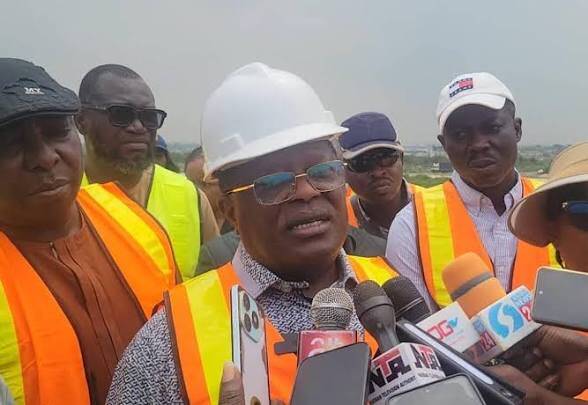
Umahi made the clarification on Thursday, July 2, 2026, during the flag-off of the rehabilitation of the second phase of the Babban Lamba–Sharam Road in Kanke Local Government Area of Plateau State. The minister's comments came amid growing public anger and social media outrage over widespread flooding that submerged roads, homes, and businesses across Lagos, with many residents and critics pointing fingers at the multi-trillion-naira coastal highway project.
Speaking to journalists at the event, Umahi said the Federal Government was aware of the flooding crisis in Lagos and would take action to address it. However, he stressed that the coastal road was not to blame. "We are going to Lagos with our headmaster: the National Assembly works committees, and we are going to see what we can do to help the Lagos State government solve the flood problem. But it's not caused by the coastal road at all," Umahi declared. The minister explained that the coastal road was elevated as part of its engineering design to act as a barrier against ocean flooding. "In fact, the coastal road has been raised to bridge the gap so that the water from the ocean will not cross over to communities and estates," he added.
The minister's latest comments follow similar clarifications made in recent weeks. On June 20, 2026, during an inspection tour of Sections One and Two of the Lagos-Calabar Coastal Highway with members of the National Assembly, Umahi addressed concerns over water retention observed on portions of the highway. He explained that water seen along the median was due to the design provision for a future railway line. "The median was designed for trains. What people are seeing there is about 25 metres wide, almost equivalent to another dual carriageway," he said. He added that excavated portions within the median had been sand-filled, and although the railway component was expected to commence immediately, drainage channels would now be constructed to prevent water accumulation. Umahi admitted that water had gathered in a few depressed sections of the highway but assured that corrective measures were already being implemented. "Where there are slight depressions, water may collect temporarily. I take responsibility for that, and we are addressing it. There is no cause for concern," he stated.
The minister had also previously attributed flooding on the coastal highway to blocked underground drainage channels caused by indiscriminate waste disposal. "The flooding of the coastal highway was because our underground channels were blocked with refuse," he had said in February 2026, urging residents to stop dumping refuse into manholes and drainage systems.
The debate over the cause of Lagos floods comes as the state grapples with one of its worst flooding crises in recent years. Heavy rainfall in June and July 2026 submerged major roads and communities across the metropolis, disrupting businesses, displacing residents, and reigniting long-standing concerns over the state's ageing drainage infrastructure. Lagos, Nigeria's commercial capital, has historically experienced severe flooding due to a combination of factors, including poor drainage systems, rapid urbanisation, and the effects of climate change. However, the construction of the coastal highway has become a lightning rod for public frustration, with many residents blaming the project for worsening the situation.
The Lagos-Calabar Coastal Highway, one of President Bola Tinubu's flagship legacy projects, is designed to stretch over 700 kilometres along Nigeria's Atlantic coastline, connecting Lagos to Calabar and passing through several states. The project has been touted as a major driver of economic growth, job creation, and regional integration. Umahi has repeatedly assured Nigerians that the project would be completed by 2031 and that the government remains fully committed to its delivery. He also disclosed that work was progressing steadily on Sections Three and Four of the coastal highway traversing Cross River, Akwa Ibom, Ogun, and Ondo states, despite challenges posed by difficult terrains, swampy locations, and environmental regulations. The minister commended Hitech Construction Company for sustaining work on the project despite delayed payments from the government, describing the contractor's commitment as a demonstration of genuine partnership in national development.
As Lagos residents continue to grapple with the aftermath of the floods, Umahi's reassurance offers little comfort to those who have lost homes and livelihoods. However, the minister has made his position unmistakably clear: the coastal highway is a solution to flooding, not a cause.
📩 Stone Reporters News | 🌍 stonereportersnews.com
✉️ info@stonereportersnews.com | 📘 Facebook: Stone Reporters News | 🐦 X (Twitter): @StoneReportNew | 📸 Instagram: @stonereportersnews
Add comment
Comments