

Reported by: Oahimire Omone Precious | Edited by: Oravbiere Osayomore Promise.
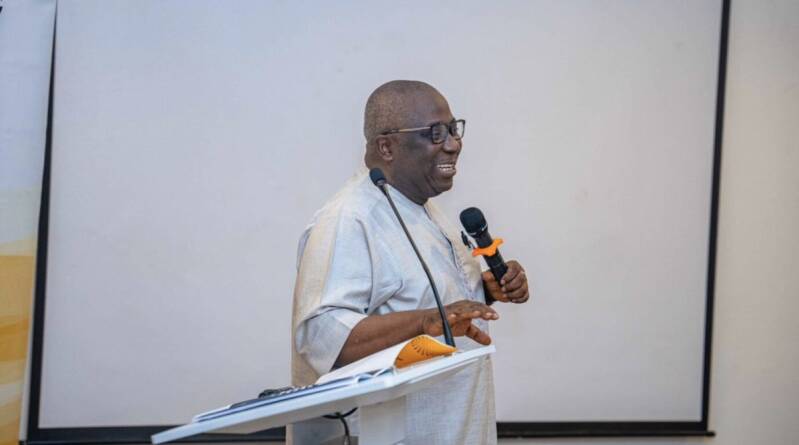
The publisher of Premium Times and Chief Executive Officer of the Centre for Journalism Innovation and Development (CJID) has called for a new professional ethic for reporting religion, warning that irresponsible media coverage of faith matters poses a direct threat to Nigeria's constitutional democracy and national cohesion. Delivering a keynote address on Monday, 13 July 2026, at a breakfast dialogue on "Religion and Freedom of Religion in Media Reports in Nigeria" organised by the Konrad-Adenauer-Stiftung (KAS) in Abuja, Olorunyomi said that while religion in Nigeria is "performed, narrated, debated, contested, celebrated, commercialised, and increasingly mediated," the journalism profession has not kept pace with the ethical demands of covering faith in a deeply religious and deeply divided society.
Olorunyomi argued that the proposed charter—which he described as an "ethical covenant" rather than a legal code—should be founded on the principle that religious freedom and press freedom are not competing liberties but mutually reinforcing rights. "When one is weakened, the other inevitably suffers," he said. He was careful to define what he meant by "Faith Journalism," clarifying that it is not journalism that advocates for a religion, defends religious institutions from scrutiny, or turns reporters into evangelists. Rather, he described it as "the disciplined, independent, constitutionally grounded practice of reporting religion with the rigour, literacy, and moral seriousness the subject demands." This includes distinguishing faith from those who speak falsely in its name, holding religious power accountable exactly as political and economic power is held accountable, and treating every citizen of every conviction—or none—as constitutionally equal.
He grounded his argument in four pillars: what the Nigerian Constitution requires under Section 38, which guarantees freedom of thought, conscience, and religion; what is known about how media framing shapes reality; what the nation's deepest moral traditions converge upon; and what the rise of artificial intelligence has now made urgent. "Behind that claim sit questions that many of us have asked in private but rarely answered in public," he said. "How should journalists report religion in a society where faith commands such deep emotional allegiance?"
Olorunyomi outlined several key principles that should guide the proposed ethical charter. These include placing truth above speed, distinguishing faith from those who falsely claim to represent it, reporting context rather than only conflict, protecting the equal dignity of every citizen, holding religious authorities accountable, rejecting sensationalism, promoting religious literacy in newsrooms, safeguarding the integrity of the information environment, and fostering the ethics of constitutional citizenship. "The pressure to be first is relentless in the digital era, but credibility is earned by accuracy, not speed," Olorunyomi said. "In religious reporting, the cost of error is measured in more than reputation; it can be measured in lives." He cautioned journalists against allowing the misconduct of a single cleric to indict an entire community or letting an extremist minority define a whole tradition. He also stressed that Nigeria's religious landscape is not defined only by conflict but also by shared festivals, interfaith marriages, joint humanitarian efforts, and peaceful coexistence. "A nation cannot imagine peace if it is shown only conflict," he said.
He further argued that religious institutions with moral, economic, and political influence deserve the same scrutiny applied to government and business. "Accountability strengthens authentic religion, because it strengthens public trust," he said. He also warned against the dangers of digital platforms that reward emotional intensity over understanding. "Headlines should illuminate, not inflame," he said. "Public trust outlasts viral traffic."
Olorunyomi concluded by urging journalists to report in such a way that every Nigerian, whatever their conviction, is treated first as a citizen of equal constitutional worth. "If our journalism is truthful, our democracy will be wiser; and if our religion is compassionate, our citizenship will be stronger," he asserted.
Also speaking at the event, the Resident Representative of KAS, Moritz Sprenker, said religion in Nigeria is not an abstract concept and that journalism can either build understanding or deepen mistrust. "A headline can clarify or inflame. A report can shed light on complexity or reduce it to a harmful binary," he said. He noted that Nigeria's conflicts are rarely one-dimensional and that religion often intersects with ethnicity, politics, and economic realities. "When we reduce complex situations to religious conflict alone, we risk overlooking deeper causes and possible solutions," he added. Sprenker said the dialogue was organised not to criticise the media but to reinforce the importance of free, professional, and responsible journalism in safeguarding both freedom of religion and freedom of expression. The event also featured contributions from political scientist and author Professor Alexander Görlach, who warned that religion is increasingly being instrumentalised for political gains in different parts of the world and urged societies to resist such manipulation.
📩 Stone Reporters News | 🌍 stonereportersnews.com
✉️ info@stonereportersnews.com | 📘 Facebook: Stone Reporters News | 🐦 X (Twitter): @StoneReportNew | 📸 Instagram: @stonereportersnews
Add comment
Comments