

Reported by: Puis Althea | Edited by: Oravbiere Osayomore Promise.
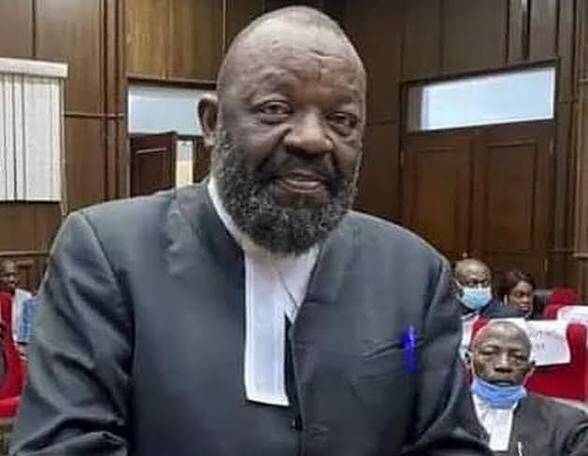
Human rights lawyer and special counsel to detained IPOB leader Nnamdi Kanu, Aloy Ejimakor, has weighed into the controversy surrounding President Bola Tinubu's 1993 civil asset forfeiture in the United States, arguing that while the case raises legitimate moral questions, it does not amount to a criminal conviction under U.S. law. Ejimakor, who said he trained and practised law in the United States for several years, maintained that the $460,000 forfeiture was a civil in rem proceeding—a lawsuit filed against the money itself, not against Tinubu as an individual—and should not be interpreted as proof of criminal guilt.
Ejimakor's intervention comes amid a fierce political battle between President Tinubu and former Vice President Atiku Abubakar, with Atiku's camp resurrecting the decades-old U.S. forfeiture case to question Tinubu's moral fitness for office. The controversy stems from a 1990s U.S. federal investigation into a Chicago-based heroin trafficking ring operated by drug kingpins Adegboyega Mueez Akande and Abiodun Agbele. According to U.S. court documents and affidavits from the IRS and FBI, funds in bank accounts controlled by Tinubu were tied to narcotics proceeds, with IRS Special Agent Kevin Moss establishing that proceeds from the drug ring were systematically deposited into multiple U.S. bank accounts opened and controlled by Tinubu.
In January 1992, U.S. authorities obtained a court order to freeze accounts holding more than $1.4 million linked to Tinubu. The investigation revealed that the massive sums in these accounts did not align with Tinubu's reported legitimate income at the time. When investigators interviewed representatives from Mobil Oil Nigeria, where Tinubu worked as a treasurer, the company stated that under no circumstances would an employee be permitted to hold corporate funds in private accounts. On September 15, 1993, an out-of-court agreement was reached before Judge John A. Nordberg, and on October 4, 1993, the U.S. District Court for the Northern District of Illinois ordered that $460,000 held in account 263226700 at First Heritage Bank in the name of Bola Tinubu be forfeited to the U.S. government. The court explicitly decreed that these specific funds represented proceeds of narcotics trafficking or were involved in financial transactions violating money laundering laws under federal statutes. The remaining funds, over $1 million, were released back to the family.
Ejimakor, who said he had represented several Africans in similar forfeiture cases during his legal career in the U.S., explained that under U.S. law, there is a clear legal distinction between criminal convictions and civil asset forfeiture proceedings. "The certified record of the pertinent proceedings in the Tinubu case show that the 1993 forfeiture of $460,000 from bank accounts linked to President Tinubu was strictly a civil in rem proceeding, not a criminal in personam conviction," he said. He cited the 1996 U.S. Supreme Court decision in United States v. Ursery, which held that civil in rem forfeitures are remedial civil actions against property and are legally distinct from criminal punishment.
While acknowledging that critics may leverage the underlying allegations to question Tinubu's moral standing, Ejimakor insisted that such arguments should not be confused with the legal position. "While critics are free to leverage the underlying allegations of narcotics proceeds to argue moral turpitude or fitness for public office, the legal reality remains distinct, and that is: Tinubu was never charged, tried, or convicted of a crime," he said. "Therefore, conflating his civil asset forfeiture with a criminal guilt misinterprets statutory mechanics and the binding judicial precedents on point." Ejimakor stressed that his comments were intended as an explanation of U.S. law rather than an endorsement of the Nigerian president, noting that he was still on trial for allegedly participating in a #FreeNnamdiKanu protest.
The controversy has been fuelled by claims from Atiku's media office that Tinubu's 60-page U.S. Department of Justice files on alleged heroin trafficking and the forfeiture of $460,000 had been brought to the attention of U.S. President Donald Trump through a Washington-based lobbying firm. Atiku, the presidential candidate of the African Democratic Congress, has repeatedly challenged the Presidency to address questions surrounding the U.S. court documents, alleging that the Tinubu administration was attempting to conceal the matter through political attacks. The Presidency, however, has maintained that the civil forfeiture issue "was resolved over 30 years ago in the United States and has been thoroughly litigated, explained, and rendered moot by the electoral mandates conferred on President Bola Tinubu."
The Nigerian Presidential Election Petition Court had previously held that the forfeiture order against Tinubu was in a civil matter and not a criminal matter, emphasising that there was no evidence to show that the president was either arraigned or convicted in the U.S. over any alleged crime to warrant his disqualification. Despite this, Atiku's camp has insisted that no amount of denials or whitewashing would erase Tinubu's records of the forfeiture linked to drug trafficking. Ejimakor's intervention adds a nuanced legal perspective to the debate, distinguishing between civil forfeiture and criminal conviction while leaving the moral questions for the public to decide.
📩 Stone Reporters News | 🌍 stonereportersnews.com
✉️ info@stonereportersnews.com | 📘 Facebook: Stone Reporters News | 🐦 X (Twitter): @StoneReportNew | 📸 Instagram: @stonereportersnews
Add comment
Comments