

Reported by: Ijeoma G | Edited by: Oravbiere Osayomore Promise.
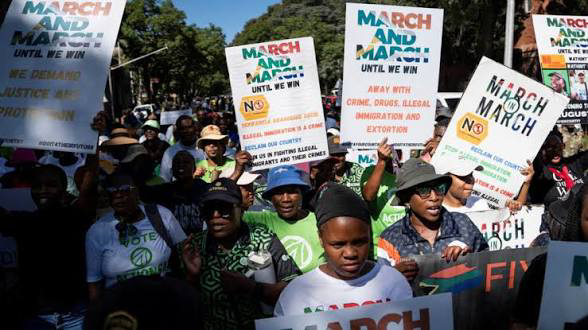
South Africa's anti-immigration movement, March and March, has escalated its campaign against undocumented migration, setting a fresh September 30, 2026, deadline for all undocumented foreigners to leave the country. The group made the announcement on Monday, August 17, while staging a demonstration in Durban, where the 46th Ordinary Summit of the Southern African Development Community (SADC) was taking place. The protesters marched through the city's central business district under the theme "It's time to fetch your people," directly appealing to African heads of state to take responsibility for their citizens residing illegally in South Africa.
The movement, led by Jacinta Ngobese-Zuma, described the upcoming action as the "second wave" of its June 30 National Day of Action and vowed that the September protest would surpass the scale of the previous demonstrations held across all nine provinces. "The movement is confident and in a structurally better position than it was on June 30 to launch the mother of all national days of action against illegal foreigners in South Africa," the group said in a statement. It called on all SADC heads of state to prepare for what it described as a "massive deportation of all illegal foreign nationals in South Africa by September 30."
The Durban protest coincided with the gathering of leaders from the 16 SADC member states, who were meeting to discuss regional integration and cooperation. March and March used the summit as a backdrop to pressure regional governments to act. "We call on all heads of state to prepare for a massive deportation of all illegal foreign nationals in South Africa by September 30, 2026," said national spokesperson Sandile Dube. The group also urged South Africans to assist law enforcement agencies by reporting individuals suspected of staying in the country illegally, and called on the police to withdraw a July 2026 national instruction circular, which it labelled unconstitutional.
The renewed anti-immigration campaign comes against a backdrop of growing concerns over xenophobia and attacks targeting foreign nationals in South Africa. The June 30 demonstrations had already sparked panic among migrant communities, with reports of foreign nationals fleeing their homes and shuttering businesses. An estimated 178,000 African migrants have reportedly left South Africa amid the wave of xenophobic protests and the threat of vigilante violence. The movement has demanded stricter visa controls, a review of asylum policies, action against employers who hire undocumented workers, accountability for corrupt police officials, and restrictions on undocumented migrants' access to public services.
President Cyril Ramaphosa has previously condemned the mistreatment of migrants from other African countries, warning against actions that undermine regional integration. Speaking at the University of KwaZulu-Natal on Friday, Ramaphosa said South Africa could not push for closer regional ties while people from neighbouring countries faced intimidation and violence. "We are deeply ashamed that people from other countries have suffered ill-treatment and that others have been forced to leave the country because of threats of violence," Ramaphosa said. "We cannot preach integration at a summit like this and practise exclusion on the streets of our countries."
The March and March movement has insisted that its campaign is not xenophobic but a legitimate demand for the enforcement of South Africa's immigration laws. However, critics have warned that the group's rhetoric and tactics risk inciting violence against foreign nationals. The movement remains concerned about the safety of its own supporters, alleging that ordinary South Africans who call for the eviction of illegal foreign nationals are not protected by their government. "They see a government that prioritises the safety of illegal foreign nationals at the expense of vulnerable South African citizens," the group said.
As the September 30 deadline approaches, tensions over immigration are expected to rise further in parts of KwaZulu-Natal, Gauteng and the Western Cape. The movement has vowed to continue its protests every Thursday until the government responds to its demands. With the deadline looming, the South African government faces mounting pressure to address the issue of undocumented migration while balancing the need to protect the rights of foreign nationals and maintain regional stability.
📩 Stone Reporters News | 🌍 stonereportersnews.com
✉️ info@stonereportersnews.com | 📘 Facebook: Stone Reporters News | 🐦 X (Twitter): @StoneReportNew | 📸 Instagram: @stonereportersnews
Add comment
Comments