

Reported by: Oahimire Omone Precious | Edited by: Oravbiere Osayomore Promise.
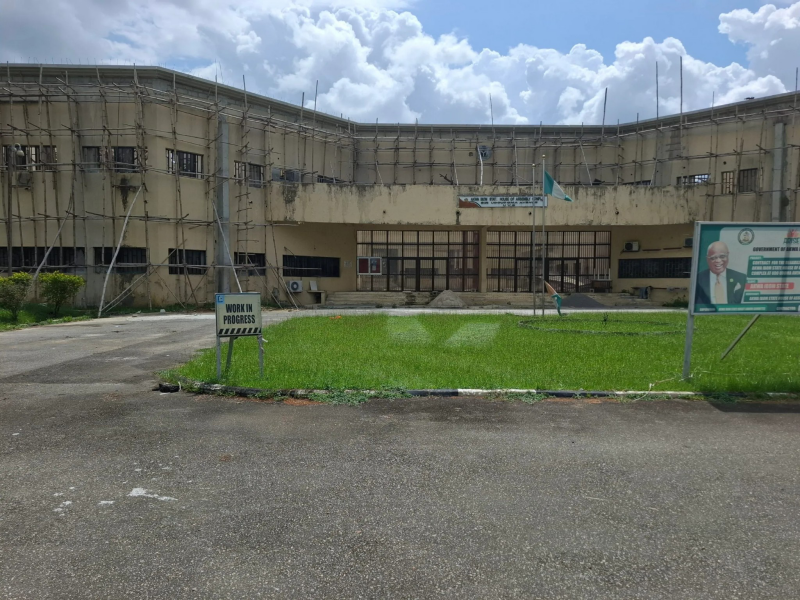
For nine months, the Akwa Ibom State House of Assembly Complex in Uyo has stood as an eerily quiet monument to abandoned promises, with no substantial work carried out despite the state government allocating a staggering N15.47 billion for its rehabilitation and remodeling. Lawmakers and staff vacated the premises in October 2025 for what was supposed to be a six-month renovation project. That deadline expired in April 2026. More than three months later, the complex remains largely untouched, while just a few metres away, construction workers are busy on three hospitality projects that the state government is funding with a combined budgetary provision of N248.83 billion. The contrast is stark, and the questions are mounting.
On a visit to the assembly complex in August 2026, Premium Times reporters found no labourers, masons, welders, carpenters, or engineers. There were no sounds of construction. The only people visible were eight security personnel. A mobile crane and a concrete mixer that had been seen during an earlier visit in June were still on the premises, but no workers were operating them. The section of the complex where the roof had been removed remained exposed to the elements, with walls showing the effects of weather damage. The football field within the assembly premises was being used by local youths for a match, a surreal sight for what should be the headquarters of the state's legislative authority.
The project, which was first publicly promised by Governor Umo Eno in July 2024, was designed to be a comprehensive overhaul of the legislative complex. The initial 2025 budget provided N2.95 billion for architectural design, construction of a multi-purpose hall, reroofing, replacement of ceilings, tiling and painting. By 2026, the scope had expanded dramatically to include structural remodelling, construction of new office buildings, library facilities, marble flooring, parking lots, and an electric security perimeter fence. The allocation for these expanded works totalled N12.52 billion. Combined with the 2025 provision, the project attracted a total budgetary allocation of N15.47 billion within two years.
Yet, despite the billions of naira allocated, the work remains unfinished. In October 2025, the Clerk of the House, NsikakAbasi Orok, issued a circular directing lawmakers, staff, and other occupants to vacate the complex ahead of the commencement of rehabilitation on October 27. Representatives of the contractor, identified as a company incorporated less than 10 months before securing the project and with no publicly available history of executing major public infrastructure contracts, met with members of the House Services Committee and gave a six-month completion timeline. That timeline expired in April 2026. By August 2026, the project was still idle.
The lawmakers, meanwhile, have been conducting plenary sessions at a facility within the Government House, Uyo, for months. The legislative headquarters of one of Nigeria's richest oil-producing states, with a revenue of N2.53 trillion in 32 months, has been reduced to an abandoned shell, while the administration pushes forward with tourism projects.
The contrasting scenes at the assembly complex and the adjoining Ibom International Hotel, International Convention Centre, and other hospitality projects have drawn sharp criticism from civil society groups and transparency advocates. The Akwa Ibom State Government has not provided any public explanation for the delay, and there has been no official statement on when the rehabilitation will resume or when lawmakers will be able to return to their permanent chambers.
The silence from the government, combined with the absence of contractor records and the unanswered questions about procurement, has fuelled speculation about a lack of political will to complete the project. Some observers have suggested that the governor's focus on high-profile hospitality projects may have diverted attention and resources away from the legislative complex. Others have questioned the independence of the legislature, which has been forced to operate away from its headquarters for nearly a year.
As the state government continues to pour billions into tourism infrastructure, the people of Akwa Ibom are left to wonder: when will their lawmakers return to their chambers? When will the N15.47 billion allocated for the rehabilitation of the assembly complex translate into visible progress? And who will be held accountable for the nine months of idleness?
For now, the Akwa Ibom State House of Assembly Complex remains a ghost project—a stark reminder that in the pursuit of grand visions, the fundamentals of governance can sometimes be left behind.
📩 Stone Reporters News | 🌍 stonereportersnews.com
✉️ info@stonereportersnews.com | 📘 Facebook: Stone Reporters News | 🐦 X (Twitter): @StoneReportNew | 📸 Instagram: @stonereportersnews
Add comment
Comments