

Reported by: Ijeoma G | Edited by: Oravbiere Osayomore Promise.
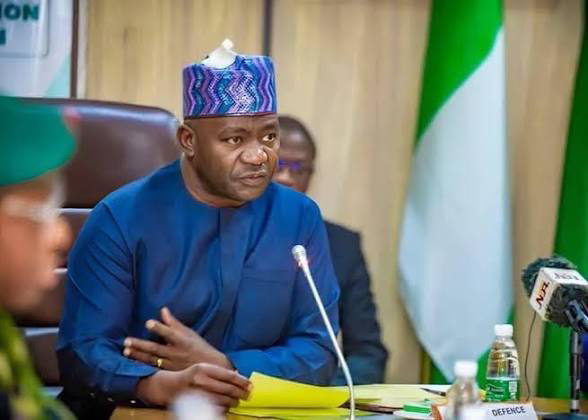
The Minister of Defence, General Christopher Gwabin Musa (retd.), has issued a stark and uncompromising warning to Nigeria's political class, declaring that no security architecture, regardless of how sophisticated, can guarantee peaceful elections in 2027 if political actors choose violence over dialogue. Speaking as the guest speaker at the 8th edition of the Blueprint Newspapers Public Lecture, Impact Series and Awards, themed "Security Challenges and the Integrity of Nigeria's 2027 Elections," the minister delivered a keynote address that pulled no punches, insisting that the responsibility for credible and peaceful elections is shared among all stakeholders and cannot be left to security agencies alone.
Represented by his Senior Special Adviser on Policy and Strategy, Major General Olufemi Akinjobi (retd.), Musa told the gathering in Abuja on Tuesday, August 18, 2026, that the character of security itself has fundamentally changed. "Today's threats rarely announce themselves with uniforms or conventional weapons," he said. "They emerge through cyberspace, spread through manipulated information, exploit economic hardship, inflame ethnic and religious divisions, and undermine confidence in public institutions. Increasingly, they seek not merely to influence how citizens vote, but whether citizens believe in democracy itself." The minister argued that election security can no longer be viewed simply as the protection of polling stations, but rather as the protection of democratic legitimacy. "This distinction matters because, while elections may be won at polling units, democracies are sustained by public trust," he said. "Public trust has become one of the most strategic national assets any country can possess."
Musa's warning was unambiguous: "No security architecture, regardless of how sophisticated, can guarantee peaceful elections if political actors choose violence over dialogue. No electoral law can succeed where misinformation is allowed to replace truth. No democratic institution can flourish where citizens lose faith in the rule of law." The minister stressed that security, in its truest sense, is not merely the absence of violence but the presence of confidence. "It is the assurance that every Nigerian can speak freely, assemble peacefully and vote without fear. It is the certainty that our institutions will act with integrity, professionalism and fidelity to the Constitution," he said.
To address the evolving threats, Musa proposed a six-point "Secure Framework" for strengthening election security ahead of the 2027 polls. The framework comprises strategic intelligence integration, threat assessment, protection of digital infrastructure, electoral cyber resilience, civil-military coordination, and unified strategic communications. He said the proposed pillars would provide a practical pathway not only to securing elections but also to protecting the democratic legitimacy upon which national stability depends. The minister assured that as the country moves towards the 2027 elections, the Ministry of Defence would work closely with the Office of the National Security Adviser, the Armed Forces of Nigeria, the Nigeria Police Force, the Department of State Services, the Defence Intelligence Agency, the Independent National Electoral Commission, and other relevant institutions to ensure that all constitutionally assigned responsibilities in support of the electoral process are discharged professionally, impartially and effectively.
In a section of his address that carried particular weight, Musa reiterated that the Armed Forces have no partisan interest in the outcome of elections. "Let me emphasise once again that the Armed Forces have no partisan interest in the outcome of elections. Our institutional interest is that Nigeria remains peaceful, united and secure, and that every lawful responsibility assigned to us is carried out with honour, professionalism and accountability," he declared. "The Armed Forces of Nigeria are, first and foremost, defenders of the Constitution. Our mandate is to defend the sovereignty and territorial integrity of the Federal Republic of Nigeria and, where lawfully authorised, to provide Military Aid to Civil Authority in support of other security agencies. This support is never partisan. It is constitutional."
The minister also warned of the growing threat of cyber interference, misinformation, and manipulated digital content, which he said could pose as much danger to the integrity of the 2027 elections as physical violence. He noted that the digital revolution and artificial intelligence have created new vulnerabilities, including the ability to generate convincing but entirely fabricated videos, cloned voices, and manipulated images capable of misleading millions within minutes. "The greatest threat to an election today may not necessarily be the individual carrying a weapon near a polling unit. It may well be the anonymous actor operating behind a computer screen, deliberately manipulating information, exploiting social divisions and attempting to weaken confidence in democratic institutions," Musa said.
The minister called on political parties to place national interest above partisan advantage, and candidates to recognise that political competition is not warfare. He urged the media to report with courage, accuracy and restraint, while civil society deepens civic education and promotes peaceful participation. Traditional and religious leaders, he said, must remain voices of moderation and reconciliation, while young people must reject every attempt to recruit them as instruments of violence. "Every institution has a role. Every citizen has a responsibility. Every vote carries not only a political choice but also a commitment to the future of our Republic," he said.
Musa concluded his address with a powerful reminder of what is at stake in 2027: "The election of a President, Governor or legislator is undoubtedly important. But there is something even greater that must emerge victorious in 2027: Nigeria herself. Long after campaign slogans have faded, after ballots have been counted and after winners have been declared, this nation must remain united, secure and confident in the strength of her democratic institutions."
The minister's warning comes at a time of heightened political tension ahead of the 2027 general elections, with opposition figures and civil society groups increasingly vocal about concerns over electoral violence, misinformation, and the manipulation of state institutions. His call for a shared responsibility and his insistence that the Armed Forces remain non-partisan serve as a reminder that the integrity of Nigeria's democracy depends not on the might of its security apparatus, but on the willingness of its political actors to place the nation above their ambitions. As one observer put it, "No security architecture can save a country from itself." The defence minister has made that point unmistakably clear.
📩 Stone Reporters News | 🌍 stonereportersnews.com
✉️ info@stonereportersnews.com | 📘 Facebook: Stone Reporters News | 🐦 X (Twitter): @StoneReportNew | 📸 Instagram: @stonereportersnews
Add comment
Comments