

Reported by: Ijeoma G | Edited by: Oravbiere Osayomore Promise.
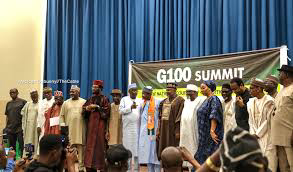
A coalition of six opposition political parties has proposed a historic framework for a single, four-year "Government of National Competence" (GNC) to serve as a transition administration if they succeed in unseating President Bola Tinubu in the 2027 general elections. The proposal, unveiled at a summit convened by the political pressure group G100 at the Shehu Musa Yar'Adua Centre in Abuja on Monday, August 31, 2026, seeks to move beyond the fragmented opposition that handed the ruling All Progressives Congress (APC) victory in 2023.
The summit was attended by representatives of the African Democratic Congress (ADC), Allied Peoples Movement (APM), Nigeria Democratic Congress (NDC), Peoples Democratic Party (PDP), Peoples Redemption Party (PRP), and Social Democratic Party (SDP). While the meeting drew presidential and vice-presidential candidates, including Adewole Adebayo (SDP), Donald Duke (PRP), and Lawal Musa Daura (APM), three of the alliance's most prominent figures were notably absent: former Vice President and ADC presidential candidate Atiku Abubakar, NDC presidential candidate Peter Obi, and Oyo State Governor and APM presidential candidate Seyi Makinde.
Presenting the proposal on behalf of the G100, Mallam Salihu Moh. Lukman, a former National Vice-Chairman (North-West) of the APC, outlined a framework designed to avoid the errors of 2023, when opposition votes were fatally split. He argued that the opposition's failure to unite then was a self-inflicted wound that cost them the presidency.
The core of the proposal is the establishment of a GNC built on the principles of competence, integrity, national inclusion, and fair representation for all participating parties. The proposed government would be bound by a disciplined, time-limited "Four-Year National Reset Programme" and an "enforceable Transition Charter" to ensure compliance.
Lukman stressed that the arrangement must be more than a collection of political promises. "We want to underline the word 'enforceable.' This gathering does not need more sincerity. Nigerian politics has never suffered from a shortage of sincere promises. What it has suffered from is promises that nobody could enforce when the person who made them changed his/her mind," he declared. He insisted that any agreement "must be written, it must be witnessed, and it must have consequences".
Lukman used the arithmetic of the 2023 election to underscore the urgency of unity. He noted that the APC's Bola Tinubu secured just under nine million votes, while two major opposition candidates jointly polled over 13 million votes. "Thirteen million votes on one side of the argument, under nine million on the other. And the side with fewer votes formed the government, lawfully, constitutionally, and entirely predictably," he said.
The G100 proposal establishes a clear structure for the coalition. It includes three standing bodies: a Central Leadership Committee, a Publicity and Communication Committee, and a Legal Committee. Five working groups are expected to develop key documents within four weeks. These include a National Covenant for Democratic Renewal, a Single-Term Transition Charter, a National Reform Programme, a Framework for Opposition Unity, and a roadmap for selecting a common presidential candidate.
Lukman clarified that the summit was not calling for the dissolution of any political party or the immediate withdrawal of any candidate. "The immediate objective is to establish a framework for cooperation before discussions on leadership and candidates begin," he said. He also stressed that the G100 was not endorsing any party or candidate but was facilitating the process to provide Nigerians with a credible alternative government.
The absence of Atiku, Obi, and Makinde at the inaugural summit has raised immediate questions about the viability of the coalition. Their eventual participation will be crucial for the success of any united opposition front in 2027. The G100 initiative, however, has laid down a clear and structured path forward. It attempts to transform the perennial opposition calls for unity into a binding, enforceable framework designed to prevent the fragmentation that has been the opposition's Achilles' heel in past elections.
The success of this ambitious plan now hinges on whether the parties and their presidential candidates can overcome personal ambitions to commit to a single-term government that would reset Nigeria's political and economic trajectory. For a nation weary of the ruling party's policies, the G100's proposal offers a concrete, if challenging, alternative for the 2027 elections.
📩 Stone Reporters News | 🌍 stonereportersnews.com
✉️ info@stonereportersnews.com | 📘 Facebook: Stone Reporters News | 🐦 X (Twitter): @StoneReportNew | 📸 Instagram: @stonereportersnews
Add comment
Comments