

Reported by: Ijeoma G | Edited by: Oravbiere Osayomore Promise.
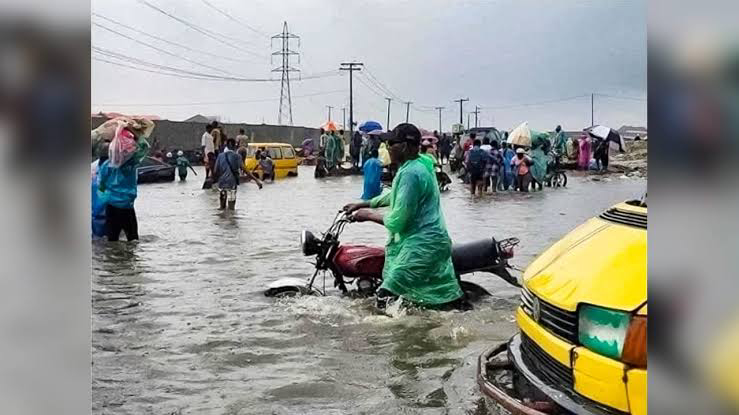
Floodwaters that submerged luxury vehicles, stranded commuters, and forced businesses to shut their doors in Abuja on Saturday have once again exposed a troubling paradox at the heart of Nigeria's capital city: despite receiving a staggering N227.4 billion in federal allocations over the past 12 months and N766.3 million in Ecology Fund distributions, the Federal Capital Territory remains dangerously vulnerable to flash floods that have become a seasonal nightmare for residents.
The heavy downpour on August 15, 2026, turned major roads into rivers, inundated residential areas, and left motorists trapped for hours in Wuse 1 and Wuse 2, as well as parts of Durumi, Gaduwa, Gudu, Lugbe, Nyanya, Gwarinpa, Asokoro, Maitama, Utako and Wuye. At Adetokunbo Ademola Crescent in Wuse 2, floodwater rose above car bonnets. The bridge linking Gaduwa and Durumi was overwhelmed, cutting off movement between two busy districts. In Gudu, the Delight Event Centre was heavily flooded, while Efab Estate in Lokogoma also recorded significant inundation. One resident, filming the submerged Ebeano-Gudu road, made a direct plea to FCT Minister Nyesom Wike: "Mr Project, please come and help us."
But the question on many lips is not whether the minister heard the cry, but why such devastation continues despite the billions of naira already channelled into the territory's coffers. A SaharaReporters analysis of federal allocation figures reveals that the FCT received a total of N227.4 billion between July 2025 and June 2026, averaging about N18.95 billion monthly. June 2026 alone saw a record N30.6 billion inflow – more than 13 per cent of the entire 12-month total. During the same period, the six Area Councils – Abaji, Abuja Municipal Area Council (AMAC), Bwari, Gwagwalada, Kuje and Kwali – received at least N766.3 million in Ecology Fund distributions meant specifically to tackle environmental challenges like flooding. AMAC, the most urbanised council, received the largest share of N211.31 million.
Yet, despite these substantial funds, the flooding has continued unabated. The Nigeria Hydrological Services Agency had warned that flooding could worsen between August and September, and the FCT was listed among areas at high risk. Residents and environmental observers point to a litany of systemic failures: blocked drainage channels, poor waste management, rapid urbanisation that has replaced natural absorption surfaces with concrete, and the encroachment on designated green areas and waterways. Some residents have also accused the FCT Administration of deviating from the Abuja Master Plan, which was carefully designed to prevent precisely this kind of environmental crisis.
The FCT Administration has attributed the recurrent flooding to scavengers who steal drainage covers and ageing infrastructure that has failed to keep pace with the city's expansion. The government has said it is reviewing the 1979 Master Plan to accommodate new realities. But for residents who watched their cars disappear under muddy water and their businesses come to a standstill, these explanations ring hollow.
"With over N227 billion in federal allocations and N766 million in ecology funds, where is the money going?" one resident asked. "We are seeing floods in places we never used to see them. This is not just about rainfall; this is about governance failure."
The Saturday flood is the latest in a series of similar incidents that have plagued Abuja despite repeated warnings and substantial public spending. Daily Trust had previously reported that more than N109.5 billion was released from Nigeria's Ecological Fund between July 2023 and December 2025, yet flooding has continued to ravage communities across the country, including the FCT. The funds were meant to strengthen flood-control measures, improve drainage systems, and address environmental challenges, but the gap between expenditure and outcome remains painfully wide.
As the rainy season reaches its peak, residents of Abuja are left to wonder whether the city that was once a symbol of Nigeria's aspirations has become a monument to wasted resources. The sight of luxury vehicles submerged in floodwater is not just a traffic inconvenience; it is a stark indictment of a system that collects billions but delivers little more than excuses. And as one resident put it, "The rain is not the problem. The problem is that we have a government that cannot protect its own capital city."
📩 Stone Reporters News | 🌍 stonereportersnews.com
✉️ info@stonereportersnews.com | 📘 Facebook: Stone Reporters News | 🐦 X (Twitter): @StoneReportNew | 📸 Instagram: @stonereportersnews
Add comment
Comments