

Reported by: Ijeoma G | Edited by: Oravbiere Osayomore Promise.
Troops of the Joint Task Force (North East), Operation HADIN KAI (OPHK), have maintained a relentless tempo of air and ground offensives against terrorist groups in Borno State, neutralising dozens of insurgents, dismantling a major waterway logistics hub, and destroying key hideouts in a series of coordinated strikes over the past two weeks. The latest operations, conducted between mid and late April 2026, targeted Islamic State West Africa Province (ISWAP) elements operating in the Lake Chad basin and the Sambisa Forest, as well as Boko Haram factions in the Mandara Mountains.
In one of the most significant raids, the Air Component of OPHK delivered devastating precision air strikes that dismantled an ISWAP logistics network along the Lake Chad waterways near the Kaniram Island axis on the night of 21–22 April. Acting on credible Intelligence, Surveillance and Reconnaissance (ISR) inputs, air assets established a persistent overhead presence and confirmed the concentration of over 30 terrorist boats and associated fighters coordinating resupply activities. Lt. Col. Sani Uba, Media Information Officer for OPHK, disclosed in a statement that following careful target validation, the air component executed well-coordinated precision strikes that destroyed several boats and disrupted the terrorists’ logistics hub. The attack immediately degraded the insurgents’ mobility and ability to sustain operations.
Real-time ISR enabled rapid follow-on strikes against fleeing elements within nearby vegetation, leading to the neutralisation of over 30 terrorists. The military assessed that the surviving fighters escaped in disarray, reflecting a breakdown in their cohesion and command structure. In a related engagement at Sowolwolo in the Sambisa Forest axis, additional precision-guided strikes were conducted, taking out three terrorist gun trucks and neutralising more insurgents within the vicinity. Battle Damage Assessment (BDA), supported by post-strike intelligence, confirmed significant enemy losses, with evidence of mass burial activities noted around the Mallam Fatori axis.
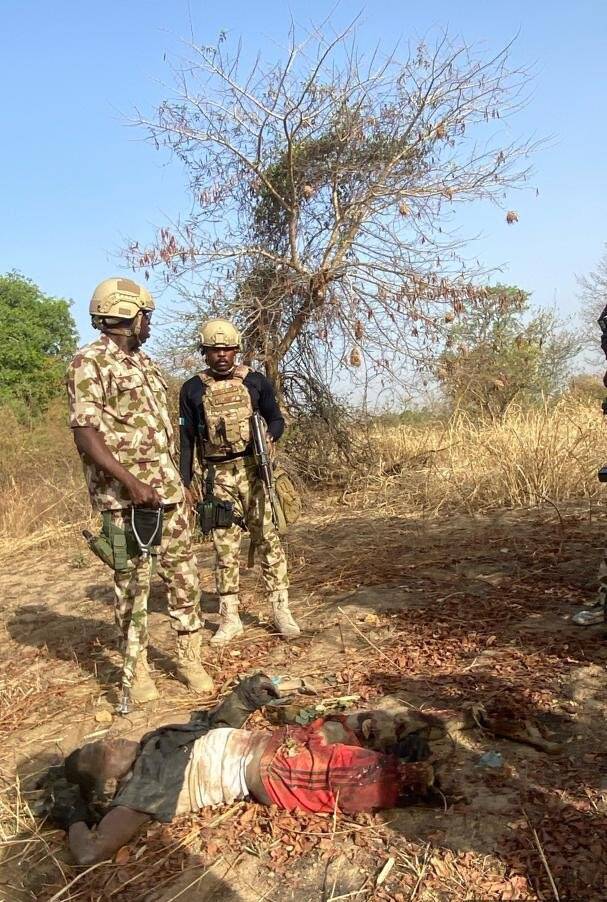
The sustained air pressure was complemented by aggressive ground clearance operations. On 26 April, troops of Sector 2, in conjunction with the Stabilisation Force Brigade and elements of the Civilian Joint Task Force, cleared multiple insurgent enclaves in the Bulabulin Forest and Timbuktu axes. Troops made contact near Malam Shiri Village, where they executed a coordinated flanking manoeuvre and engaged the insurgents in a fierce battle. According to a statement from Lt. Col. Uba on 29 April, 11 terrorists were neutralised in that encounter, with life-support structures destroyed and significant quantities of arms and logistics recovered. The troops’ exploitation led to the recovery of nine AK-47 rifles, three PKT anti-aircraft automatic machine guns, five motorcycles, assorted ammunition, and materials used for Improvised Explosive Devices (IEDs).
Simultaneously, troops operating along the Timbuktu axis near the Wajiroko Sabongari corridor decisively dealt with another terrorist group. In that engagement, seven insurgents were neutralised, with blood trails and body parts indicating significantly higher enemy casualties. Recovered items included AK-47 rifles, RPG tubes, a large cache of ammunition, bandoliers, and communication equipment.
Earlier in the month, on 11 April, OPHK had destroyed a key terrorist logistics hub near the abandoned village of Jilli in Gubio Local Government Area. The precision airstrike, which followed sustained Intelligence, Surveillance and Reconnaissance (ISR) missions over the Bindul–Jilli axis, neutralised scores of insurgents and destroyed their logistics infrastructure. Lt. Col. Uba explained that multiple reports of ISWAP gun trucks and motorcycles moving along the axis led to intensified surveillance. The air component executed a series of precision strikes, after which post-strike assessment confirmed the destruction of the terrorist logistics enclave. The military further disclosed that on 12 April, a terrorist logistics courier identified as “Turja Bulu” was arrested at Ngamdu Town. He confessed to having participated in an attack on 9 April and that he had been dispatched from Jilli to provide supplies to other terrorist cells.
In the northern highlands, the Nigerian Air Force carried out a fresh air strike on 27 April on a suspected terrorist enclave located in the Mandara Mountains at Guduf. The operation destroyed key structures believed to be supporting insurgent operations, significantly weakening the group’s operational capacity. The strike followed credible intelligence and surveillance missions that confirmed the presence of active logistics points.
The Air Component Command of OPHK played a decisive role in all the operations, providing persistent ISR that enabled accurate target acquisition and real-time situational awareness for ground troops. The military high command has commended the troops for their gallantry and resilience, urging them to sustain the operational tempo. OPHK continues to maintain relentless pressure on all terrorist elements, with aggressive follow-up exploitation operations ongoing along the Forfor, Multe, and Wajiroko axes to consolidate gains and prevent any regrouping by fleeing insurgents.
📩 Stone Reporters News | 🌍 stonereportersnews.com
✉️ info@stonereportersnews.com | 📘 Facebook: Stone Reporters News | 🐦 X (Twitter): @StoneReportNew | 📸 Instagram: @stonereportersnews
Add comment
Comments